
Psi Chi and RCPA put on an event with Adrien Monti a LCSW-Certified Sex Therapist at Inner Flame Counseling on 3/17/26
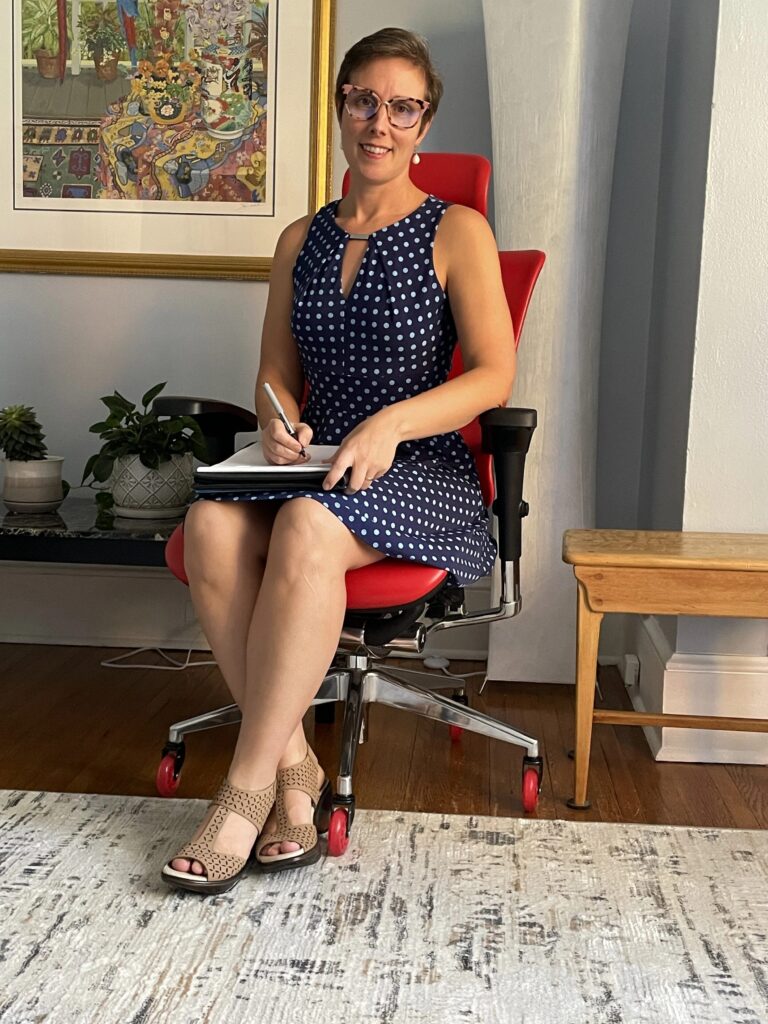

Adrian Monti is the only licensed sex therapist in the Roanoke area at Inner Flame Counseling. She sees the need for more licensed sex therapists in this area. Monti has her Bachelors of English and her Masters of Social Work both from Syracuse University. She enjoys her job and says it is never boring.
Road to becoming a sex therapist: Adrian Monti says there are many ways to become a therapist. Her journey started as an undergraduate student at Syracuse University majoring in English. Monti then applied to creative writing masters programs and got denied. She then worked in the mental health field as she was applying to masters programs for social work. She obtained her masters of social work from Syracuse University. She says that she learned more on the job doing applied practice than in her masters.
Why did you choose sex therapy? “When I first completed my masters program I went into the mental health field. I took any job that took me without experience, but that is where I had some difficult experiences. The job I had was working with people with chronic mental illnesses. I loved working with that population but not the system. Then, I got into management positions where I was organized and on top of my work.”
Independent practice and how did you get there: She worked in the social work field, then took the path to do administrative duties for mental health related fields. Private practice was never an option for her because she felt she did not have a specialty to offer. Eventually, Monti decided to take it upon herself to obtain a specialty and enrolled in her first sex therapy course. She didn’t even know that sex therapy was an option until 15 years into her career. She resigned from her day job the following Monday after she started her sex therapy course.
In private practice of sex therapists: Monti, at first, was in at a practice that had multiple therapists working under an owner. The owner did insurance and marketing and this opportunity provided a lot for her like office space and allowed her to do just clinical work. “The owner collects percentage of what you bill in.” She said it was worth it at first but after 2 years she went out on her own. “In private practice you receive no health insurance, no paid time off, and no disability in private practice.” She has to strategically save money and is only paid per session. She says she is pretty busy as the only licensed sex therapist in the area. Monti’s recommendation is to not go straight into private practice. She also mentioned that is was easier to get hours and supervision with an agency until approved. Some days she has back to back sessions and on others she has big gaps.
What she enjoys about sex therapy: She enjoys allowing people to have someone to talk to about sensitive stuff. People blame themselves for problems and she can normalize problems to clients to help people feel better with education that she provides.
What is the hardest thing about being in private practice? For Monti, managing her own schedule is the most difficult thing. She also finds it hard to sit so much and she needs to put more effort into taking care of her body.
What is the demographic/age range that you see? Once she stopped accepting insurance, the demographic of people she saw was older. She is currently seeing the range of 40-50s. Monti’s oldest clients are in their 80s and her youngest clients are in their 20s.
Why is there a lack of sex therapy: Sex is a taboo topic for people and the path to becoming one is investment of time and money. There is around 18 mos and 150 hrs of coursework with about 50 more supervision hours and 300 hours of sex therapy.
Common issues she treats: With women, she sees pain with sex. This reinforces that sex isn’t pleasurable and is a recipe for not wanting to have sex. What see sees with men is the cultural narrative to always want it and always be in the mood. She tries to break down the cultural norms to allow her clients to see the more realistic side of sex.
Monti works with a lot of people with a sexual trauma background. She helps them to seek how to help people have fun again after the trauma is gone.
Desire discrepancy: This is a common problem she sees in therapy as well. It is basically when one partner wants more sex than the other. She focuses on goals and addresses the differences in desire. The lower desire partner feels guilty and leads to disconnect physically and no one bringing up the problems. While the high desire feels rejected and frustrated with the situation at hand.
Do the couple’s agree on going to therapy? She says she sees a common trend where one person is dragging another person because they are most likely embarrassed. It takes two people to fix the problem and both need to come in to therapy.
Advice for students pursuing masters degrees or higher education: It is helpful to reflect on why you want to be a therapist. Monti encourages students to reflect on how your interests energizes you and drains you to see where your motivation lies. Is this a career path for you or something that is your social life and quality? Don’t go into it thinking that you don’t have other choices, because you will always have options.
–
–
–
Get Connected!
Blog: https://psych.pages.roanoke.edu/
Facebook: https://www.facebook.com/rcpsychology
Linked In: https://www.linkedin.com/groups/RC-Psychology-8140491/about
Website: https://www.roanoke.edu/inside/a-z_index/psychology
Instagram: rcpsychology