As the title says, New Majors’ Orientation has been changed to the Wednesday the 29th and Thursday the 30th of November (the week following Thanksgiving Break).
If you signed up through SONA, then the date has automatically been changed and you do not have to sign up again. HOWEVER, if the day no longer works for you, you will need to sign up for the other day.
The orientation will be at the same time, from 6-7 pm, and in the same place, Life Science 502.
Look forward to seeing you there (the author heard Dr. Powell makes it fun, so don’t stress too much)!
“Do you like watching movies? Do you like winning free money? Would you like a chance to do both at the same time?”
Sound like a dream come true?
Then please plan on attending Psi Chi’s annual movie night on Tuesday, November 28th. Prior to this, submissions for any movie recommendation relating to psychology (like last year’s winner, Inside Out) are open until the end of Tuesday, November 14th. Voting will then continue until November 21st. The winner will receive a $5 gift card to Mill Mountain to contribute towards their coffee fund and preparation for finals.
Think you have a winning movie? Want free coffee or a hot chocolate (or whatever your heart desires from Mill Mountain)? Then please send your suggestion to mtmccall@mail.roanoke.eduby Tuesday, November 14th.
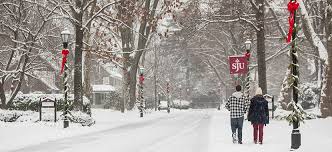
SJU is located in Philadelphia, Pennsylvania. Picture credit: https://plexuss.com/college/saint-josephs-university/overview
For students interested in pursuing a masters degree in experimental psychology, consider attending Saint Joseph’s University’s virtual (online) open house on Monday, November 13th at 11:30 am.
Saint Joseph’s University offers an intense, full-time program where students acquire a strong foundation for the scientific study of psychology through equal emphasis on coursework and empirical research.
For more information on how to attend the open house, click here. For those interested in the overall program, follow this link to go to the official site.
A brochure for SJU’s M.S. in Psychology can be found here.
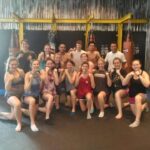
Students pose after learning the Muay Thai boxing style.
In Part I, we talked about the more academic side of the trip and some differences noticed between cultures. In Part II of the Thailand May Term, we will discuss the more inherently fun and less academic parts of the trip, because, even though this was a class, it was still an experience of a lifetime.
For Dr. Darcey Powell, in addition to the conversations the group had with locals, her two favorite experiences were the Muay Thai boxing class and their day as mahouts:
[…] In the Muay Thai boxing class, we learned about that style of boxing and practiced the techniques. As mahouts, we learned how to take care of elephants with respect to feeding and bathing, as well as how to ride elephants, and then put what we learned into practice with our own elephant for the day.
Dr. Darcey Powell
Students’ experiences as mahouts at the Patara Elephant Farm in Chiang Mai was definitely one of the most favorite and memorable experiences of the trip, as Peyton Holahan ’19 recounts:
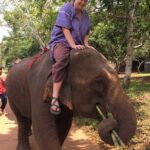
We spent the entire day playing with and learning about elephants. It really does not get much better than that in my opinion. We were greeted in the morning by the director of Patara who explained their mission as an elephant sanctuary focused on educating individuals about the health and well-being of these beautiful animals. Each person got assigned an elephant (or two) to spend the day with and it was pure magic. I was one of the lucky ones to get assigned both a mom elephant and her two-year-old baby. They told us that they assigned the elephants based on our personalities but I am certainly not planning on having kids anytime soon. I learned how to groom, feed, and bathe my elephants. Bathing them was by far the most fun because this involved getting on their backs and scrubbing them with a brush in the river. This was also really refreshing because Thailand’s climate is HOT.
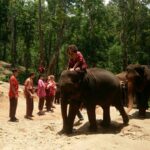
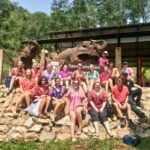
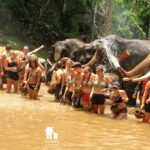
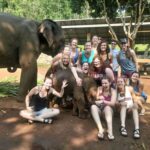
A group picture interrupted by cuteness at Patara Elephant Sanctuary, picture courtesy of Dr. Powell
Along with our elephants we were partnered with mahouts who are the elephants’ caretakers and trainers. Our mahouts assisted us throughout the day in helping us ride the elephants and showing us how to take care of them. Patara is such a unique elephant sanctuary in Thailand in that they do not cage the elephants but rather let them roam freely because their mission is focused on recovery, reproduction, and reintroduction of elephants into the wild. Patara is one of the most humane elephant farms in Thailand for that reason and I am so glad that Dr. Powell chose this once in lifetime opportunity for us all to experience.
Holahan ’19
Sarah Hughes agrees with Holahan, giving her own description of her experience at the elephant farm.
I had been looking forward to going to the elephant farm since I had signed up for the trip, so I was tremendously thrilled when I found out that we each would have our own elephant for the day. We had the opportunity to feed our elephant sugar cane and bananas, inspect them for good health, bathe them, and ride them for their daily walk. I quickly learned that elephants like to eat a lot and eat quickly. This was because every time I would feed my elephant she would get mad at me and start to yell because I was not feeding her enough at a time and not quick[ly] enough. We then had the chance to speak to them in Thai and make sure they had slept properly the night before and were happy and healthy.
The next part was my favorite part of the trip. […] We had the opportunity to scrub them and play in the water with each of our elephants. It was interesting to see that some of the elephants really liked the water and others did not. Afterwards we rode our elephants to lunch. This ride was not what I was expecting, as we rode for thirty minutes straight up a mountain and only had a rope to hold on to.
Dr. Powell and a baby elephant, courtesy of Dr. Powell
Molly Zydel ’19 seconded the opinions of her fellow students, adding that:
The trip as a whole was absolutely amazing. I couldn’t have asked for a better first experience out of the country. As for favorite parts of the trip, I absolutely adored our time in Chaing Mai. The city was gorgeous, and not near[ly] as overwhelming as Bangkok was. It reminded me a lot of home, which is why I think I loved it so much. While we were in that city, we also had an excursion where we got to be elephant care takers for a day. We each had our own elephant and we got to feed them, bathe them, and ride them. That day was phenomenal. It feels so surreal, even though I have pictures to prove it happened.
Zydel ’19
Hughes also mentioned a number of other fun activities that students were able to experience.
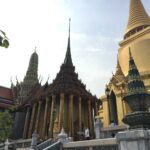
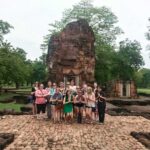
Some other things we did during the trip were visiting many temples all over Thailand, including the Grand Palace. We went to an adventure park at our hotel in Phetchabun, which is in the mountains, visited a factory, and went to Koh Samui, which is a gorgeous island in Thailand. We also were able to take a Muay Thai Boxing class, go to a rooftop restaurant, explore local night markets, and speak with monks.
According to Dr. Powell. “On day 14, we met the Imam on Koh Samui and discussed the experiences of emerging adulthood with local young men and women whose families were from the original fishing village.”
“Day 11 was spent in Chiang Mai with the students working in small groups to explore and experience the northern city, before going to one of the night markets,” said Dr. Powell on Facebook.
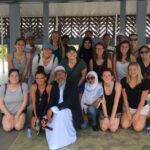
Students continue their discussion with the Inam in Koh Samui.
Students had fun while exploring Chiang Mai in small groups.
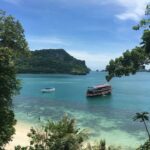
On the 14th day, students were able to take a break at Ang Thong Marine Park by boating, snorkeling, kayaking, and swimming.
I’m sorry.
Molly Zydel described her experience in Thailand as
[…] phenomenal. […] I could say so many things, but they all lead back to the statement of if you get the chance to travel abroad like this, do it. You won’t regret it. Even if it scares you half to death, do it. You find out somewhere in the middle of all of it that the experience is more exhilarating and eye-opening than it is scary. You change so much as a result of spending 3 weeks in another country that has such a different culture. Thailand was amazing. I just want to go back.
Ultimately, as Kiah Coflin ’19 concludes,
There are only so many aspects of a culture you can learn through a classroom […] [as seeing things] first hand teaches lessons better than any textbook ever can.
To see more pictures, go here to the official Facebook for the Thailand May Term. If you haven’t read the first part of the Thailand blog post, click here.
Thank you to everyone who helped with this post and were willing to write and submit pictures.
Twelve students from multiple disciplines, including psychology, went to Thailand this past summer with psychology professor, Dr. Darcey Powell to study emerging adulthood as part of a May Term program at Roanoke College.
Over the course of three weeks, students were able to compare the empirical articles they had read before departure with their own experiences as they traveled across Thailand to cities including Bangkok, Phetchabun, Chiang Mai, and Koh Samui. While there, they discussed cultural similarities and differences with local emerging adults in Thailand. By traveling from city to city, students were able to see how socioeconomic settings and geography affect the lives of different emerging Thai adults.
As Peyton Holahan ’19 recalls,
The readings for our May Term were really interesting and relevant to the cultures and places we encountered. The topics in our readings varied from the collectivist[…] ideals in Thai society, to the importance of education, to the role of the transgender community in Thailand. Almost every day, we would have group discussions about our assigned readings and consider how the readings related to what we experienced or could possibly experience in our daily ventures.
Holahan ’19
When asked to talk about one of the most interesting parts of their trip, multiple students talked about their visit to Chulalongkorn University in Bangkok where they were able to interact with Thai students. Through talking one-on-one with each other and asking questions about their social and academic lives, they came to realize that perhaps they were not so different after all.
Holahan describes how her group quickly learned that social media plays a huge role in Thai student’s everyday lives, just as media does in the United States. In fact, because of the interactions with the Chulalongkorn students, Ms. Holahan came to realize that:
[…]the Thai students in Bangkok had very similar lives to our own in that most of them were working towards getting a degree and were still financially dependent on their parents. Spending the day at Chula and getting to know Thai students on a personal level completely contradicted my initial belief that our cultures were so far apart.
Sarah Hughes ’19 also mentioned her experiences talking with the psychology graduate students at Chulalongkorn University.
[…] It was funny[;] the first question they asked was about our current president and our political systems. They did not understand that our political system creates conflicts because in Thailand everyone worships the Royal Family. […] One conversation that stood out to me was when a student asked if our traffic jams in the U.S. only lasted approximately thirty minutes. I thought this was a strange question, but I shortly learned that it is easier to walk somewhere than drive because traffic jams can last for three hours.
Sarah Hughes ’19
Molly Zydel ’19 noted that for all the similarities, Thai and USA cultures are fundamentally different.
Thai culture is very different from US culture, in so many ways. First off, it is a collectivist[…] culture, meaning they emphasize the collective whole rather than the individual. This was observed in many ways, but especially in the way they treated each other. I never once saw a Thai person yelling. Thai people are also much more conservative. They don’t really like talking about themselves.
Molly Zydel ’19
This was most noticeable during the talk with graduate students from Chulalongkorn University, as Zydel continued on to say.
[…] As Americans, we were much more open to answering questions about ourselves, but when we asked them questions, the Thai students often struggled in speaking up to answer them, especially when we asked questions that were uncomfortable in the first place (e.g. we asked about sex outside of marriage and if it happened, and that question clearly made them uncomfortable).
Through their traveling, students were further exposed to various ways of thinking about life and their own culture. For Sarah Hughes ’19, the first few moments in Thailand were a startling contrast with her home in Maryland.
As soon as we landed in Bangkok I noticed many differences. For starters[,] the airport was half-inside and half-outside. We had been traveling for 23 hours in nice cold air conditioning and the second you stepped into the airport it felt like 100 degrees or more because of the humidity. Before our trip, everyone had told us to prepare for the heat but none of us expected it to be as hot and as humid as it was. I am from Maryland near Washington D.C. and I thought I knew what humidity was, but oh[,] I was wrong. The humidity in Thailand was something I have never experienced before.
Sarah Hughes ’19
Later, Ms. Hughes began to notice something else about the differences between the United States of America and Thailand.
In the United States we tend to separate poor areas from the rich areas, but in Thailand you will have a gorgeous temple that the Rama (king) built next to shacks that people live in. It stood out to me because you would have thousands of tourist[s] admiring these stunning buildings and next door are [the homeless] or people that live in a small shack without running water.
These observations fall in line with the readings, as Peyton Holahan noted…
I remember leading a group discussion on two readings about the importance of social class in society. These readings directly related to our experiences because it was clear that social class in Thai society affected the paths of Thai emerging adults as to whether they got an education or started working at a young age to support themselves. Social class was a key factor in many of the places we visited because we witnessed higher social classes in urban areas like Bangkok.
In cities like Bangkok, education was emphasized for emerging adults because they were in an urban setting with plenty of accessible resources that stressed academic goals for better jobs and opportunities. On the other hand, we also witnessed the extent of lower social classes in more rural areas like Phetchabun. In such areas, emerging adults usually resorted to working at young ages to support their families instead of pursuing higher education because it was rarely an option within their socioeconomic sphere.
In addition to these observations and experiences, students were also able to have some fun as well. Continue to part II to learn about some of the student’s and professor’s favorite parts of the trip, including getting to spend the day with elephants.
To see more pictures of the trip, click here to go to the official RC May Term Facebook Page.
The Psychology Department would like to congratulate Dr. Powell and Dr. Findley-Van Nostrand on getting their manuscripts accepted for publishing this semester!
Dr. Powell has published two articles this semester. The first was in conjunction with Elizabeth Babskie and Aaron Metzger, titled “Variability in Parenting Self-Efficacy Across
Prudential Adolescent Behaviors” and can be found here.
The second article, titled “Prospective Parents’ Knowledge About Parenting and Their Anticipated Child-Rearing Decisions,” has received special promotion by the National Council of Family Relations as one of the five “early view” articles from their journals for October, and was co-written with Dr. Katherine Karraker of West Virginia University.
Dr. Findley-Van Nostrand has also had a manuscript acceptance for her article on “Affective-interpersonal and impulsive-antisocial psychopathy: Links to social goals and forms of aggression in youth and adults”, which is co-authored with Tiina Ojanen, a professor at the University of South Florida, and will be published in the journal Psychology of Violence.
For Dr. FVN’s description of her article and findings, please follow this link.
Again, congratulations to both professors on their recent article acceptances!
If you recently declared a major in psychology either this semester or last semester, you are required to attend the New Majors’ Orientation either on Wednesday, November 8th or Thursday, November 9th in Life Science 502 from 6:00 to 7:00 pm.
Please sign up through SONA and select which day you will be attending.
If you have any questions, feel free to email Dr. Powell at DPowell@Roanoke.edu.
If you are considering becoming a professional counselor, then look into attending the Virginia Tech Counselor Education Open House on Friday, November 3rd. The event will last from 9:00 am to 12:00 pm and you can drop-in anytime to chat with students and faculty and to tour the facilities.
Interested? Please RSVP by emailing: vtcounsed@gmail.com
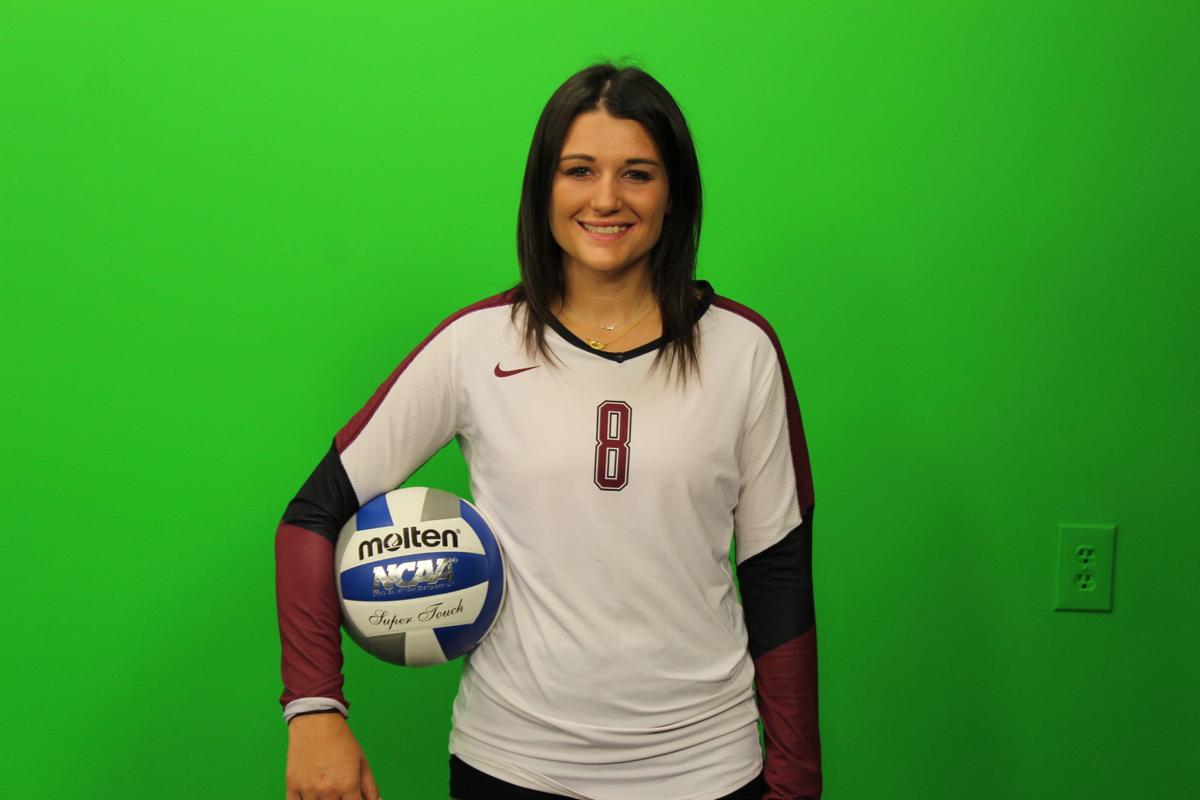
The psychology department would like to offer their sympathy and support to Ryan Hedgpeth and her family.
Ryan, a senior psychology major and volleyball player at Roanoke College, was driving back to school after visiting her friends at the University of Pittsburgh over fall break last Thursday when she was involved in a single-car accident and was seriously injured.
She’s currently in the intensive care unit at Charleston General Hospital in West Virginia. Her coach, Blair Trail, told The Roanoke Times reporter, Mark Berman, that Ryan is conscious but sedated and that she is responsive to commands and can communicate, using a card to spell out words.
Ryan will have a long recovery process ahead of her and has already undergone one surgery but is scheduled for more.
Her dog, Blue, was also injured in the accident but stayed with her until help arrived. He has undergone surgery and will need physical therapy as well.
If you want to help Ryan and are looking for ways to support her and her family but aren’t sure how, there is a gofundme page for Ryan here.
Interested in internships? Then join us on Thursday, November 2nd, from 11:45 to 1:00 in Life Science 502 for an information session to learn about the different opportunities available, as well as their requirements and deadlines, and much, much more!
Pizza will be provided, but please bring your own drink.
RSVP by Wednesday, November 1, noon, to 540-375-2462, or to dyer@roanoke.edu