Beginning this semester, Roanoke College’s Psychology Department began offering a class on Clinical Psychology taught by Dr. Hilton for those interested in learning more about the field.
Goals for the class include:
Clearly delineate the field of clinical psychology from all related professions
Help students understand the unique skills and abilities of clinical psychologists and how these things can be used across the many settings we work in
Give students the basic tools to think like clinical psychologists and learn how to approach things systematically and scientifically to be informed consumers and ethical providers in the future
When asked about his hopes and expectations for the class, Dr. Hilton responded:
I think the class is beneficial for anyone with an interest in the field of mental health broadly. Even if you don’t pursue a clinical doctorate, the clinical psychologist’s approach to studying and treating mental health problems can (and should) be applied to any other field.
As part of the course, students will regularly be asked to apply their knowledge in the form of reaction papers, discussion, and research. Students will have the opportunity to speak with a licensed psychologist regarding their education, training and work life and will learn the basic skills of the assessment and therapy process, later applying these in a role play with the instructor.
In recognition of this new course offering, a series of blog posts focusing on exploring what clinical psychology is, the process of becoming a clinical psychologist, and what other, similar career options will be posted over the new few weeks.
We look forward to and are excited about this new opportunity for students at Roanoke College to learn more about what clinical psychology as, as well as hope that our future blog posts will also help aid students in learning more about what careers are available post-graduation.
If you have any questions about the field of clinical psychology, or about the class at Roanoke, you are encouraged to contact Dr. Dane Hilton at hilton@roanoke.edu.
Looking for research opportunities and/or internships this summer, but not sure where to start?
Never fear! I bring you good news.
The American Psychological Association provides a list of opportunities at major institutions for undergraduates. Such programs are available across the United States, from New York City to California.
Take a look at a few of those offered below, you may be surprised at what’s out there.
Students interested in research on language and/or cognitive development, have experience with research methods (especially psychology or linguistics), comfortable interacting with families in a professional setting, and have excellent problem-solving and teamwork abilities
Available to high school, undergraduate, graduate, and medical school students
Receive first-rate training in neuroscience, have opportunities to network, and obtain impressive credentials when competing for graduate school, medical school, predoc or postdoc fellowships, and tenure-track positions
Applications open from mid-December through March 1st
Requires: CV or resume, a list of coursework and grades (do not need a transcript at this time), a cover letter describing research interests and career goals, and the names and contact information for two references
Program is dedicated to research and education of substance use and co-occurring disorders, prepares students for graduate school and/or Senior thesis
Up to 12 students chosen, courses in statistics and research methodology are required to be eligible
11-week program from May 27th through August 7th
And there are plenty more opportunities as well. If you are interested in learning more, follow this link to the American Psychological Association’s website where all their recommended research/internships are listed.
Applications are now open for the National Institute on Aging’s Summer Training in Aging Research (STAR) Program, based in Baltimore, Maryland. The deadline for college, graduate, and medical students is March 1, 2020.
Part of the broader NIH Summer Internship Program in Biomedical Research, the STAR Program participants (ranging from high school students to graduate or medical students) work with NIH Scientific Staff mentors regarding age-related research, culminating in presenting their research findings at the NIA Summer Student Poster Day.
While also there, participants learn about the scientific method, attend seminars, and may have the opportunity to co-author a journal article.
The aim is to provide students with the opportunity to developresearchskills through hands-on practice and seminars.
The program also provides aid regarding professionaldevelopment, through both the internship itself and assistance regarding applications to graduate or professional schools.
NIA Summer Internships range from eight to ten weeks, beginning in late May and ending mid-to-late August.
Participants will receive a stipend, with the amount depending on the level of education completed at the beginning of the internship.
If the NIA is not of interest, there are a number of other research opportunities through different NIH institutions. If interested in the other NIH research opportunities, follow this link to the NIH OITE Training Website where everything is broken down regarding overall opportunities through NIH and more.
For those interested in the NIA: applications will automatically be sent to the NIA if participants indicate such interest in the study of aging or designate the NIA as their NIH institute of choice on their application. To confirm that said application has been received by the NIA, please contact Recruitment Specialist, Ms. Arlene Jackson at jacksona@nia.nih.gov.
For advice in terms of writing a successful application, follow this link to a PDF provided by the NIH Office of Intramural Training & Education.
Potential participants are also encouraged to contact either Ms. Jackson, as mentioned above, or Ms. Taya Dunn Johnson, Assistant to the NIA Deputy Scientific Director, at dunnt@mail.nih.gov, for further information.
Pictured left-to-right: Ellen Dyer, Rick Fox, and Sandy McGhee, recipients of the 2019 Roanoke College STAR Award. Photograph courtesy of Roanoke College News.
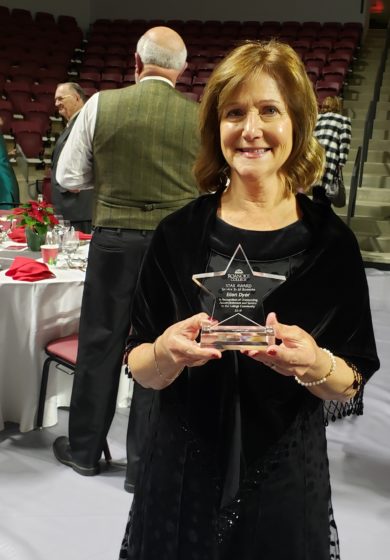
In 2019, the Psychology and Biology Department’s very own Ellen Dyer received the STAR Award!
“I was quite surprised and felt very honored to get [the STAR] Award. It’s nice to know that you are appreciated” said Ellen when asked on how she felt upon receiving the award.
The “Service to All Roanoke” or STAR is given annually to Roanoke College employees who have an “outstanding positive influence” on the College campus and with their local community as well, going above and beyond what is required.
The STAR Award is competitive, with only one recipient chosen from each employee category: exempt, non-exempt, and hourly.
Dr. Osterman, who wrote the nomination for Ellen, said this:
Ellen is amazing, embodying the perfect intersection of competence and kindness. We have all been hopeful that she would win the STAR Award for a number of years now and we were so thrilled to see her recognized for all of the outstanding work that she does with us. We’re really lucky to have her.
Mrs. Ellen Dyer, secretary of the Roanoke College Psychology and Biology Departments, with award. Photograph courtesy of Dr. Buchholz.
Dr. Buchholz, department chair of the Psychology department, agreed, saying:
Ellen is amazing! She is essential to the daily functioning of the Psychology (and Biology) departments. She is kind, considerate, and a really great human being. She is truly deserving of this award.
Dr. Camac and Ellen Dyer laughing at something Dr. Osterman said
Walking past the elevator, you might notice the new pictures for the faculty members, where their representations if they were South Park characters have been carefully designed by the Master of Photoshop, Dr. Lindsey Osterman.
Further in to the Psychology Department, you might notice the googly eyes staring back at you from Dr. Osterman’s door frame. If you walk inside her office, you will quickly realize that you are being stared at from multiple googly eyes, including those on her phone, lampshade, chairs, books and the different memes she has on her walls for decoration.
“They missed a few good opportunities. I’m kind of disappointed,” said Dr. Osterman as we examined her room a few weeks ago and found more and more googly eyes.
If you were part of Dr. Allen’s class, you were likely suddenly told that you had an exam without any previous mention and were given a link that took you directly to a certain music video titled “Never Gonna Get Over You.”
UVA Educational Psych – Applied Developmental Science Master’s Program is still accepting applications!
If you are interested in learning more about how developmental processes impact learning in an educational and community environment, and enjoy conducting research to improve the lives of youth, then this program would be a great fit for you!
The Applied Developmental Science Master’s Program at UVA is 12 month long and gives you the opportunity to work with and learn from their supportive faculty. You will learn more about human development, educational psychology, and research methods. As part of this program, you are expected to complete a 6 credit (200 hour) internship with a local lab or community-based organization.
What can you do with this degree? Graduates go on to become educators, researchers, or consultants working in a variety of settings including schools, labs, and non-profit organizations.
Applications are due May 15th, and the program has a new start date of June 3rd. To learn more about the program click HERE.
On April 3rd, high achieving students at Roanoke College were presented with awards from their departments as part of the 2019 Academic Awards Ceremony.
“The Academic Awards Ceremony is a time to celebrate some of our top Psychology Majors, as well as leadership in student groups and our two concentrations: Neuroscience and Human Development. We have a lot of hardworking and talented students in our program and I am proud of this year’s award recipients,” said Dr. Buchholz.
This year, the Psychology Department distributed awards to seventeen students overall. These students were:
Cody Dillon-Owens (Senior Scholar; The Jan H. Lynch Human Development Concentration Award; Psi Chi Achievement Award; and the Karl W. Beck Memorial Prize)
Thomas Thomas (Outstanding Junior Psychology Majors)
Kestrel Thorne-Kaunelis (The Charles E. Early Award)
Noelle Warfford (Karl W. Beck Memorial Prize)
Molly Zydel (The Jan H. Lynch Human Development Concentration Award)
When asked for a statement, Dr. Osterman added that “We are all so proud of the accomplishments of our students. It was a pleasure to be able to celebrate all of their hard work and dedication with them at the awards ceremony. We can’t wait to see what they do next.”
On behalf of the Psychology Department, congratulations again to all of our students. You have worked hard and done well and we look forward to seeing what you will achieve in the future!
Earlier this month, newly declared Psychology majors attended the New Majors Orientation and “officially” signed in to the department! If you are a newly declared Psychology major and you have not attended an orientation yet, be sure to lookout for New Majors Orientation dates this upcoming Fall 2019!
Click on the image to go to SRCD’s official website.
Overview:
The second part of the blog posts discussing the students and professors who traveled to Baltimore on March 21st through 23rd to present research at the Society for Research in Child Development Biennial Conference, this post will focus on Dr. Powell’s Research Lab.
Students and professors presented research through six different poster presentations, as well as one essay presentation that was part of a symposium. Dr. FVN and Dr. Powell presented one poster together, titled “Variations on a Lifespan Development Project Intended to Enhance Quality of Student Outcomes and Reflection of Reality.” Dr. Buchholz’s and Dr. FVN’s labs collaborated to present their work on “Early Adolescent Cognitive and Affective Empathy: Direct and Interactive Ties to Social-Emotional Adjustment.”
The students who traveled include: Taylor Kracht ’18 (alumna; Dr. Powell’s lab), Cody Dillon-Owens ’19 (worked with both Dr. FVN and Dr. Buchholz; officially part of Dr. Buchholz’s lab), Aislinn Foutz ’19 (Dr. FVN’s lab), Kiah Coflin ’19 (Dr. Powell’s lab), Ciprianna Azar ’19 (Dr. FVN’s lab), Rachel Harmon ’20 (Dr. Powell’s lab) , and Alaina Birkel ’21 (Dr. Powell’s lab).
Descriptions of the presentations have been included to learn more about the types of research the two labs are doing.
Left to right: Dr. Powell. Alaina Birkel, and Taylor Kracht
Dr. Powell’s Research Lab
Statements:
Dr. Powell:
The first disciplinary conference that I attended was SRCD during my senior year of college. I was not presenting that year, but rather I tagged along with the faculty member and graduate students with whom I was working. I am very appreciative that Roanoke College also supports undergraduates to attend and present at disciplinary conferences! Hearing the students enthusiastically discuss the scholars they heard from and the ideas it provoked related to their research between sessions and over group dinners is exactly why I encourage my research assistants to attend a disciplinary conference.
SRCD’s biennial conference is quite large and so it can be difficult choosing between sessions to attend, as so many overlap at a single time. However, I was able to attend several that are related to my research agenda as well as a few related to topics that I teach in my Life-Span and Child Development courses. Another thing that I make it a point to do at conferences is to reconnect with colleagues. My Alma mater, WVU, hosted a social for current students and alumni of their developmental program, and I was able to grab lunch with a few other colleagues. It was enjoyable catching up with them and updating each other on the status of our careers.
Left to right: Dr. Powell, Rachel Harmon, and Kiah Coflin
Kiah Coflin ’19:
This year’s biennial SRCD conference was held at the Baltimore convention center and it was huge! I have attended a poster presentation before, but my expectations were exceeded by SRCD, its number of intriguing speakers and talk topics, and its overall expanse across the convention center. It was certainly unique to see so many approaches to childhood and development, and an incredible experience to network with other students, professors, and scholars!
Personally, I presented a poster with my fellow lab mate, Rachel Harmon, on preliminary data exploring the impact of short-term, study-abroad programs on the Intercultural Competencies (ICCs) of Emerging Adults (EAs)… AKA I got to talk about my amazing May Term! We discussed the changes my May Term class perceived in our ICCs from a month before our trip, the middle of our trip, and a week after we returned. Our poster was well received and many were interested in how the data collection will progress when Dr. Powell continues to bring more students on future May Terms to Thailand!
Who says conferences can’t be fun? – Left to right: Kiah Coflin, Rachel Harmon, Alaina Birkel, and Dr. Powell
Posters:
Overall, there were three posters presented from this lab, though one was presented by Dr. FVN and Dr. Powell.
This particular poster was presented at the “Developmental Teaching Institute pre-conference on possible modifications to the life-span paper project.”
Left to right: Dr. Powell and Dr. FVN
The other two posters were presented by students and Dr. Powell. As mentioned above, Kiah Coflin, Dr. Powell, and Rachel Harmon discussed their findings in conjunction with Dr. Nipat Pichayayothin of Chulalongkorn University “on the development of students’ intercultural competencies” during their May Term course to Thailand in 2017.
The other poster was presented by Taylor Kracht (an alumna, now studying at William & Mary), and Alaina Birkel, who presented a poster based on Kracht’s “Honors in the Major project at the conference on how emerging adults’ implicit theories of relationships can be modified after watching certain types of romantic media.”
On March 21st through 23rd, Drs. Findley-Van Nostrand and Powell took seven students (including one alumnus) to the Society for Research in Child Development to present research through poster sessions, presentations, and a symposium. These students included Taylor Kracht ’18, Cody Dillon-Owens ’19, Aislinn Foutz ’19, Kiah Coflin ’19, Ciprianna Azar ’19, Rachel Harmon ’20, and Alaina Birkel, ’21.
Students and professors presented research through six different poster presentations, as well as one essay presentation that was part of a symposium. Dr. FVN and Dr. Powell presented one poster together, titled “Variations on a Lifespan Development Project Intended to Enhance Quality of Student Outcomes and Reflection of Reality.” Dr. Buchholz’s and Dr. FVN’s labs collaborated to present their work on “Early Adolescent Cognitive and Affective Empathy: Direct and Interactive Ties to Social-Emotional Adjustment.”
Descriptions of the presentations have been included below to learn more about the types of research the two labs are doing.
Dr. FVN’s and Dr. Powell’s research labs are presented separately. In this post, Dr. FVN’s Research Lab is the focus; Dr. Powell’s Research Lab will follow shortly.
Dr. FVN’s Research Lab
Dr. Findley-Van Nostrand:
I think the conference went really well. It was great to catch up with old friends and colleagues, and even better to get the students exposure to the work being conducted by SRCD members. It is a large and prestigious meeting, so they should be proud of their accomplishments. There were not many undergraduate students in attendance, let alone presenting their work! So very proud of all them from both labs being represented. I also appreciated that interactions with audience members and folks stopping by posters gave us several
good ideas for future research and even refinement of the research we presented. This was also my first time attending the SRCD Teaching Institute, which was a great opportunity. I left with good ideas and was able to share some of ours (mine and Dr. Powell’s) as well!
Cody Dillon-Owens:
At SRCD 2019 I had the amazing opportunity to present my lab’s research on how different forms of empathy can affect the social-emotional adjustment of adolescents. Being such a large conference, there were a vast number of symposiums to choose from that incorporated many other topics of interest besides developmental psychology. I had the chance to learn about new research ranging from community initiatives’ effects on adolescents’ political involvement, to how gut microbiota can affect our health across time, to how racial discrimination can affect children’s perceptions of the world. The conference was also a great time to network with other researchers and find out more about where our field is headed!
Symposium & Posters:
There were four posters and one symposium from Dr. FVN’s lab. Included in the poster session was a collaboration between Dr. Powell and Dr. FVN where they presented together on “a number of variations we have made to a cumulative assignment that is commonly used in Lifespan Development courses, all which aim to improve learning outcomes and interest from students.”
The symposium was titled “Circle Up: Using interpersonal theory and the interpersonal circumplex to study interpersonal relationships across development.” Dr. FVN and her colleague presented on “Social Goal Development during Middle School: Normative Changes and Prediction by Self-Esteem and Narcissism” as part of this symposium. This manuscript is in review for publication.
“My colleague and I presented research examining trajectories of social goals across early adolescence in the framework of the interpersonal circumplex model. Specifically, we discussed how agentic (striving for social status, respect, dominance) goals and communal (striving for closeness, friendship, affiliation) change across three time points, beginning to end of middle school. We also examined growth trajectories of combinations of these overarching goals. Finally, we examined how self-esteem and narcissism deferentially predict later goals. In short, narcissism predicts heightened agentic goal strivings, but primarily the social dominance (low communal) form of agency.”
Dr. Findley – Van Nostrand
Ciprianna Azar ’19 (left) and Aislinn Foutz ’19 (right)
There were three student posters from Dr. FVN’s lab. Aislinn Foutz and Ciprianna Azar presented a poster based on Aislinn’s Honors project, titled “Associations among Parental Perspectives of Children’s Theory of Mind, Relationships with Parents, and Social Difficulties.” The manuscript of this research is currently in preparation for publication. To learn more about Aislinn’s Honors research, click here. Aislinn also presented another poster at the conference with Dr. FVN, discussing research that they and Dr. Ojanen, Dr. FVN’s graduate school advisor, completed. This was titled “Early Adolescent Self-Concept Clarity: Negative Affect, Aggression, and Mediation by Self-Esteem.”
For the latter poster, Dr. FVN elaborates on the topic, saying: “Self-concept clarity refers to the degree to which an individuals’ self-concepts are clear and consistent to an individual. This construct has long been associated with positive emotional adjustment and behaviors in adults, but research on adolescents is limited. Research on youth in Dutch samples has established that self-concept clarity is related to lowered depression, and greater identity commitment, but this research has not concurrently assessed self-concept clarity and self-esteem and has not been extended to US samples. This study establishes self-concept clarity as a predictor of lowered negative affect, and this association is mediated by self-esteem. Further, when examining both self-concept clarity and self-esteem, self-concept clarity alone is related to lower levels of peer-group aggression.”
Dr. FVN also adds that: A manuscript reflecting a similar set of studies in young adults is presently in review for publication. This manuscript is in preparation for publication.
Cody Dillon-Owens ’19
The final poster was presented by Cody Dillon-Owens on research conducted by himself, Dr. FVN, Dr. Buchholz, and Dr. Ojanen. The title of this work is: “Early Adolescent Cognitive and Affective Empathy: Direct and Interactive Ties to Social-Emotional Adjustment.”
In this study, we examined cognitive (e.g., perspective-taking) and affective (emotional) empathy in relation to a number of indices of social-emotional adjustment in a diverse sample of middle school students. These two forms of empathy show diverging relations with adjustment: whereas cognitive empathy seems to be almost universally good, emotional or affective empathy can sometimes elicit problems when experienced. Recent research in adults utilizing a common assessment of empathy, the Basic Empathy Scale, have found that this measure actually better reflects three sub-factors of empathy: cognitive empathy, emotional disconnection, and emotional contagion, the latter of which explaining some of the associations found between emotional empathy and social-emotional problems. We validated this three-factor structure of the Basic Empathy Scale in early adolescence, a period in which development of empathic understanding might be particularly important. Results suggest that emotional contagion is related problems like negative affect, victimization by peers, and low social self-efficacy, but to higher friendship quality, whereas cognitive empathy was related to positive social-emotional adjustment.
Dr. Findley – Van Nostrand
Dr. FVN also adds that this manuscript is in preparation to submit for publication.
Stay tuned for the next blog post, which will highlight Dr. Powell’s research lab at SRCD!