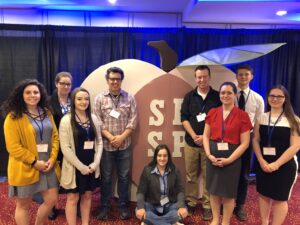
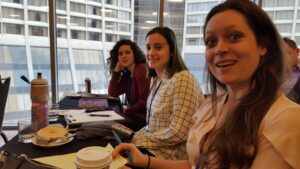
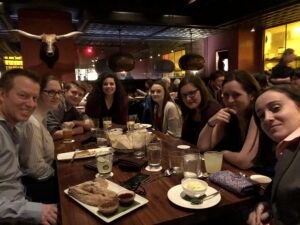
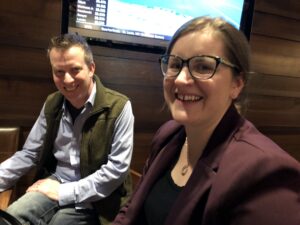
On October 10–12, Dr. Findley-Van Nostrand and Dr. Powell took three students to the Society for the Study of Emerging Adulthood (SSEA) Conference in Toronto, Canada to present research through poster sessions and presentations. These students included Casey Jo Gough ‘20, Sophie Bacon ‘20, and Abbey Packard ‘21.
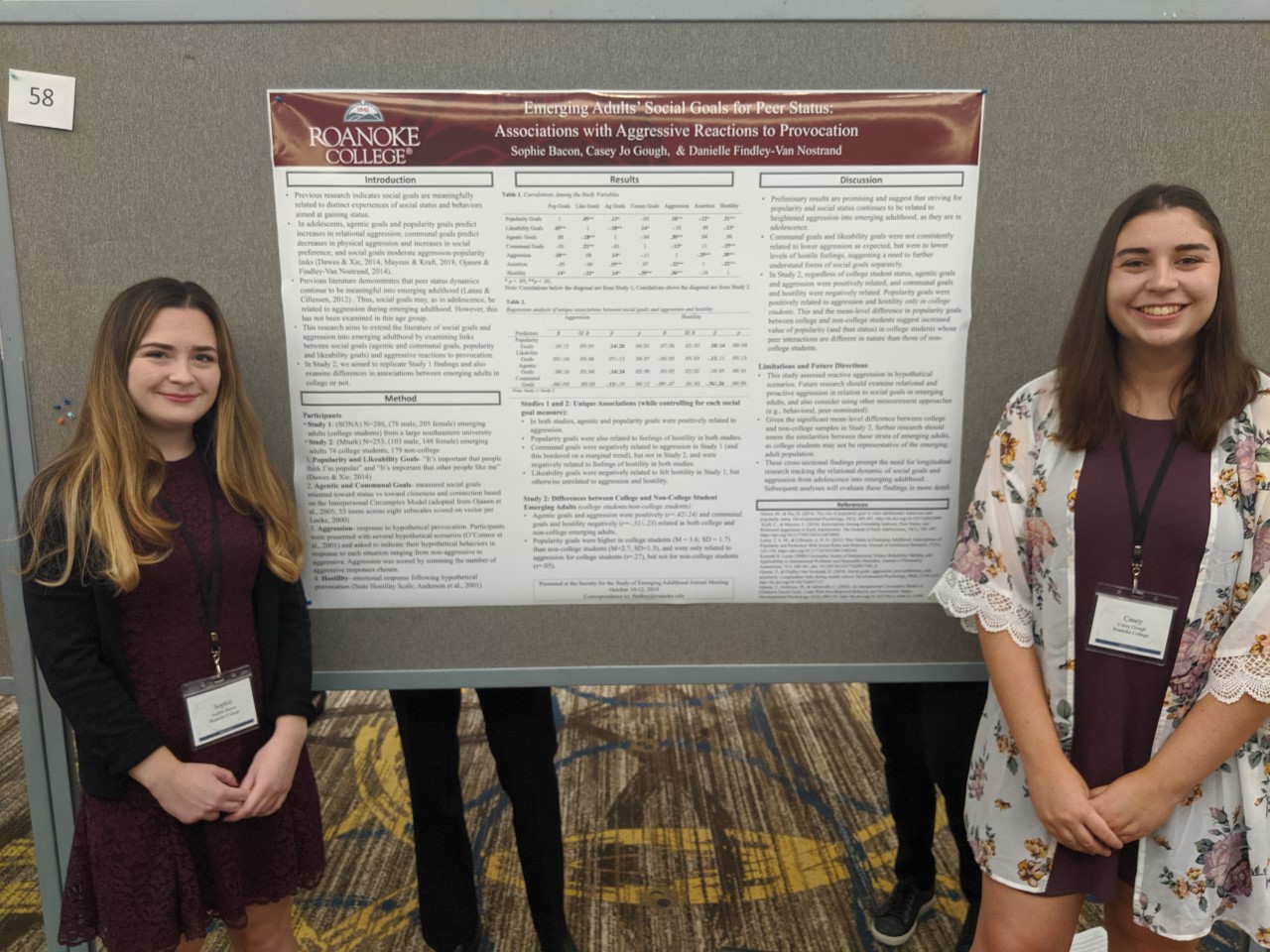
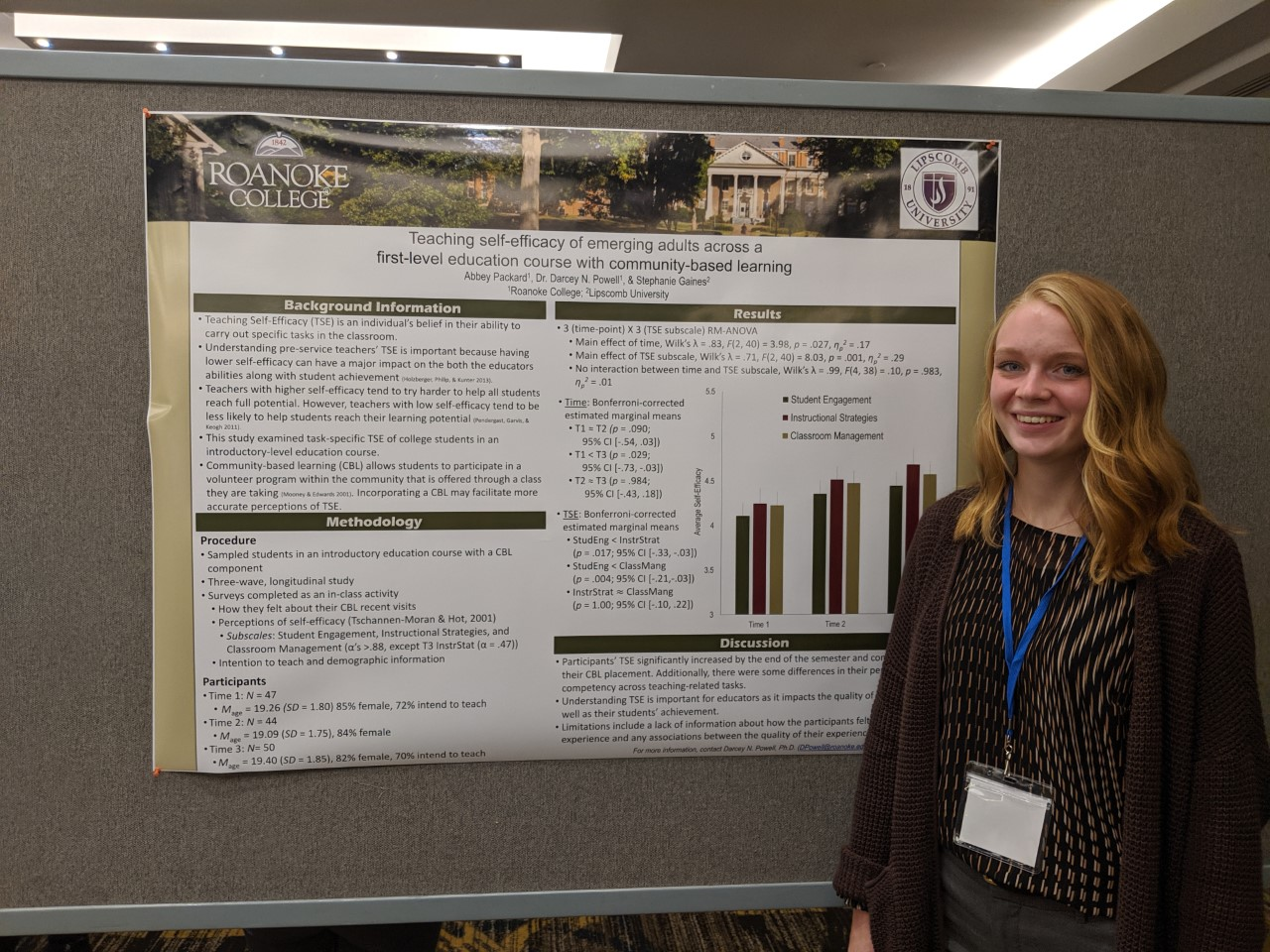
Students presented research through two different poster presentations.Casey Jo Gough and Sophie Bacon both worked alongside Dr. Findley-Van Nostrand and presented their poster titled “Emerging Adults’ Social Goals for Peer Status: Associations with Aggressive Reactions to Provocation”.Abbey Packard worked alongside Dr. Powell and presented her poster titled “Teaching self-efficacy of emerging adults across a first-level education course with community-based learning”.
The students have since given some insight onto what it was like presenting at the conference as well as their reactions to Toronto:
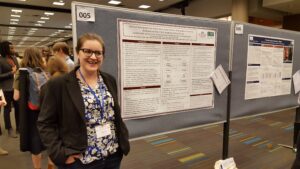
Sophie Bacon and Casey Jo Gough with the poster they presented
Casey Jo Gough
The opportunity to not only partake in undergraduate research but to then fly out of the country to present at a professional conference was an unforgettable learning experience. This was my first experience leaving the country, and it was fun to explore the streets of Toronto and take in all the sights. Presenting at the conference gave me confidence in my research abilities as I prepare for grad school. I was able to speak to other researchers and received great advice about my career path as a future school psychologist. I think the best part of the conference experience was the opportunity to attend lectures and poster sessions of unpublished research. I was able to speak to other researchers about their studies and look at exciting unpublished data in my areas of interest. I can’t wait to see where my research will take me next!
Sophie Bacon
Attending SSEA in Toronto was an incredible experience. Presenting our poster and findings was a really fulfilling experience and everyone who we talked to was so friendly and excited about our interest in research. Also, because I am still unsure of the direction that I want to go in when pursing graduated school, it was so helpful to talk to others who were recently in my shoes! I found walking and looking at all of the other posters to be really informative and eye-opening regarding the knowledge that we can learn about this newly defined stage of life. I felt very lucky that we were able to travel to such a cool place like Toronto, the city felt so walkable and had an abundance of hip-restaurants and soaring skyscrapers!
Abbey Packard
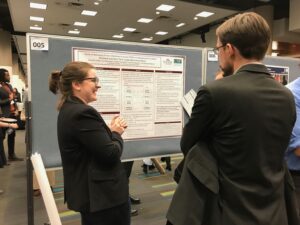
Abbey Packard with the poster she presented
Canada was an amazing experience overall and as an undergraduate research student I gained lots of insight into graduate level research and felt confident being able to present my work to graduate and PhD students. The other presentations were extremely impressive and networking opportunities were all around which is always a bonus! Being able to go to Toronto was a wonderful experience thanks to the help of Dr. Powell! The city was beautiful and was an experience I’ll never forget.
Dr, Powell
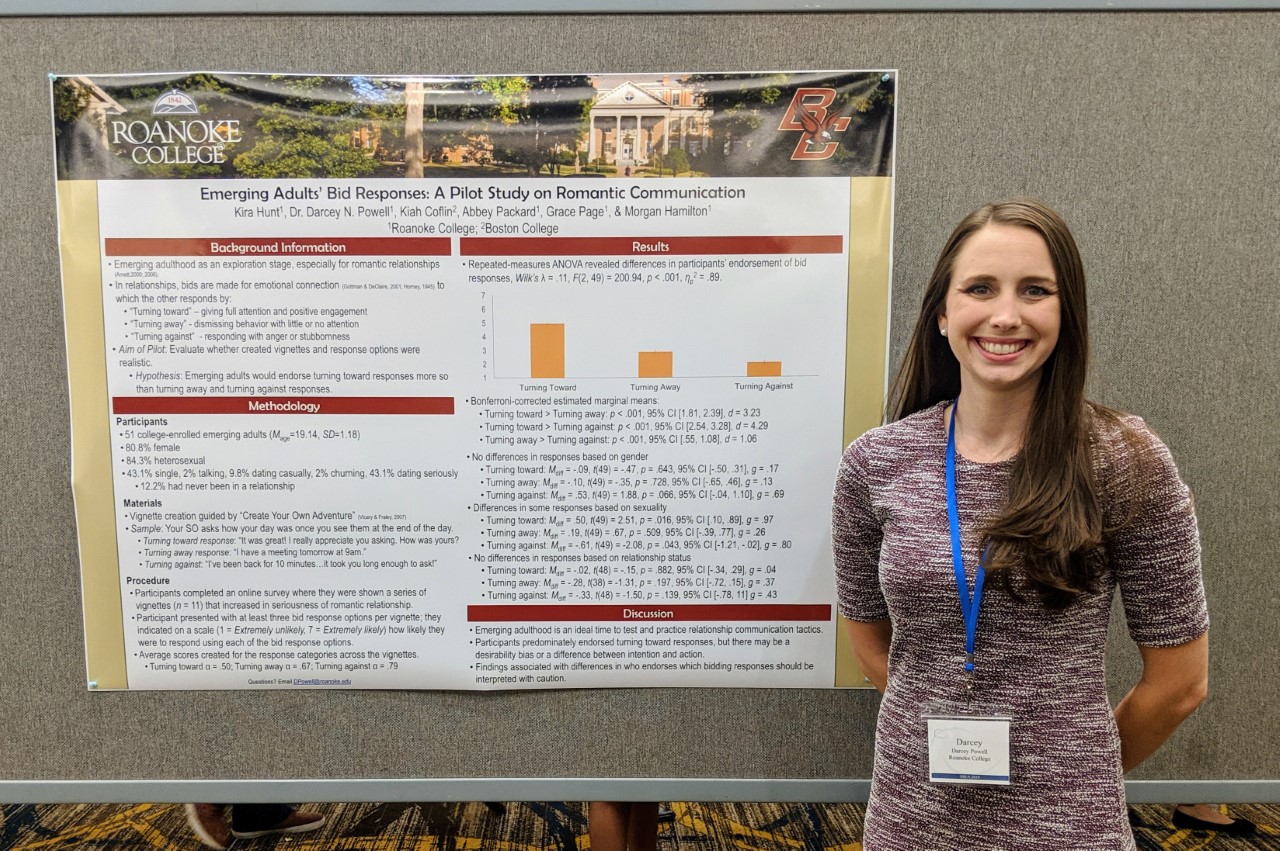
Dr. Powell standing beside the poster students have been working on alongside her
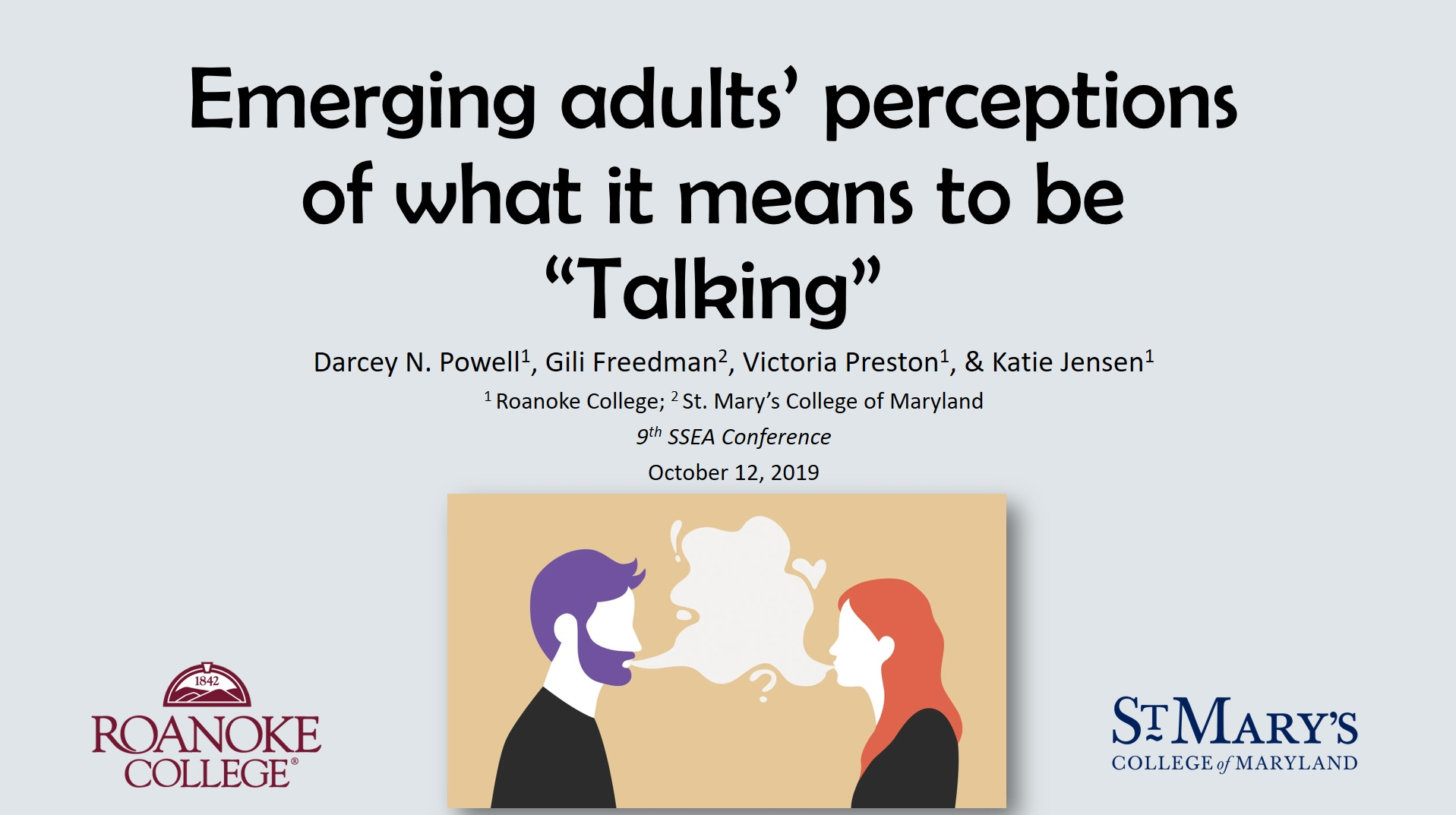
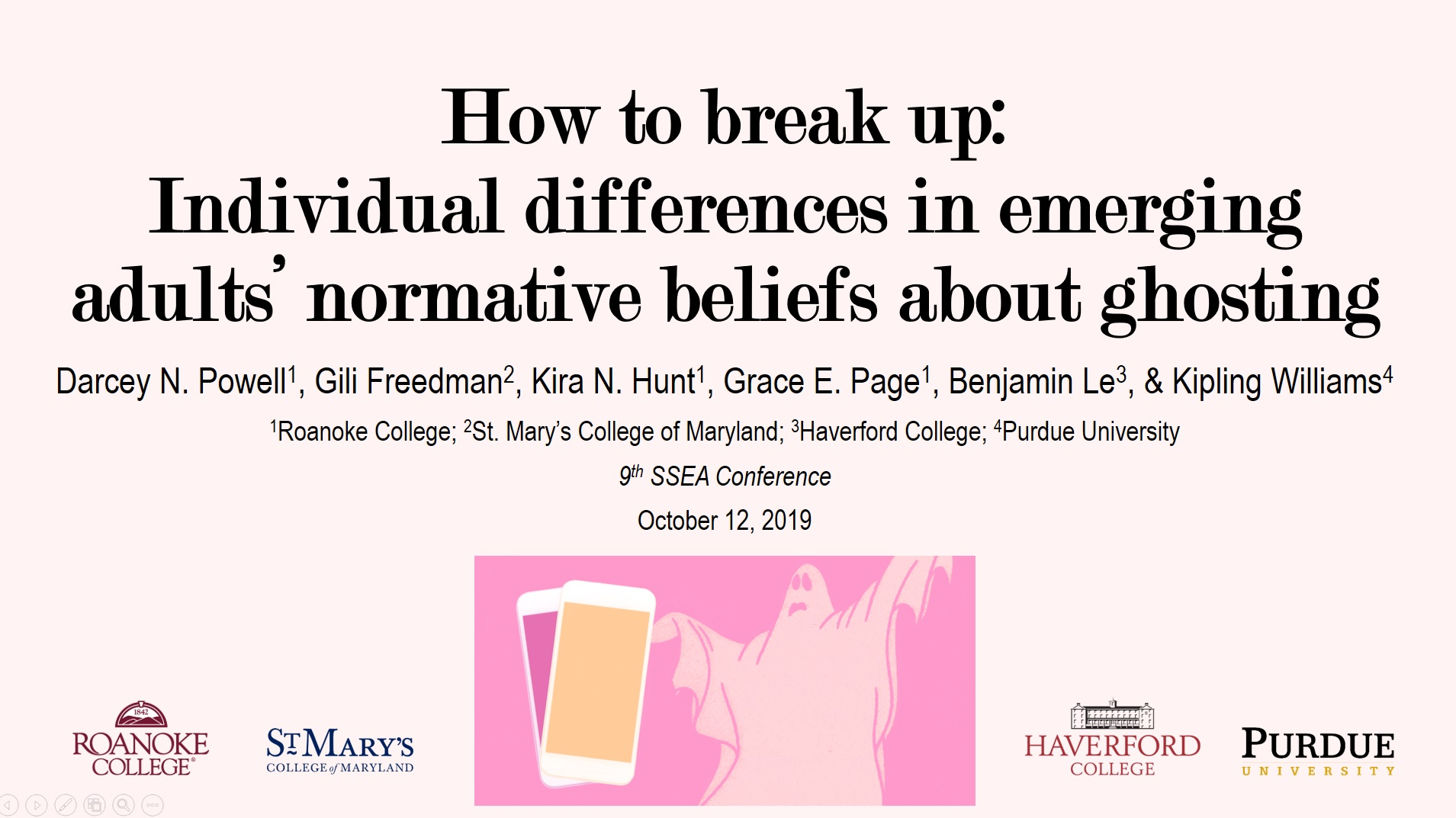
Dr. Powell also presented one poster titled “Emerging Adults’ Bid Responses: A Pilot Study on Romantic Communication” as well as two papers, “How to break up: Individual differences in emerging adults’ normative beliefs about ghosting” and “Emerging adults’ perceptions of what it means to be “Talking””.
One of the paper presentations Dr. Powell gaveThe second paper presentation Dr. Powell gave
Congratulations to all those who attended the conference and for having successful presentations!
Click on the image to go to SRCD’s official website.
Overview:
The second part of the blog posts discussing the students and professors who traveled to Baltimore on March 21st through 23rd to present research at the Society for Research in Child Development Biennial Conference, this post will focus on Dr. Powell’s Research Lab.
Students and professors presented research through six different poster presentations, as well as one essay presentation that was part of a symposium. Dr. FVN and Dr. Powell presented one poster together, titled “Variations on a Lifespan Development Project Intended to Enhance Quality of Student Outcomes and Reflection of Reality.” Dr. Buchholz’s and Dr. FVN’s labs collaborated to present their work on “Early Adolescent Cognitive and Affective Empathy: Direct and Interactive Ties to Social-Emotional Adjustment.”
The students who traveled include: Taylor Kracht ’18 (alumna; Dr. Powell’s lab), Cody Dillon-Owens ’19 (worked with both Dr. FVN and Dr. Buchholz; officially part of Dr. Buchholz’s lab), Aislinn Foutz ’19 (Dr. FVN’s lab), Kiah Coflin ’19 (Dr. Powell’s lab), Ciprianna Azar ’19 (Dr. FVN’s lab), Rachel Harmon ’20 (Dr. Powell’s lab) , and Alaina Birkel ’21 (Dr. Powell’s lab).
Descriptions of the presentations have been included to learn more about the types of research the two labs are doing.
Left to right: Dr. Powell. Alaina Birkel, and Taylor Kracht
Dr. Powell’s Research Lab
Statements:
Dr. Powell:
The first disciplinary conference that I attended was SRCD during my senior year of college. I was not presenting that year, but rather I tagged along with the faculty member and graduate students with whom I was working. I am very appreciative that Roanoke College also supports undergraduates to attend and present at disciplinary conferences! Hearing the students enthusiastically discuss the scholars they heard from and the ideas it provoked related to their research between sessions and over group dinners is exactly why I encourage my research assistants to attend a disciplinary conference.
SRCD’s biennial conference is quite large and so it can be difficult choosing between sessions to attend, as so many overlap at a single time. However, I was able to attend several that are related to my research agenda as well as a few related to topics that I teach in my Life-Span and Child Development courses. Another thing that I make it a point to do at conferences is to reconnect with colleagues. My Alma mater, WVU, hosted a social for current students and alumni of their developmental program, and I was able to grab lunch with a few other colleagues. It was enjoyable catching up with them and updating each other on the status of our careers.
Left to right: Dr. Powell, Rachel Harmon, and Kiah Coflin
Kiah Coflin ’19:
This year’s biennial SRCD conference was held at the Baltimore convention center and it was huge! I have attended a poster presentation before, but my expectations were exceeded by SRCD, its number of intriguing speakers and talk topics, and its overall expanse across the convention center. It was certainly unique to see so many approaches to childhood and development, and an incredible experience to network with other students, professors, and scholars!
Personally, I presented a poster with my fellow lab mate, Rachel Harmon, on preliminary data exploring the impact of short-term, study-abroad programs on the Intercultural Competencies (ICCs) of Emerging Adults (EAs)… AKA I got to talk about my amazing May Term! We discussed the changes my May Term class perceived in our ICCs from a month before our trip, the middle of our trip, and a week after we returned. Our poster was well received and many were interested in how the data collection will progress when Dr. Powell continues to bring more students on future May Terms to Thailand!
Who says conferences can’t be fun? – Left to right: Kiah Coflin, Rachel Harmon, Alaina Birkel, and Dr. Powell
Posters:
Overall, there were three posters presented from this lab, though one was presented by Dr. FVN and Dr. Powell.
This particular poster was presented at the “Developmental Teaching Institute pre-conference on possible modifications to the life-span paper project.”
Left to right: Dr. Powell and Dr. FVN
The other two posters were presented by students and Dr. Powell. As mentioned above, Kiah Coflin, Dr. Powell, and Rachel Harmon discussed their findings in conjunction with Dr. Nipat Pichayayothin of Chulalongkorn University “on the development of students’ intercultural competencies” during their May Term course to Thailand in 2017.
The other poster was presented by Taylor Kracht (an alumna, now studying at William & Mary), and Alaina Birkel, who presented a poster based on Kracht’s “Honors in the Major project at the conference on how emerging adults’ implicit theories of relationships can be modified after watching certain types of romantic media.”
On March 21st through 23rd, Drs. Findley-Van Nostrand and Powell took seven students (including one alumnus) to the Society for Research in Child Development to present research through poster sessions, presentations, and a symposium. These students included Taylor Kracht ’18, Cody Dillon-Owens ’19, Aislinn Foutz ’19, Kiah Coflin ’19, Ciprianna Azar ’19, Rachel Harmon ’20, and Alaina Birkel, ’21.
Students and professors presented research through six different poster presentations, as well as one essay presentation that was part of a symposium. Dr. FVN and Dr. Powell presented one poster together, titled “Variations on a Lifespan Development Project Intended to Enhance Quality of Student Outcomes and Reflection of Reality.” Dr. Buchholz’s and Dr. FVN’s labs collaborated to present their work on “Early Adolescent Cognitive and Affective Empathy: Direct and Interactive Ties to Social-Emotional Adjustment.”
Descriptions of the presentations have been included below to learn more about the types of research the two labs are doing.
Dr. FVN’s and Dr. Powell’s research labs are presented separately. In this post, Dr. FVN’s Research Lab is the focus; Dr. Powell’s Research Lab will follow shortly.
Dr. FVN’s Research Lab
Dr. Findley-Van Nostrand:
I think the conference went really well. It was great to catch up with old friends and colleagues, and even better to get the students exposure to the work being conducted by SRCD members. It is a large and prestigious meeting, so they should be proud of their accomplishments. There were not many undergraduate students in attendance, let alone presenting their work! So very proud of all them from both labs being represented. I also appreciated that interactions with audience members and folks stopping by posters gave us several
good ideas for future research and even refinement of the research we presented. This was also my first time attending the SRCD Teaching Institute, which was a great opportunity. I left with good ideas and was able to share some of ours (mine and Dr. Powell’s) as well!
Cody Dillon-Owens:
At SRCD 2019 I had the amazing opportunity to present my lab’s research on how different forms of empathy can affect the social-emotional adjustment of adolescents. Being such a large conference, there were a vast number of symposiums to choose from that incorporated many other topics of interest besides developmental psychology. I had the chance to learn about new research ranging from community initiatives’ effects on adolescents’ political involvement, to how gut microbiota can affect our health across time, to how racial discrimination can affect children’s perceptions of the world. The conference was also a great time to network with other researchers and find out more about where our field is headed!
Symposium & Posters:
There were four posters and one symposium from Dr. FVN’s lab. Included in the poster session was a collaboration between Dr. Powell and Dr. FVN where they presented together on “a number of variations we have made to a cumulative assignment that is commonly used in Lifespan Development courses, all which aim to improve learning outcomes and interest from students.”
The symposium was titled “Circle Up: Using interpersonal theory and the interpersonal circumplex to study interpersonal relationships across development.” Dr. FVN and her colleague presented on “Social Goal Development during Middle School: Normative Changes and Prediction by Self-Esteem and Narcissism” as part of this symposium. This manuscript is in review for publication.
“My colleague and I presented research examining trajectories of social goals across early adolescence in the framework of the interpersonal circumplex model. Specifically, we discussed how agentic (striving for social status, respect, dominance) goals and communal (striving for closeness, friendship, affiliation) change across three time points, beginning to end of middle school. We also examined growth trajectories of combinations of these overarching goals. Finally, we examined how self-esteem and narcissism deferentially predict later goals. In short, narcissism predicts heightened agentic goal strivings, but primarily the social dominance (low communal) form of agency.”
Dr. Findley – Van Nostrand
Ciprianna Azar ’19 (left) and Aislinn Foutz ’19 (right)
There were three student posters from Dr. FVN’s lab. Aislinn Foutz and Ciprianna Azar presented a poster based on Aislinn’s Honors project, titled “Associations among Parental Perspectives of Children’s Theory of Mind, Relationships with Parents, and Social Difficulties.” The manuscript of this research is currently in preparation for publication. To learn more about Aislinn’s Honors research, click here. Aislinn also presented another poster at the conference with Dr. FVN, discussing research that they and Dr. Ojanen, Dr. FVN’s graduate school advisor, completed. This was titled “Early Adolescent Self-Concept Clarity: Negative Affect, Aggression, and Mediation by Self-Esteem.”
For the latter poster, Dr. FVN elaborates on the topic, saying: “Self-concept clarity refers to the degree to which an individuals’ self-concepts are clear and consistent to an individual. This construct has long been associated with positive emotional adjustment and behaviors in adults, but research on adolescents is limited. Research on youth in Dutch samples has established that self-concept clarity is related to lowered depression, and greater identity commitment, but this research has not concurrently assessed self-concept clarity and self-esteem and has not been extended to US samples. This study establishes self-concept clarity as a predictor of lowered negative affect, and this association is mediated by self-esteem. Further, when examining both self-concept clarity and self-esteem, self-concept clarity alone is related to lower levels of peer-group aggression.”
Dr. FVN also adds that: A manuscript reflecting a similar set of studies in young adults is presently in review for publication. This manuscript is in preparation for publication.
Cody Dillon-Owens ’19
The final poster was presented by Cody Dillon-Owens on research conducted by himself, Dr. FVN, Dr. Buchholz, and Dr. Ojanen. The title of this work is: “Early Adolescent Cognitive and Affective Empathy: Direct and Interactive Ties to Social-Emotional Adjustment.”
In this study, we examined cognitive (e.g., perspective-taking) and affective (emotional) empathy in relation to a number of indices of social-emotional adjustment in a diverse sample of middle school students. These two forms of empathy show diverging relations with adjustment: whereas cognitive empathy seems to be almost universally good, emotional or affective empathy can sometimes elicit problems when experienced. Recent research in adults utilizing a common assessment of empathy, the Basic Empathy Scale, have found that this measure actually better reflects three sub-factors of empathy: cognitive empathy, emotional disconnection, and emotional contagion, the latter of which explaining some of the associations found between emotional empathy and social-emotional problems. We validated this three-factor structure of the Basic Empathy Scale in early adolescence, a period in which development of empathic understanding might be particularly important. Results suggest that emotional contagion is related problems like negative affect, victimization by peers, and low social self-efficacy, but to higher friendship quality, whereas cognitive empathy was related to positive social-emotional adjustment.
Dr. Findley – Van Nostrand
Dr. FVN also adds that this manuscript is in preparation to submit for publication.
Stay tuned for the next blog post, which will highlight Dr. Powell’s research lab at SRCD!
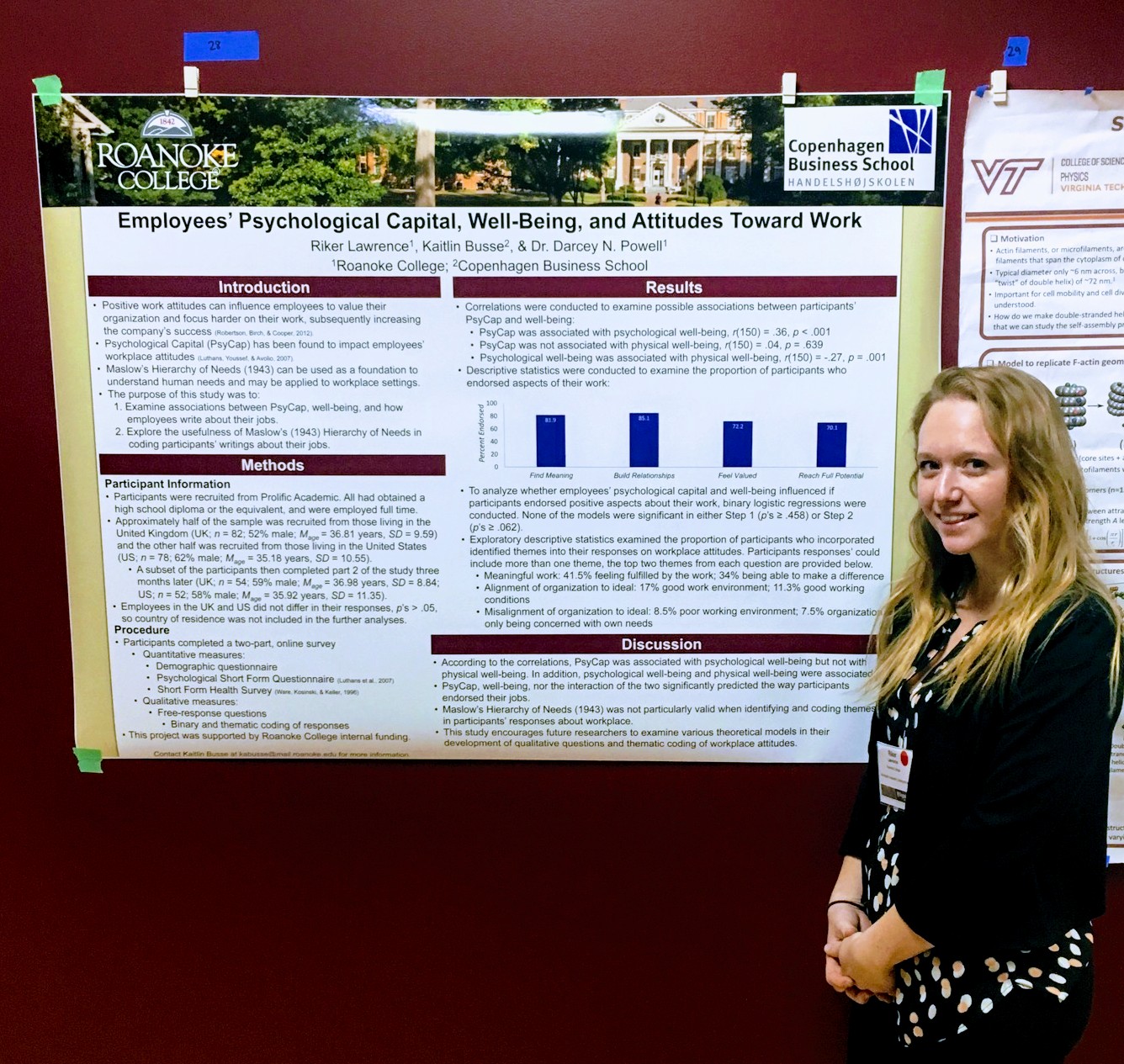
Riker Lawrence ’21 discusses her experience presenting at the Mid-Atlantic Undergraduate Research Conference below.
Attending the Mid-Atlantic Undergraduate Research Conference last weekend was an interesting experience for me. In the past, I have attended conferences that mainly focused on behavioral science. This conference included multiple different fields of research, so I learned many new concepts in fields such as physics, wood science, and chemistry. I enjoyed learning about information that I wouldn’t normally research on in my specific field. My poster presentation focused on Psychological Capital (PsyCap) and workplace attitudes. Specifically, my lab mate and I examined associations between PsyCap, well-being, and how employees write about their jobs. We also explored the usefulness of Maslow’s (1943) Hierarchy of Needs in coding participants’ writings about their jobs, because his theory can be used to explain human needs. Overall, I thought the conference was well organized and provided a good research experience to undergraduates.
Congratulations to Lawrence for her successful presentation on Psychological Capital and workplace attitudes!
Molly Zydel discusses her recent presentation at JMU for the 10th Annual MadRush Undergraduate Conference below.
I presented part of my Honors in the Major/Distinction Project at the 10th Annual MadRush Undergraduate Conference hosted by James Madison University on Saturday, March 16th. The presentation focused on part of the larger project, which seeks to understand foster parents’ perceptions of former foster care youth, former foster care youth’s perceptions of themselves, and college students perceptions of former foster care youth on different aspects of their academic identity, specifically academic self-efficacy, resiliency, and academic expectations and attainment. The presentation at MadRush focused on the data I have collected from foster parents concerning their perceptions of foster care youth on these constructs.
Rather than your typical poster presentation session, I had the chance to give an actual presentation in front of a room concerning the project. The presentation went very well, as did the following discussion. The session consisted of 3 total presentations, all from different disciplines, that all in some way focused on populations of youth who are not the normal. There was a presentation on juvenile sex offenders, one on the orphan trains, and my presentation. It went very well, and it was interesting to see how different disciplines connect together to engage in a conversation about youth from different perspectives. Overall, I enjoyed the conference!
Thank you to Molly Zydel for taking time to tell us about her research and presentation at MadRush! Congratulations on your successful presentation and we look forward to seeing what you will do in the future!
Congratulations to Aislinn Foutz ’19 for her successful Honors in the Major and Honors Distinction Project defense last semester! Her project was titled “Parental and Peer Factors in Children’s Theory of Mind Development” and Dr. Findley-Van Nostrand was her advisor. Foutz is now working towards building off of this work and applying to graduate programs to continue studying Theory of Mind. She also has a presentation under review to present this work at the Society for Research on Child Development in the Spring.
Aislinn Foutz describes her project and how she felt about defending it below:
For my Honors in the Major/Distinction Project, I collected parent-reports of children’s theory of mind and various other parental and peer/social variables and found a number of significant associations. For instance, theory of mind was positively associated with variables such as parental willingness to serve as an attachment figure, closeness in parent-child relationships, mind-mindedness, and pro-social behavior, whereas theory of mind was negatively associated with conflict in parent-child relationships and various peer difficulties (e.g., peer problems). Follow-up analyses revealed child age, closeness, and mind-mindedness seem to be especially important to children’s theory of mind development, and that, although these associations were significant throughout early, middle, and late childhood, the closeness-theory of mind relationship was strongest in early childhood. I am aiming to extend this research in several ways, primarily by examining how various sub-types of theory of mind (e.g., belief and desire) may relate differently to these parental and peer factors.
Dr. Findley-Van Nostrand was my research mentor for this project and working with her was a great experience. Whenever I needed help, she was always readily available. She also helped me sharpen my research skills while challenging me to learn new ones.
Although I was nervous for my defense, I was also excited for the opportunity to share my research. Successfully defending my distinction/honors in the major project was a rewarding experience, and now I’m looking forward to continuing to extend this research.
Congratulations again to Aislinn Foutz ’19! Thank you for taking time to answer our questions! We look forward to seeing what you will accomplish in the future.
Interested in psychology, human development, or neuroscience?
Then an upcoming talk at the nearby Virginia Tech Research Institute (VTCRI) on November 29th at 5:30 pm might be of interest to you!
The talk, titled “Synapses Lost and Found: Developmental Critical Periods and Alzheimer’s Disease”, is part of the VTCRI Maury Strauss Distinguished Public Lecture series, will be given by Stanford’s Dr. Carla Shatz.
As the talk relates to neuroscience and human development, the psychology department is encouraging and organizing students in multiple classes and in the Neuroscience Concentration and the Human Development Concentration to attend.
The psychology department can provide transportation for students or faculty who need to or are interested in carpooling for the event but we need to know by the end of the day on November 26th (TODAY) regarding whether or not we will take a van.
If you plan to attend the talk on November 29th, please fill out the Doodle poll at: https://doodle.com/poll/cupicv2v6qqmdprv. Feel free to send the survey link to other students or faculty that you think would be interested in attending.
The first weekend of spring break, Drs. Buchholz, Osterman, Carter, and Findley-Van Nostrand, in addition to several students, traveled to Atlanta to present their studies at the 2018 Society for Personality and Social Psychology Conference.
The students in attendance included:
Cody is a psychology major and biology minor.
He is also a student assistant and works in Dr. Buchholz’s lab.
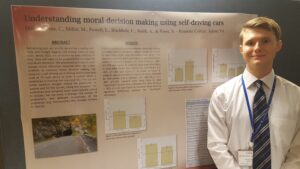
Cody Dillon-Owens ’19, who presented on “Understanding moral decision making using self-driving cars.” This study was supervised by Dr. Buchholz and included several other students, including Megan Miller ’18, Allison Smith, Lauren Powell ’21, and Seth Poore ’20. They found that participants generally thought positively of self-driving cars. Faced with a moral dilemma on who to save during an impending crash, the participants were generally more likely to save themselves and their mothers over anyone else. Participants were also more likely to save “significant” individuals rather than strangers.
To learn more about the study, please contact Dr. Buchholz at buchholz@roanoke.edu.
Nicole Moughrabi ’19 and Lauren Furlow ’19
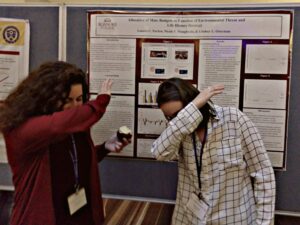
Their dabbing is impeccable.
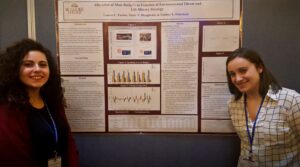
Lauren Furlow ’19 and Nicole Moughrabi ’19 presented on the “Allocation of Mate Budgets as Function of Environmental Threat and Life History Strategy.” From Dr. Osterman’s lab, Furlow and Moughrabi added to further research to the field discussing how “women’s mating psychologies shift as a function of early environment and current environment demands.”
To learn more about this study, email Dr. Osterman at osterman@roanoke.edu.
Sabrina McAllister ’18 presents her findings.
Sabrina McAllister ’18, a member of Dr. Nichols’s lab, discussed the results of her study titled “Time Perspective as a State-Based Measure.” To learn more about her study, follow this link. (If you have any questions, please contact Dr. Nichols at dnichols@roanoke.edu.)
Lauren Powell ’21
Dr. Buchholz
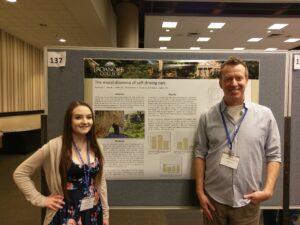
Lauren Powell ’21 and Dr. Buchholz with their poster.
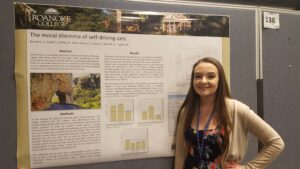
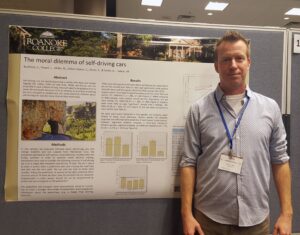
Lauren Powell ’21, also a member of Dr. Buchholz’s lab, discussed the study titled “The moral dilemma of self-driving cars.” As this study was conducted alongside the first discussed study, the same researchers also worked on this inquiry. The main goal in this study was to see how gender and empathy would affect how the participants answered the moral dilemmas. However, the results showed that neither gender nor empathy predicted the answers, but that there was a “three-way interaction between gender, cognitive empathy, and affective resonance.” They also found that men possessed significantly more positive attitudes towards self-driving cars than women.
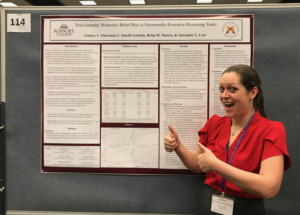
Dr. O giving a “thumbs-up”
Dr. Osterman
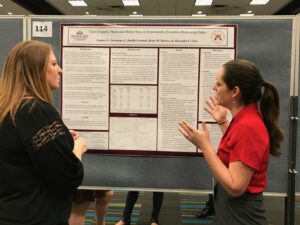
In addition, Drs. Osterman and Findley-Van Nostrand also presented their research. Specifically, Dr. O presented findings found in conjunction with Dr. Gornick of the Virginia Military Institute, Mr. Brian Matera, and Mr. Alexander Carr, titled “Trait Empathy Moderates Belief Bias in Emotionally-Evocative Reasoning Tasks.” To learn more, please contact Dr. Osterman at the above mentioned email address.
Dr. Findley-Van Nostrand presents at SPSP 2018
She is otherwise known as Dr. FVN.
Dr. Findley-Van Nostrand’s study was titled: “Sense of Belonging Drives Intentions to Leave STEM in Undergraduate Students: Mediated and Short-Term Longitudinal Association.” She worked alongside Drs. Sophie Kuchynka, Jennifer Bosson, and Richard Pollenz, all from the University of South Florida. If you are curious about the study and want to learn more, Dr. FVN can be contacted at findley@roanoke.edu.
Dr. Carter and Lauren Furlow ’19
Courtesy of Dr. O’s editing skills.
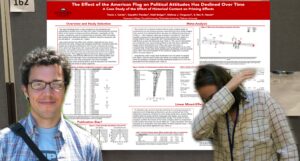
Finally, the day before the official SPSP conference began, Dr. Carter presented his study on “The Effect of the American Flag on Political Attitudes Has Declined Over Time: A Case Study of the Effect of Historical Context on Priming Effects,” at the JDM preconference.
The preconferences are one-day, mini conferences that allow for colleagues to gather to discuss their specific areas of interest. For Dr. Carter, this was to discuss the changes since the first study he and his fellow researchers had conducted in 2011, wherein his research revealed that using the American flag as a primer has become less effective in shifting participants towards more politically conservative attitudes and beliefs. The effect is shown to be roughly zero at present. To learn more, please contact Dr. Carter at tjcarter@roanoke.edu.
(Unfortunately, no pictures were taken of Dr. Carter while he was presenting at the JDM preconference. Instead, Dr. O provided a dramatic reenactment via hard work and editing skills.)
A group photo at SPSP 2018
Drinking coffee and working.
Behind the scenes
Celebrating a successful conference
Dr. Buchholz and Dr. FVN
When asked about the experience, Dr. Osterman said…
We had a fantastic time at SPSP, and all of our student presenters did a wonderful job of talking about their research with other scholars. They represented the college and department exceedingly well.
Cody seconded this, saying:
SPSP went really well! It was a wonderful opportunity to present research to a large body of our peers in psychology, as well as learn about a lot of the exciting new research that’s being conducted in the field. I definitely look forward to attending my next conference!
Congratulations to our students and professors for their successful SPSP conference!
Riker Lawrence ’20 (left) and Kaitlin Busse ’18 (right) presented two posters at the Academy of Human Resource Development conference in Richmond, VA, this past week..
Congratulations to Kaitlin Busse ’18 and Riker Lawrence ’20 for their successful poster sessions at the Academy of Human Resource Development (AHRD) Conference in Richmond, Virginia!
Part of Dr. Powell’s lab, Busse and Lawrence presented two posters on their findings from researching work-life balance and perceptions of organizational climate and job satisfaction in employees from the United States and the United Kingdom.
Have you recently completed a research study, are an undergraduate student, and want to present your findings at a well-regarded conference?
On Friday, April 13th, 2018, the University of Virginia’s annual L. Starling Reid Psychology Undergraduate Research Conference will occur.
This event highlights “outstanding empirical research conducted by undergraduate scholars.”
The proposal deadline has been extended to Monday, March 15th, 2018 at 8:00 am.
Accepted students will be notified by 5:00 pm on Thursday, March 22nd.
Due to the high volume of applicants and the limited number of spots available, this conference is competitive.
Presentation formats are either research talks lasting around fifteen minutes, or posters. The selection process for research talks are more competitive, but if an applicant fails to secure a research talk position, then they will automatically be considered for a poster.
The application is now live and can be found here. For more information about the conference, follow this link.
If you have any questions, please contact UVA psychology department’s Taylor Young, who is the Interim Undergraduate Coordinator. His email is psy-umaj@virginia.edu.






 peer problems). Follow-up analyses revealed child age, closeness, and mind-mindedness seem to be especially important to children’s theory of mind development, and that, although these associations were significant throughout early, middle, and late childhood, the closeness-theory of mind relationship was strongest in early childhood. I am aiming to extend this research in several ways, primarily by examining how various sub-types of theory of mind (e.g., belief and desire) may relate differently to these parental and peer factors.