Month: April 2018

  • How Many “Likes” Did I Get?

    Image result for likes meme

    The fourth article written for Dr. Carter’s Social Psychology course, this post discusses the power of the “like” system. Written by Julian Edwards, Emily Jones, and Brice Hinkle, the original source can be found here.

    Have you ever felt inadequate after seeing only one like on your selfie? If you are an avid Facebook, Twitter, Instagram, or some other social media user, the culmination of likes on a picture or video is crucial. The incorporation of the “like” system in social media has changed the way in which people view themselves. You expect people such as your family or close friends to like your posts, but what if that is only 10 to 20 people? What does this say about you
    as a person? It is common to believe that the more likes one receives the better they believe others see them, thus determining how they see themselves. The presence of active and/or immediate feedback on a picture you are proud of can make or break how you view yourself. Because of this, social media has become a large factor in the level of self-esteem a user may have. The more likes someone receives the greater self-esteem they will have. Also in contrast, if a person were to receive little to no likes on a selfie or family picture they may begin to suffer through low self-esteem. To help support this claim a study was conducted by researchers Anthony L. Burrow and Nicolette Rainone titled “How many likes did I get?:
    Purpose moderates links between positive social media feedback and self-esteem” (Burrow & Rainone, 2016).
    Image result for likes meme

    In this study, participants first had to complete several forms and surveys – demographics form, a survey measuring their purpose in life, and a personality inventory (which was not used in the experiment). After this was completed, the experimenters told the
    participants they were there to test a new social media site a lot like Facebook and to get started, they had to set up a profile and take a picture of themselves for the experimenter to upload (Burrow & Rainone, 2016). The experimenter told the participants that their picture would be shown on the test site for five minutes and that other users could see and like it. Five minutes later, the experimenter came in the room and told them how many likes their picture got. The amount of likes the experimenter told the participants that they got were a randomized average number of likes, more than average number of likes, or below average number of likes. Afterwards, participants completed another survey, which measured their self-esteem. The results found that the groups that showed a low purpose and low self-esteem were affected more by their number of likes more than the groups with high purpose and high self-esteem, who were not as affected by the likes (Burrow & Rainone, 2016).
    Image result for likes meme

    The researchers established two groups: high purpose and low purpose. In each group, the self-esteem manipulator was introduced to affect self-esteem positively, negatively, or not at all (high, low, and average likes). The participants in each group then reported their post-experiential self-esteem (Burrow & Rainone, 2016). Because the experiment showed no correlation between high purpose and a high number of likes, it can be assumed that the
    participants with high purpose also have self-esteem high enough that it is unaffected by an otherwise effective self-esteem booster: a high number of likes that they receive. Those with low purpose can be said to have a lower baseline self-esteem and so are more affected by a high number of likes (Burrow & Rainone, 2016).

    One critique would be that the researchers should have included an “average purpose” group apart from the “high purpose” group to be manipulated to see more precise results.

    Additionally, it would have been nice to have reported any findings on a decrease in self-esteem for a fuller picture of the effects.
    The lesson that can learned from this article is that self-esteem is that although there are a countless number of things that go into a person’s self-esteem and sense of purpose in life, social media affects them much more than someone thinks.

    Get connected!
    Instagram & Twitter:  #PsychRC @RC_Psychology
    Facebook:  https://www.facebook.com/rcpsychology
    Blog:  https://psych.pages.roanoke.edu/
    Linked In:  https://www.linkedin.com/groups/RC-Psychology-8140491/about
    Website:  https://www.roanoke.edu/inside/a-z_index/psychology
  • What Makes A Great Leader

    Image result for leader

    In another post written by students of Dr. Carter’s Social Psychology course, Corey Woodford, Hannah Lester, Michaela Hicks discuss an article on leadership titled “Two ways to the top: Evidence that dominance and prestige are distinct yet viable avenues to social rank and influence.” The original article can be found here. 

    How do people reach leadership positions? Is it because they are generally likable and compassionate about the group? Or is it because they are ruthless and their followers are too scared to do anything but listen to them? Maybe it is a combination of both. Researchers Cheng, Tracy, Foulsham, Kingstone and Henrich formed an experiment that tests these theories. They wanted to know if dominance and prestige work together to get people to the top. In the case of this study, dominance is a force and intimidation and prestige is being able to share your experiences and knowing how to gain respect. Cheng et al. performed two studies that tested the roles in which dominance and prestige play in the selection of a leader. They used students from the University of British Columbia, who had no prior knowledge of each other before the study, as participants for both of the studies.

    The first study’s goal was to distinguish whether or not dominance and prestige are acceptable ways of predicting social influence. It was set up as a round robin setting where groups of 4 to 6 of the same gender, not already acquainted with each other, completed an assignment, then interacted with each other, and then were asked to fill out a questionnaire at the end. Each side of the table was recorded by a video camera looking exclusively at one side of the table. The questionnaire provided peer ratings on who seemed to have more influence, who had more “dominance and prestige” in their group, and the likeability of the group members. The results of the study concluded that, in fact, both dominance and prestige predict greater social influence, but that they are different paths to attaining social rank, with prestige seen as more likeable than dominance.

    Going off the first study, the second study’s goal was to “determine whether gaze allocation patterns corresponded to perceived Dominance and Prestige”. In other words, do dominant or more prestigious individuals receive more visual attention? The participants watched a series of video clips used from the first study, and were asked to think of who they would want to work with on the same task if they were in the room doing the same thing. The participants were wearing eye trackers so the researchers were able to see who they looked at the most while watching these video clips. The results showed that people do tend to notice who the dominant or more prestigious person in the room is, and they subconsciously do visually fixate on them, meaning they receive more visual attention.

    Study 1: with 191 participants, this study compensated them with a chance of extra compensation during the study. The participants first completed an individual activity and then a group activity. The group activity was recorded for 20 minutes.

    Study 2: 59 participants were involved and were instructed to watch 6 twenty-second videos. This study was used to determine a relationship between gaze allocation patterns and perceived Dominance and Prestige.

    While the study was something always relevant and very interesting, it did have some aspects that it did not take into consideration. First, the study did not use co-ed groups. Especially in today’s time, gender norms are a hot topic and are of interest to many people. A future study could use co-ed groups to help distinguish between gender norms that influence leadership positions. Second, the participants of the study were of all different ages. Age is indicative of knowledge and when you are older you can be seen as more superior of those who are younger than you.  Keeping age brackets for each group would have been a beneficial addition to the parameters of the study. With these critiques in mind, a future study would be beneficial to really dive into the psychology of leadership positions from a non-age or non-gender biased study.

    Get connected!
    Instagram & Twitter:  #PsychRC @RC_Psychology
    Facebook:  https://www.facebook.com/rcpsychology
    Blog:  https://psych.pages.roanoke.edu/
    Linked In:  https://www.linkedin.com/groups/RC-Psychology-8140491/about
    Website:  https://www.roanoke.edu/inside/a-z_index/psychology
  • Strategies to Combat Threatened Masculinity

    An analysis of the study “Manning Up: Threatened men compensate by disavowing feminine preferences and embracing masculine attributes” for Dr. Carter’s Social Psychology course. This article was written by Sophie Bacon, Cristoni Couvrette, and Carter Smith.

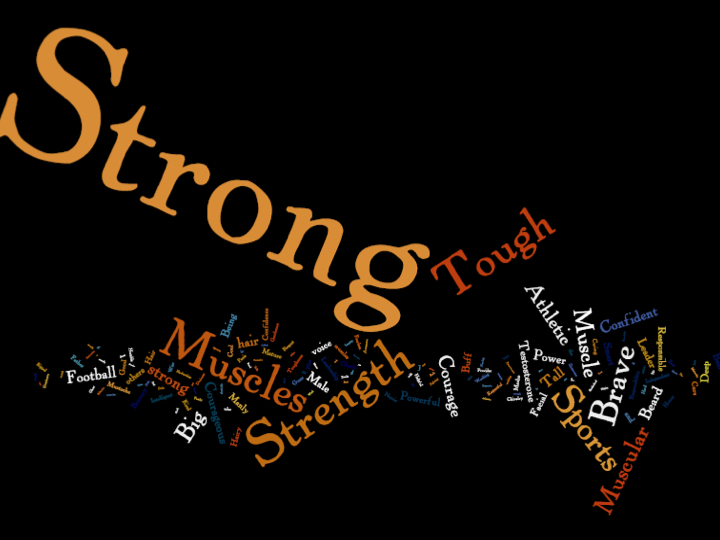
    In society, men are expected to conform to gender-stereotypic attributes in order to prove their masculinity. Some of these attributes include; being tall, athletic, having an active sex life,
    and being assertive or dominant. Studies have shown if a
    man is in a sense “less masculine” they will compensate
    for this by presenting themselves in a more stereotypical
    masculine manner. In the study, Manning Up, researchers, Sapna Cheryan, Jessica Schwartz Cameron, Zach Katagiri, and Benoît Monin conducted two experiments, in which they examined three techniques that men may use when they perceive a threat to their
    masculinity: avoid feminine preferences, embrace masculine preferences, and claim masculine attributes. The question the researchers were asking is whether or not men are more likely to distance themselves from feminine preferences when their masculinity is threatened versus the responses of those men who are not threatened.

    In the first study some of the male participants were randomly assigned to receive false feedback that they had failed a test of masculinity (a score of 26 out of 100) while the other
    participants received a non-threatening score (73 out of 100). The participants were then asked to rate how much they would like to receive three very masculine products and three very feminine products. Results from study one suggest that men who have their masculinity threatened are more likely to distance themselves from stereotypically feminine preferences, but do not embrace stereotypically masculine preferences more than non-threatened men.

    In the second study, researchers tried to instill a different type of threat to masculinity (telling participants they were
    physically weaker than other males) to see if threatening
    one specific aspect of masculinity causes men to embrace
    another aspect in order to compensate. Participants were
    asked to take a test of handgrip strength. Having a strong
    hand grip is associated with being more masculine.

    Some of the participants received false feedback that their score fell along the female distribution while the other participants were told their score fell into the male distribution. Afterwards they were asked to complete a questionnaire which included masculine and feminine attributes such as: height, handiness with tools, number of previous relationships (all masculine attributes), and personality traits (both masculine and feminine attributes). Participants then
    repeated the grip test which reinforced their false feedback and were asked to rate their interest in receiving five masculine, three feminine, and seven neutral products. Results from this study
    found that men who did not have their masculinity threatened showed no difference in their preference for masculine and feminine products while men who were threatened showed less interest in feminine products. Researchers also found that men who had their masculinity threatened were more likely to exaggerate their other masculine attributes; they claimed to be taller, have more past relationship partners, and higher levels of athleticism and aggressiveness than men in the non-threatened condition

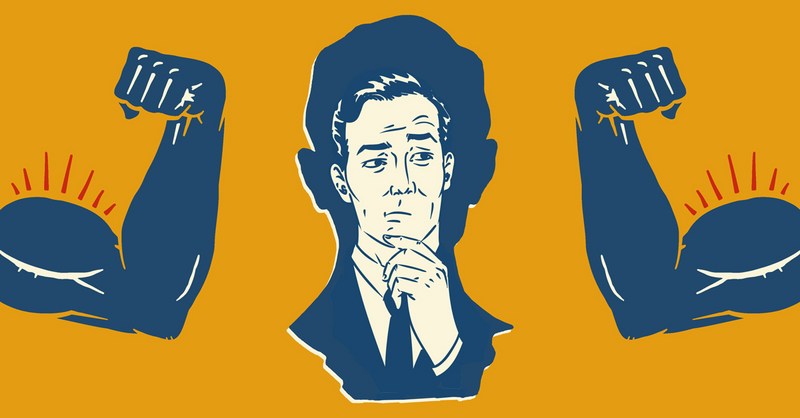
    Researchers examined the strategies used when there is a perceived threat to masculinity. They threatened masculinity as a whole as well as physical masculinity and then examined the ways the participants compensated for the blow. Researchers also said that men who are threatened are more likely to embrace masculine attributes over preferences. An example being, if a man feels his masculinity is being attacked it weighs more for him to defend his physical traits (strength, height and build), compared to him trying to declare his masculinity through his masculine preferences (liking trucks and hunting). Researchers discovered that rejecting
    feminine preferences was more reassuring to their self image rather than restating their masculine preferences.

    In this study, researchers provided insight into the strategies men employ when they feel their masculinity has been
    threatened. However, there are three limitations that can be
    observed in this study. The first limitation of this study is the
    fact that they only focused on how masculine attributes were
    affected when men were under masculinity threat. If they
    wanted to get a more well-rounded perspective, they should
    have also examined how feminine attributes were affected by
    masculine threats. In addition, in two of the studies, they used a
    subset of product preferences making it difficult to decipher the
    results of masculine versus feminine preferences. Finally, when
    concluding this study, it wasn’t clear from the results whether or not distancing oneself from a stigmatized outgroup versus a
    related identity would be sufficient in responding to masculinity
    threats.

    Get connected!
    Instagram & Twitter:  #PsychRC @RC_Psychology
    Facebook:  https://www.facebook.com/rcpsychology
    Blog:  https://psych.pages.roanoke.edu/
    Linked In:  https://www.linkedin.com/groups/RC-Psychology-8140491/about
    Website:  https://www.roanoke.edu/inside/a-z_index/psychology

  • Ready to Dance? Then Just Dance.

    Want to celebrate the end of finals in style?

    Then just dance!

    The psychology department will be hosting their annual Psychology Dance Party on Wednesday, May 2nd from 1:30 – 3:30 pm in Life Science 502.

    Here’s an example of the fun you can have:

    This is a chance to challenge your professors to a friendly game of Just Dance on the Wii.

    A chance to groove to the beat and laugh in relief as finals are finally over and you are free. 

    As such, all are welcome.

    You may also get to see Dr. Nichols dance to Let it Go in-person. Here’s a video clip to help make your day a little brighter.

    Get connected!
    Instagram & Twitter:  #PsychRC @RC_Psychology
    Facebook:  https://www.facebook.com/rcpsychology
    Blog:  https://psych.pages.roanoke.edu/
    Linked In:  https://www.linkedin.com/groups/RC-Psychology-8140491/about
    Website:  https://www.roanoke.edu/inside/a-z_index/psychology
  • Ice-Cream, Decisions, and Culture

    The time has come.

    A decision must be made.

    Your family members have designated you as the ‘chooser’ of the group. The responsibility weighs on your shoulders. You try to remain calm.

    ‘Focus,’ you tell yourself. ‘Should I purchase the double chocolate ice-cream from x-brand, or the devil’s chocolate ice-cream from y-brand?’

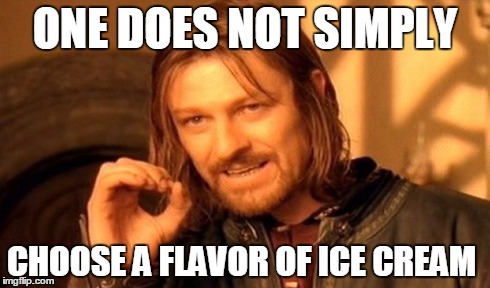
    Even Boromir agrees

    The choices are the same in terms of the contents and price, but they have different names and are from different brands. You cannot decide between the two as you feel equally about both of them, so you ask for the advice of your family; they reply negatively towards the y-brand and you feel relieved, finding yourself agreeing with them, and choose the ice-cream from the x-brand instead.

    While a silly example, this dilemma helps illustrate an interesting observation about humans, at least of European descent (or influenced by Western culture): when we are highly ambivalent towards two choices, we are more easily influenced in our decision. According to psychology researchers, Mr. Andy Ng, Dr. Michaela Hyne and Dr. Tara MacDonald, those of European descent are more likely to be influenced either positively or negatively when unsure of what to think about two objects or subjects. Yet, they also point out that East Asians exhibit greater levels of tolerance towards conflicting views or when possessing high levels of ambivalence towards objects/subjects. In other words, those of East Asian descent or region are more likely to hold two conflicting ideas in their minds without the need to pick one as superior to the other.

    In their study published in 2011, titled “Culture Moderates the Pliability of Ambivalent Attitudes,” Ng, Hyne, and MacDonald were interested in researching the degree to which culture influences the willingness to shift attitudes in those of Western and Eastern cultures after a persuasive attempt.

    (more…)

  • Research Poster Session Spring ’18

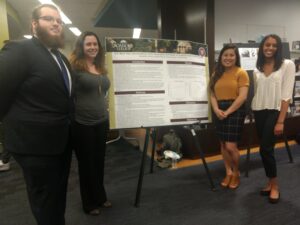
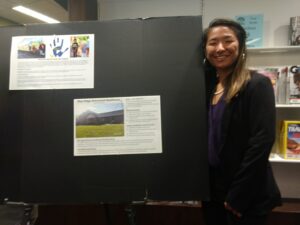
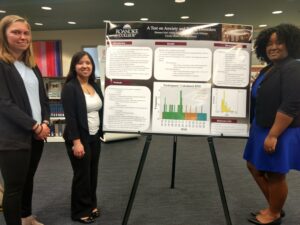
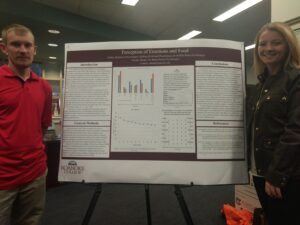
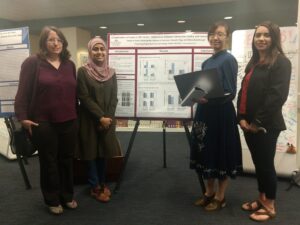
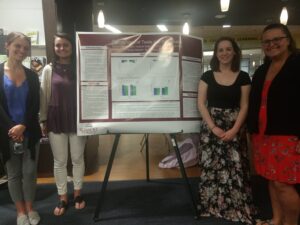
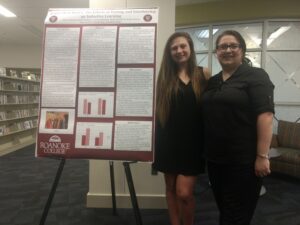
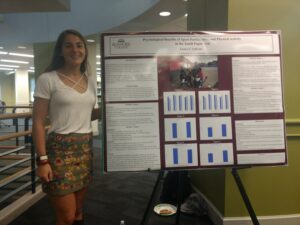
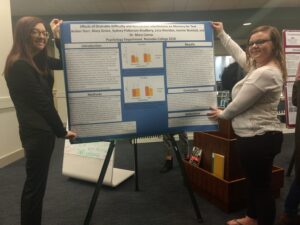
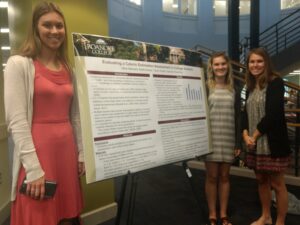
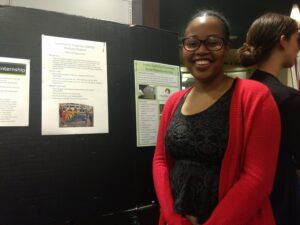
    The Psychology Department hosted their research poster session on Thursday, April 19th 2018. Many students presented on their research projects and internships; students were also able to donate to the American Foundation for Suicide Prevention while choosing which professor they’d like to see pied with whipping cream and sprinkles. Great job to everyone who presented and thanks to everyone who came!

    Get connected!
    Instagram & Twitter:  #PsychRC @RC_Psychology
    Facebook:  https://www.facebook.com/rcpsychology
    Blog:  https://psych.pages.roanoke.edu/
    Linked In:  https://www.linkedin.com/groups/RC-Psychology-8140491/about
    Website:  https://www.roanoke.edu/inside/a-z_index/psychology
  • Pie A Professor TODAY!

    Today is the day. The day you get to see your professors pied! From 5pm-6pm at Sutton Terrace RCPA and Psi Chi will make your dreams come true by pieing 6 of our beloved professors for your enjoyment, all while raising money for the American Foundation for Suicide Prevention.

    Pieing will occur at 5:30pm, with the opportunity for students to pay $10 to personally pie a professor of their choice. Bring your friends!

    The current rankings are:

    1. Dr. Buchholz & Dr. Carter (tied for first)
    2. Dr. Findley-Van Nostrand
    3. Dr. Nichols
    4. Dr. Osterman
    5. Dr. Allen
  • Belated April Fools: Psychology Department Antics

    This year, April 1st fell on a Sunday.

    So, naturally, the psychology department decided to celebrate Belated April Fools the following day.

    What resulted was nothing less than genius.

    Part of this included a revenge plot that had been brewing for years.

    Dr. O tells her side of the story below:

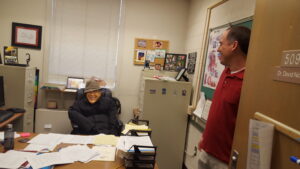
    Weeeeeell… It all started many moons ago, in Spring 2014, when Dr. Nichols was on his way to do an optical illusion demonstration in his Research Methods class and got the bright idea to don his George W. Bush mask (a prop in the demonstration), his trench coat, and his fedora (all together, a rather intimidating combination), and slowly peeked around the doorway of my office in an attempt to get me to pee my pants.

    It very nearly worked.

    After I recovered from my extreme fright, I told Dr. Nichols in no uncertain terms that wearing a mask in public on a non-Halloween day was highly illegal behavior (which we later confirmed), and that I wouldn’t tolerate it in my workplace. I also vowed, privately, to seek revenge upon him at the first opportunity.

    Months passed.

    Years passed.

    And I bided my time, quietly, patiently. Until one day, in February 2018, I walked into Life Science 502 a few minutes before the start of my Quantitative Methods class and noticed atop the “technology tower” in the corner of the room… The Mask, completely unattended (and very creepily staring at the ceiling with its vacant, soulless eye-sockets). Immediately, I grabbed The Mask and ran back to my office to conceal it until April 1st.

    A close-up

    Over the intervening weeks, I discussed with esteemed colleagues on what prank I might involve the mask. Many excellent ideas were put forward (e.g., perhaps we could dangle the mask by a string from the ceiling; perhaps one of us could put on the mask and startle Dr. Nichols as he had startled me), but eventually, we landed on the following plan:

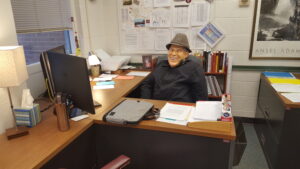
    We would construct a lifelike “scarecrow” from garbage bags, recycled paper, and dress the scarecrow in the mask, trench-coat, and fedora (the latter of which Dr. Nichols usually leaves in his office). We would sit the scarecrow in Dr. Nichols’s desk chair, and Dr. Buchholz would construct a complicated pulley system connecting the office door to the desk chair, so that when Dr. Nichols entered his office, the chair would spin around to face him, and hopefully cause Dr. Nichols to shout in alarm.

    The plan went off without a hitch, but I found Dr. Nichols’s reaction somewhat underwhelming. So, over the course of that  fine Monday, the scarecrow moved around from office-to-office, scaring a number of colleagues (including myself, somehow), and I came up with one final step in the plan.

    At the end of the day, Dr. Nichols was teaching his Neuroscience lab, and a few minutes before the end of class, I donned the scarecrow’s disguise, and seated myself, perfectly still, in Dr. Nichols’s chair. When Dr. Nichols entered his office, he thought it was just the scarecrow, and was not alarmed until my hands sprang into the air like scary claws and I yelled “RAAAAWR” and Dr. Nichols said “Ah!” and it was my very favorite moment of my entire life.

    And that is the story of the mask.

    Test One:

    Dr. Nichols confirmed the events of that fateful day, telling his side of the story:

    The mask is something that I use in PSYC 202 to tell a hopefully amusing story about some silliness my friends and I did in college. However, I scared Dr. Osterman with it in her first year at Roanoke College when I wore it down the hall on my way to class. Since then, I include in class a life lesson that apparently wearing a mask in public outside of Halloween is illegal in many states, including Virginia. Apparently, the last time I used the mask in PSYC 202, I left it in the classroom and Dr. Osterman found it, planning a frightening surprise when the chance arose.

    On Monday morning, April 2nd, I came into the office a little bit later than I usually do since my kids were on Spring Break and I didn’t have to get up as early as I normally do. I said ‘hi’ to Dr. Buchholz, who ‘just so happened’ to be out in the hall on my way in. I opened my door and noticed that someone seemed to be sitting in my chair with a hat and trench coat on and remembered thinking something like ‘That’s weird that there is someone sitting in my office chair in the dark. Huh, how about that?’. Then when I opened the door completely, the chair swung around and it looked quite realistic. I started slightly before realizing it was my mask. I was quite impressed by the system of fishing line that was rigged up to get the chair to move that way!

    Then, at the end of the day after the dummy had been moved around to the offices of other department faculty, I came back to my office after my afternoon class was over. The day had not gone well at all because of technical difficulties preparing for Neuro lab, so I was feeling exhausted but glad that the lab had gone alright in the end. Dr. Allen was waiting out in the hall and took out her camera to film me entering my office, which seemed suspicious. I remember saying something like ‘I’ve seen it already’ because I expected the dummy to be back in my office, though suspected something else to possibly be going on.

    When I entered the office, the dummy sprung to life as it jumped out of my chair! I started on the inside but didn’t have too much of a physical reaction, though it was a very good set-up with Dr. Osterman inside a padded suit so that it looked pretty much just like the original dummy, even though someone was now inside it.

    I very much appreciated the thought and planning that went into both surprises! It’s great to work in a department that enjoys one another so much. 🙂

    The Real Dill:

    Get connected!
    Instagram & Twitter:  #PsychRC @RC_Psychology
    Facebook:  https://www.facebook.com/rcpsychology
    Blog:  https://psych.pages.roanoke.edu/
    Linked In:  https://www.linkedin.com/groups/RC-Psychology-8140491/about
    Website:  https://www.roanoke.edu/inside/a-z_index/psychology
  • Pie a Prof!

    It’s that time of the year!

    Stop by the table outside of Colket or by the box in the hallway of the 5th floor to choose your victim(s) to get pied! The professor with the most money in their jar will get a special pie, with sprinkles.

    All proceeds will go to The American Foundation for Suicide Prevention.

    Hope to see you there!

    Get connected!
    Instagram & Twitter:  #PsychRC @RC_Psychology
    Facebook:  https://www.facebook.com/rcpsychology
    Blog:  https://psych.pages.roanoke.edu/
    Linked In:  https://www.linkedin.com/groups/RC-Psychology-8140491/about
    Website:  https://www.roanoke.edu/inside/a-z_index/psychology
  • Mr. Dane Hilton is Looking for Student Research Assistants!

    Dr. Dane Hilton, a new faculty member in the Department of Psychology, is recruiting student research assistants to start in the fall.

    The research conducted in the lab will focus on:

    • Cognitive mechanisms of social encoding
    • Mindfulness meditation and other alternative treatments for self-regulatory deficits
    • Improving measurement of social information processing
    • The use of technology in psychotherapy research/intervention
    • Treatment mechanisms in ADHD Parent Training

    He is looking for research assistants who:

    • Are conscientious and hard-working
    • Have excellent time-management skills
    • Are intellectually curious
    • Interested in ADHD, executive function, or social interaction (preferred, not required)
    • Are familiar with MS Office/Google Docs
    • Have some familiarity with research methods and statistics (preferred, not required)
    • Interested in applying technology (e.g., smartphones, activity trackers, etc.) to research (not required)

    Research assistants will be involved with many aspects of the research process, including developing experimental materials, data collection (in and outside of the lab), data entry, and literature reviews. Highly motivated students will have opportunities for more involvement in study design, statistical analysis, and other more advanced aspects of the research process.

    Interested students from all class years are encouraged to contact Dr. Hilton for an application (dchilton@crimson.ua.edu).

    Get connected!
    Instagram & Twitter:  #PsychRC @RC_Psychology
    Facebook:  https://www.facebook.com/rcpsychology
    Blog:  https://psych.pages.roanoke.edu/
    Linked In:  https://www.linkedin.com/groups/RC-Psychology-8140491/about
    Website:  https://www.roanoke.edu/inside/a-z_index/psychology