Category: Faculty News

  • SPSP Conference 2018

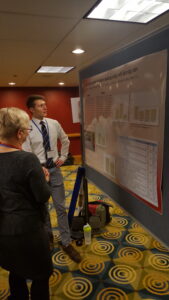
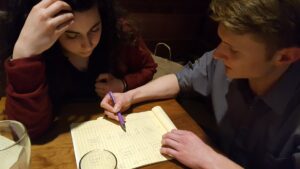
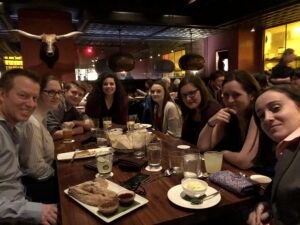
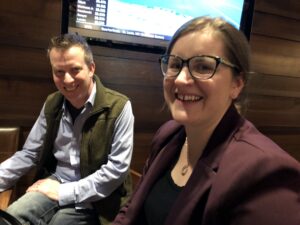
    The first weekend of spring break, Drs. Buchholz, Osterman, Carter, and Findley-Van Nostrand, in addition to several students, traveled to Atlanta to present their studies at the 2018 Society for Personality and Social Psychology Conference.

    The students in attendance included:
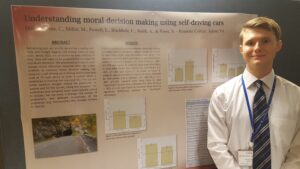
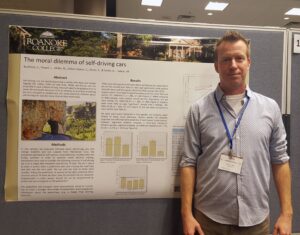
    • Cody Dillon-Owens ’19, who presented on “Understanding moral decision making using self-driving cars.” This study was supervised by Dr. Buchholz and included several other students, including Megan Miller ’18, Allison Smith, Lauren Powell ’21, and Seth Poore ’20. They found that participants generally thought positively of self-driving cars. Faced with a moral dilemma on who to save during an impending crash, the participants were generally more likely to save themselves and their mothers over anyone else. Participants were also more likely to save “significant” individuals rather than strangers.
    • To learn more about the study, please contact Dr. Buchholz at buchholz@roanoke.edu.
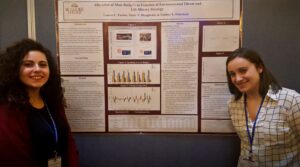
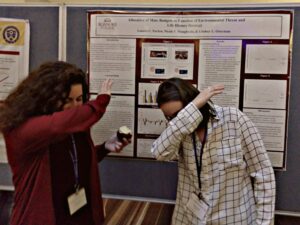
    • Lauren Furlow ’19 and Nicole Moughrabi ’19 presented on the “Allocation of Mate Budgets as Function of Environmental Threat and Life History Strategy.” From Dr. Osterman’s lab, Furlow and Moughrabi added to further research to the field discussing how  “women’s mating psychologies shift as a function of early environment and current environment demands.”
    • To learn more about this study, email Dr. Osterman at osterman@roanoke.edu.
    Sabrina McAllister ’18 presents her findings.
    • Sabrina McAllister ’18, a member of Dr. Nichols’s lab, discussed the results of her study titled “Time Perspective as a State-Based Measure.” To learn more about her study, follow this link. (If you have any questions, please contact Dr. Nichols at dnichols@roanoke.edu.)
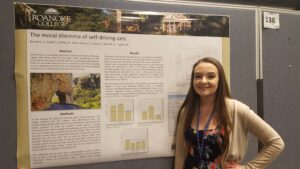
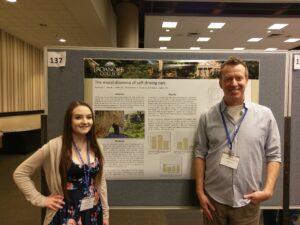
    • Lauren Powell ’21, also a member of Dr. Buchholz’s lab, discussed the study titled “The moral dilemma of self-driving cars.” As this study was conducted alongside the first discussed study, the same researchers also worked on this inquiry. The main goal in this study was to see how gender and empathy would affect how the participants answered the moral dilemmas. However, the results showed that neither gender nor empathy predicted the answers, but that there was a “three-way interaction between gender, cognitive empathy, and affective resonance.” They also found that men possessed significantly more positive attitudes towards self-driving cars than women.
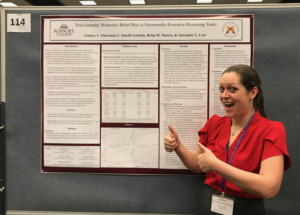
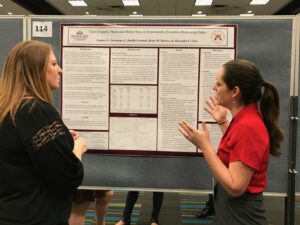
    In addition, Drs. Osterman and Findley-Van Nostrand also presented their research. Specifically, Dr. O presented findings found in conjunction with Dr. Gornick of the Virginia Military Institute, Mr. Brian Matera, and Mr. Alexander Carr, titled “Trait Empathy Moderates Belief Bias in Emotionally-Evocative Reasoning Tasks.” To learn more, please contact Dr. Osterman at the above mentioned email address.
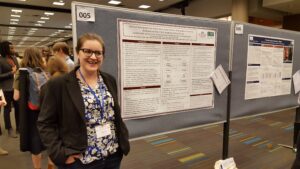
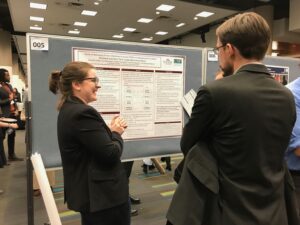
    Dr. Findley-Van Nostrand’s study was titled: “Sense of Belonging Drives Intentions to Leave STEM in Undergraduate Students: Mediated and Short-Term Longitudinal Association.” She worked alongside Drs. Sophie Kuchynka, Jennifer Bosson, and Richard Pollenz, all from the University of South Florida. If you are curious about the study and want to learn more, Dr. FVN can be contacted at findley@roanoke.edu.
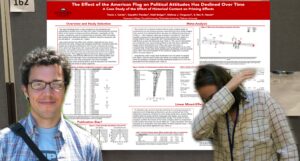
    Finally, the day before the official SPSP conference began, Dr. Carter presented his study on “The Effect of the American Flag on Political Attitudes Has Declined Over Time: A Case Study of the Effect of Historical Context on Priming Effects,” at the JDM preconference.

    The preconferences are one-day, mini conferences that allow for colleagues to gather to discuss their specific areas of interest. For Dr. Carter, this was to discuss the changes since the first study he and his fellow researchers had conducted in 2011, wherein his research revealed that using the American flag as a primer has become less effective in shifting participants towards more politically conservative attitudes and beliefs. The effect is shown to be roughly zero at present. To learn more, please contact Dr. Carter at tjcarter@roanoke.edu.

    (Unfortunately, no pictures were taken of Dr. Carter while he was presenting at the JDM preconference. Instead, Dr. O provided a dramatic reenactment via hard work and editing skills.)
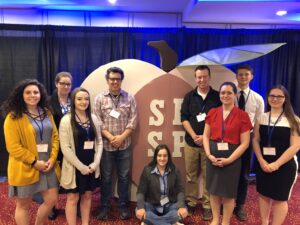
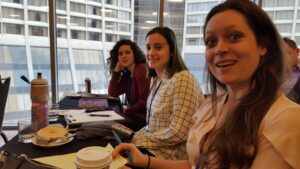
    When asked about the experience, Dr. Osterman said…

    We had a fantastic time at SPSP, and all of our student presenters did a wonderful job of talking about their research with other scholars. They represented the college and department exceedingly well.

    Cody seconded this, saying:

    SPSP went really well! It was a wonderful opportunity to present research to a large body of our peers in psychology, as well as learn about a lot of the exciting new research that’s being conducted in the field. I definitely look forward to attending my next conference!

    Congratulations to our students and professors for their successful SPSP conference!

    Get connected!
    Instagram & Twitter:  #PsychRC @RC_Psychology
    Facebook:  https://www.facebook.com/rcpsychology
    Blog:  https://psych.pages.roanoke.edu/
    Linked In:  https://www.linkedin.com/groups/RC-Psychology-8140491/about
    Website:  https://www.roanoke.edu/inside/a-z_index/psychology
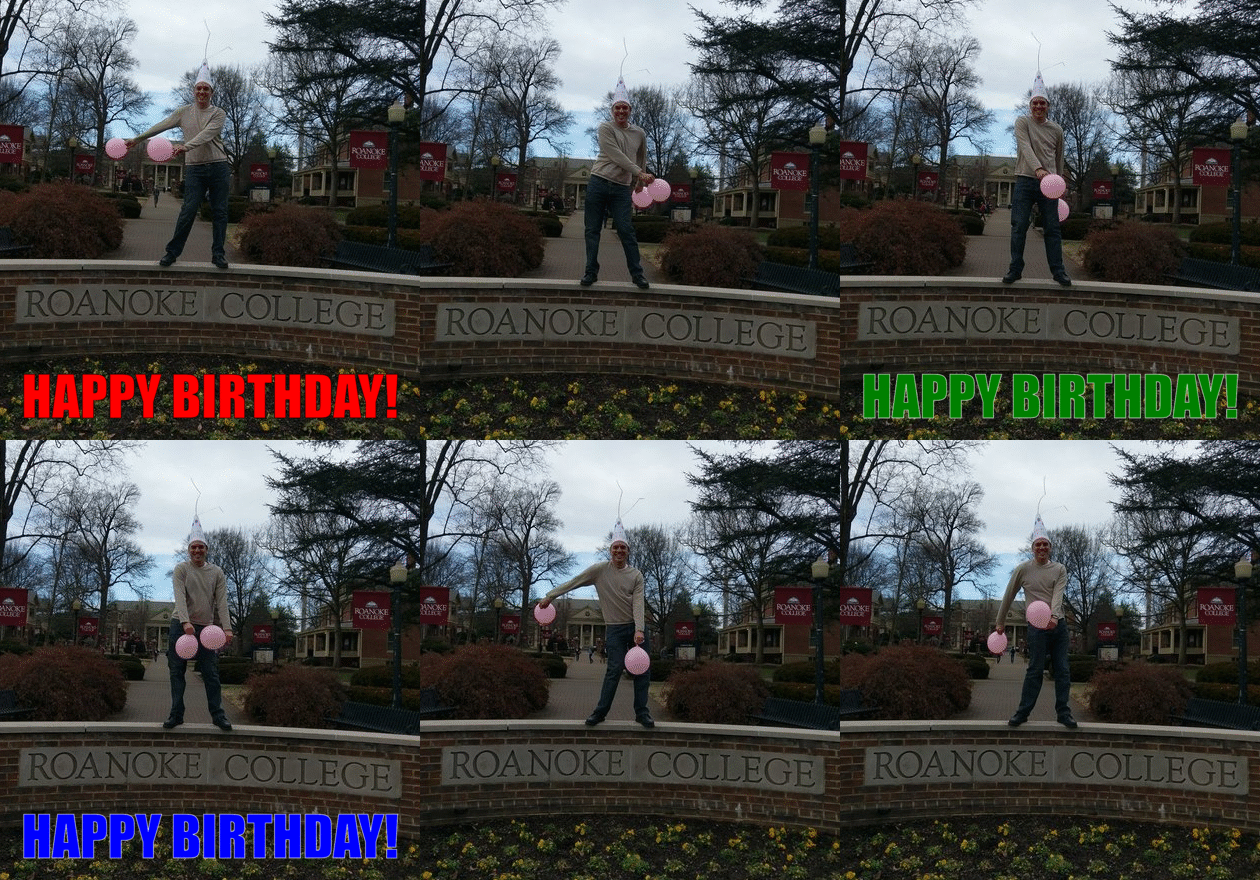
  • The Story Behind the GIF

    In honor of three very special birthdays, including Dr. FVN and recent alums Stephanie Shields and Nikki Hurless, Dr. Nichols demonstrated how to “floss.”

    Naturally, it was made into a GIF.

    For a brief period of time, it was also shown on the psychology television near the elevators.

    To see the original video that inspired this masterpiece, click here.

    Get connected!
    Instagram & Twitter:  #PsychRC @RC_Psychology
    Facebook:  https://www.facebook.com/rcpsychology
    Blog:  https://psych.pages.roanoke.edu/
    Linked In:  https://www.linkedin.com/groups/RC-Psychology-8140491/about
    Website:  https://www.roanoke.edu/inside/a-z_index/psychology

  • Manuscript Published!

    Congratulations to Dr. Powell (Roanoke College), Dr. Freedman (Dartmouth University), Dr. Le (Haverford College), and Dr. Williams (Purdue University) for their recent publishing in the Journal of Social and Personal Relationships, titled “Ghosting and Destiny: Implicit theories of relationships predict beliefs about ghosting”!

    The research article focuses on two studies conducted by the authors to determine how implicit theories such as destiny and growth influence relationship terminations and how participants view “ghosting.”

    For more information, follow this link to see the original study.

    Again, congratulations to Dr. Powell and her fellow researchers for their manuscript publishing!

    Get connected!
    Instagram & Twitter:  #PsychRC @RC_Psychology
    Facebook:  https://www.facebook.com/rcpsychology
    Blog:  https://psych.pages.roanoke.edu/
    Linked In:  https://www.linkedin.com/groups/RC-Psychology-8140491/about
    Website:  https://www.roanoke.edu/inside/a-z_index/psychology

  • Toy Like Me ’17

    A Student at Oak Grove Receiving Her Toy. Original Source: Roanoke College News

    Last December, Christmas was made particularly special for a class at Oak Grove Elementary School in Roanoke, Virginia.

    As reported by the local WDBJ7 news station, Roanoke College students and biology professor, Dr. Frances Bosch, delivered toys they had altered to Mrs. Gruber’s special education classroom.

    For children with disabilities, finding toys that look like them can be difficult and they can sometimes feel left out as a result.

    As Dr. Bosch points out,

    [… because only] twenty percent of the population have a disability of some sort, it is unlikely that major manufacturers would make toys to truly give every child a toy like them.

    Yet, for students of this classroom, and for many other children as a result of the Toy Like Me project in Roanoke and the UK, finding toys that represent them has been made a little easier.

    The Toy Like Me project at Roanoke College began when Dr. Bosch was researching for her 2015 May Term class, and she read about the Toy Like Me program started by Rebecca Atkinson in the UK.

    Atkinson recognized the need for more diversified toys and started the program in order to lobby major toy manufacturers into producing toys more diverse toys.

    The following year, while planning for her 2016 May Term class, Dr. Bosch decided not to wait for toy manufacturers to start diversifying their products.

    I contacted Rebecca and asked if we could modify toys and give them away in the name of Toy Like Me. 

    Atkinson approved.

    So, the May 2016 class modified $300 worth of toys, and we gave most of them to Carilion Clinic’s Children’s Hospital in Roanoke.

    Dr. Bosch helps a student during her May Term class. Source: Facebook

    This was not the end, however, as this project would spark continued projects in the name of Toy Like Me at Roanoke College. As Dr. Bosch describes,

    Last school year, we did a Santa Claus Toy drive, and gave away $1600 worth of toys. [We] then gave toys away for Valentine’s [Day], and again in April.

    My May 2017 class modified $700 worth of toys for the Pediatric Oncology ward at UVA through RC alumna Karra (Slaughter) Lee, who is a PA in that ward.

    This year’s Santa Claus toy drive saw toys go to children in several schools in Roanoke City and County.

    Including Oak Grove Elementary.

    Last semester, we partnered with  Dr. Findley-Van Nostrand’s Developmental Psychology classes. They modified toys with us, then participated in the delivery of toys to Oak Grove Elementary.

    According to Dr. Findley-Van Nostrand, her students worked with Professor Bosch, the “heart and soul of the program” in order modify the toys based on each individual student.

    If someone is in a wheelchair, a doll can be modified to include a wheelchair; if a child has a feeding tube, a tube can be inserted in toys; if a child wears glasses or has crutches, they add those […]

    RC Students and Dr. FVN introducing themselves at Oak Grove. Not Mine: Roanoke College News, David Matheny

    For Dr. Findley-Van Nostrand, the Toy Like Me program was “a memorable experience” as she “loved seeing the kids get so surprised and excited over the toys, and it was a great opportunity for my students as well.”

    Dr. Bosch notes plans to partner with Dr. Findley-Van Nostrand’s class again this semester, as well as with Psi Chi, the Honors Society for psychology.

  • Tenure Track Professor Candidate Research Talk

    The Psychology Department would like to invite the campus community to attend a presentation by Dane Hilton, a candidate for a tenure track professor in the department, on the “Social Functioning and the Executive System: Improving Theory, Informing Intervention” TODAY in Life Science 402 at 4:00 pm.

    For more information, please contact Dr. Buchholz.

    Hope to see you there!

    Get connected!
    Instagram & Twitter:  #PsychRC @RC_Psychology
    Facebook:  https://www.facebook.com/rcpsychology
    Blog:  https://psych.pages.roanoke.edu/
    Linked In:  https://www.linkedin.com/groups/RC-Psychology-8140491/about
    Website:  https://www.roanoke.edu/inside/a-z_index/psychology

  • Dr. Powell and Ms. Lawrence at NCFR

    Courtesy of Dr. Powell. The NCFR was held in Florida.

    Recently, Dr. Darcey Powell and Ms. Riker Lawrence were able to present their studies at their first visit to the National Council on Family Relations (NCFR).

    NCFR is an annual conference that is the “premier professional association for understanding families” through various ways.

    Dr. Powell presented on a study by herself and Sophia Bolton of Duke University, titled “Parental Knowledge and Adjustment of Mothers in a Treatment Facility.”

    @Dr.DarcyPowellFB

    She posted on Facebook, saying about the experience:

    The lab’s first #NCFR17 won’t be our last NCFR! Our projects were well received, catching up with colleagues and networking with new ones was productive, and (last, but certainly not least) the sunny Florida weather was much enjoyed!

    Ms. Riker Lawrence also presented on her research, which was in conjunction with Dr. Powell and Dr. Katherine Karraker of West Virginia University, and titled “Caring for Toddlers: Parents’ Experiences, Desires, and Satisfaction.”


    Overall, we’re incredibly proud of our department’s Dr. Powell and Ms. Lawrence for their successful presentations at NCFR and for representing the department and Roanoke College well.

    Get connected!
    Instagram & Twitter:  #PsychRC @RC_Psychology
    Facebook:  https://www.facebook.com/rcpsychology
    Blog:  https://psych.pages.roanoke.edu/
    Linked In:  https://www.linkedin.com/groups/RC-Psychology-8140491/about
    Website:  https://www.roanoke.edu/inside/a-z_index/psychology

  • Congratulations to Dr. Powell and Dr. FVN on their Manuscript Acceptances!

    The Psychology Department would like to congratulate Dr. Powell and Dr. Findley-Van Nostrand on getting their manuscripts accepted for publishing this semester!

    Dr. Powell has published two articles this semester. The first was in conjunction with Elizabeth Babskie and Aaron Metzger, titled “Variability in Parenting Self-Efficacy Across
    Prudential Adolescent Behaviors” and can be found here.

    The second article, titled “Prospective Parents’ Knowledge About Parenting and Their Anticipated Child-Rearing Decisions,” has received special promotion by the National Council of Family Relations as one of the five “early view” articles from their journals for October, and was co-written with Dr. Katherine Karraker of West Virginia University.

    Dr. Findley-Van Nostrand has also had a manuscript acceptance for her article on  “Affective-interpersonal and impulsive-antisocial psychopathy: Links to social goals and forms of aggression in youth and adults”,  which is co-authored with Tiina Ojanen, a professor at the University of South Florida, and will be published in the journal Psychology of Violence.

    For Dr. FVN’s description of her article and findings, please follow this link.

    Again, congratulations to both professors on their recent article acceptances!

  • A Brief Interview with Dr. Findley-Van Nostrand

    Dr. Findley Van-Nostrand is pictured above. She is a new Psychology professor here at Roanoke College.

    A student assistant was recently able to interview Dr. Findley-Van Nostrand amidst the chaos and confusion that is midterms about herself and her research interests, as well as her recent manuscript acceptance in the journal Psychology of Violence.

    So, how do you like Roanoke so far? Is it very different from Florida?

    It’s great! Definitely different from Tampa. Smaller city, slower pace, cooler weather…all good things for me.

    Can you tell me about your academic background?

    I did my undergraduate degree at the University of South Florida. I also remained there, for a variety of reasons, for my Ph.D. (and Masters along the way). Towards the end of my doctorate, I broadened my interests some and was involved in a couple of projects outside of the Psychology department that involved applying psychology to the problem of STEM (Science, Technology, Engineering, and Math) student persistence. These projects ended up leading to an offer to remain as a postdoctoral researcher after wrapping up my dissertation. So, after my postdoc, here I am!

    What classes are you teaching right now and what types of courses will you be teaching in the future?

    Right now I am teaching PSCY221- Developmental Psychology, and PSYC321- Child Development. In the near(ish) future I will teach these, as well as Intro to Psychology, Adolescent Development, and a Research Seminar in Developmental Psychology.

    What are some of your past and current research experiences and interests?

    My research interests are related but twofold. In my primary research, I am interested in peer relationships and social behaviors during adolescence and early adulthood. In this line, I have

    focused on aggression among peers, underlying motivational factors, and the ways in which aggression is tied to social status among peers. I also have continuing research aimed at understanding the role of the self in aggression and prosociality, and my studies in these area are driven by both developmental and social psychology literatures and studies. In my second line of research, I’m also interested in understanding how social experiences, like felt belonging, as well as self-concepts and motivation may drive interest and persistence in STEM disciplines. Much of the research in this area is also related to academic persistence and achievement more broadly, but has some specific nuances related to the STEM context.

    I recently heard that you have been approved to publish an article in a journal, can you tell me more about that?

    Sure! The paper will be published in the journal Psychology of Violence, and includes two studies (one in early adolescence, and one in young adulthood) examining two forms of psychopathy, social goals, and forms of aggression. In previous research, we’ve demonstrated that social goals for status predict heightened aggression (especially relational aggression) over time in adolescents, and social goals for closeness and affiliation are related to lower levels of aggression. In a separate line of research, psychopathy and callous-unemotional traits are consistently tied to high aggression. In our study, we demonstrated differences in relationships between psychopathy and social goals based on form of psychopathy (one form entailing interpersonal manipulation was related to social goals, whereas the other form entailing behavioral impulsivity was not), and that social goals mediated the links between psychopathy and aggression in both age groups. So, within the context of psychopathy as a risk factor, targeting social goals may help in aggression-related interventions.

    What are some random/cool facts about you?

    First, my husband and I have an 1 ½ year old son, who keeps us busy and I’m forever in awe of. Second, I am a huge Formula 1 racing fan! We have a lot of awkward hours in our house where we will wake up to watch the European races live. It’s a much more complex sport than you might think, and the psychology of the drivers, their competitiveness, decision making, team dynamics, etc. is really fascinating.

    Is there anything else that you’d like to mention?

    Everyone here has been super welcoming. So thanks!

    Congratulations Dr. FVN for your recent manuscript acceptance and thank you for taking time to answer our questions!


    Get connected!
    Instagram & Twitter:  #PsychRC @RC_Psychology
    Facebook:  https://www.facebook.com/rcpsychology
    Blog:  https://psych.pages.roanoke.edu/
    Linked In:  https://www.linkedin.com/groups/RC-Psychology-8140491/about
    Website:  https://www.roanoke.edu/inside/a-z_index/psychology

  • A Brief Interview with Dr. Travis Carter

    Dr. Travis Carter, Psychology Professor at Roanoke College

    A student assistant for the psychology department was recently able to interview Dr. Travis Carter, a new Psychology professor at Roanoke College this year, as a follow-up interview to learn more about him, his interests in psychology, and other cool things as the semester is now in full-swing. The following is the interview:

    So, how do you like Roanoke so far? Is it very different from Maine?

    I think it’s great! Everyone I’ve met has been incredibly welcoming, and although we’ve just started to explore the area, it seems like there’s a ton of stuff to do. And yes, it is very different from Maine in a lot of ways, but I think the biggest differences will be apparent this winter. I am not going to miss shoveling 3+ feet of snow from my driveway.

    Can you tell me a little about your educational background?

    I did my undergrad at the University of Chicago, which has a reputation as a large research university, but the undergraduate population is actually not all that big, so it operates more like a liberal arts college. I received my PhD from Cornell University, and then returned to Chicago for a postdoc in the Center for Decision Research, housed in the University of Chicago’s Booth School of Business.

    What classes are you teaching right now and what types of courses will you be teaching in the future?

    Right now, I am teaching PSYC-251: Social Psychology and PSYC-204: Quantitative Methods in Psychology. I’ll continue to teach those courses in the future, and will teach what I hope will be a fun INQ-120 course this coming spring, called A Perfect World. It aims to examine past utopian visions through the lens of modern psychological research. Next year, I’ll also be teaching some upper level courses, including a course in Judgment and Decision Making, and one on Social Cognition.

    What are your past and current research interests?

    I continue to have a diverse range of research interests, examining everything from political attitudes to consumer behavior to a fairness bias exhibited by Major League Baseball umpires. Broadly speaking, I’m interested in the ways that our judgments, beliefs, attitudes, and behaviors can be biased by both external forces (subtle exposure to a symbol in the environment, a manager screaming at an umpire about a bad call) and internal motivations (political ideology, desire to gorge yourself on potato chips).

    What are some random/cool facts about you?

    Just this summer my wife and I had a baby, who I think is in the running for cutest baby of all time. (And as someone who studies biased beliefs, I can comfortably say that my opinion about her cuteness is completely objective.)

    Other than that, I love music, technology, and the boring sports (baseball, soccer).

    Thank you Dr. Carter for taking time to answer our questions and congratulations on having a baby! We’re glad to have you at Roanoke College!

  • Dr. David Nichols wins award

    Dean Richard Smith presented Dr. David Nichols with the prestigious Professional Achievement Award for his many accomplishments in professional life (research publications, internal and external grants, conference presentations, and dedication to mentoring undergraduates in research). Congratulations Dr. Nichols!