Category: Faculty News

  • ESP? Dr. Lindsey Osterman Takes a Look

    Dr. Lindsey Osterman was recently interviewed by a student assistant on a podcast about ESP or extrasensory perception.

    ESP is believed to be akin to a “second sight” or “sixth sense”.

    For their 149th episode, the podcast, Serious Inquiries Only, focused on a meta-study published in the American Psychologist that indicates there might be some truth to the existence of ESP.

    As a follow-up to their initial podcast, they asked Dr. Osterman, an expert in Experimental Psychology, to discuss the article and whether the findings reported in the meta-study were legitimate.

    According to Dr. Osterman,

    “…the podcast itself [Serious Inquiries Only] is a show about science, philosophy, and current events, all discussed from a ‘skeptical’ perspective in the truest sense of the term ‘skeptical.’ The host (Thomas Smith) is committed to approaching all the topics he covers with both curiosity and a critical evaluation of the evidence, and he does his best to correct for (and be transparent about) the preexisting biases that might be contributing to his thinking about those topics.”

    Dr. Osterman had been featured on Serious Inquiries Only two years previously, where she discussed a critique on the history of evolutionary psychology published by a historian.

    Both of my appearances served a similar goal, which was to provide a nuanced and evidence-based opinion about a scientific-sounding claim that was not actually rooted in high-quality evidence. In the first one [from two years ago], I responded to an interview that Thomas conducted with a historian, who had published a very-detailed — but in my opinion, very ill-informed — critique of evolutionary psychology.

    Similarly, in this latest podcast, Dr. Osterman responded to a conversation…

    [Smith] recorded with a professor of philosophy and a clinical psychologist about a review paper (published in American Psychologist, a respected, peer-reviewed journal), which argued that the empirical evidence for psi (or paranormal cognitive abilities, like being able to see the future) is very strong and consistent. My contention was that the article omitted critical details about the evidence, and in turn, presented a case that looked much stronger than it actually was.

    Thank you to Dr. Osterman for being awesome as usual.

    For those interested in knowing more details about the article and what Dr. Osterman found within it, the links to the podcasts are below. The first episode has been included for those who want to know what sparked the debate and to have a better idea of what Dr. Osterman and Thomas are discussing in the later episode.

    In addition, click here for the link to the PDF of the article that sparked this debate.

    Take a listen.

    https://seriouspod.com/sio149-is-esp-real-no-really-it-might-be-2/

    Dr. Osterman’s analysis:

    https://seriouspod.com/sio150-ok-esp-isnt-real-with-dr-lindsey-osterman-2/

    .

    .

    .

    Get connected!
    Instagram & Twitter:  #PsychRC @RC_Psychology
    Facebook:  https://www.facebook.com/rcpsychology
    Blog:  https://psych.pages.roanoke.edu/
    Linked In:  https://www.linkedin.com/groups/RC-Psychology-8140491/about
    Website:  https://www.roanoke.edu/inside/a-z_index/psychology

  • A Brief Interview with Dr. Stacy Wetmore

    The following is a brief interview with Dr. Stacy Wetmore, a new tenure-track professor at Roanoke College. A student assistant was recently able to interview her to learn more about her, her interests, and some cool facts that readers may not know. There’s a picture of a cute puppy at the end of this interview: keep reading to see it.

    So, how do you like Roanoke so far? Is it very different from what you’re used to?

    So far, I’m loving it!! I’m excited that the semester is underway and I get to teach some really interesting topics. I like that I have fairly small class sizes and I will know all of my students’ names in no time. RC is similar in a lot of ways to where I most recently taught, so now it’s just a matter of learning the little quirks about how about things work here.  One thing that is a little different are the class times, so I’m always a bit nervous I’m going to be late!

    Where did you go to undergraduate and graduate school?

    University of Oklahoma

    For my undergraduate (BA in Psychology) and Master’s degree (Experimental Psychology) I was at The University of Alabama in Huntsville. And I got my PhD from the University of Oklahoma. (Dr. Osterman and I actually met there many years ago!!!).

    What classes are you teaching right now and what types of courses will you be teaching in the future?

    Currently, I’m teaching two sections of the INQ 260 Psychology in the Media, and one PSYC 101 Introduction to Psychology. In the near future, I’ll be teaching Cognitive Psych and Research Methods.  I will also be developing (over the upcoming years) a new INQ 110, a Memory course, and a Psychology and Law/Forensic Psych course as well.

    What are some of your past and current research experiences and interests?

    Founders Building, Egham, England.

    My most exciting research experience was getting to be a Postdoctoral Researcher at Royal Holloway, University of London, in Egham, England. I hadn’t yet finished my dissertation, but accepted a position overseas to work on a project evaluating the U.K.’s eyewitness identification system/technique. I got to be a researcher, without any teaching responsibilities for 1.5 years and learned a lot of new stuff, as well as did research that could inform policy abroad.

    In terms of research interests, Dr. Wetmore explains…

    The overall focus of my research examines the intersection between cognition and the legal system. Research that I have been involved in, thus far, has been in three major areas.

    Dr. Wetmore

    The first is research on jailhouse informants. Jailhouse informants are a leading cause of wrongful conviction, yet very little is known about this form of evidence, including how jurors perceive and weigh this information, and if there are effective safeguards against it.

    Another cause of wrongful conviction that I have studied are eyewitness identifications. Specifically, my research focused on show-up identification procedures, in which the individual must make a decision from a single face. My colleagues and I found that the show-up was a more unreliable memory test than a more traditional six-pack lineup. I’m interested in developing other procedures or methods of evaluating eyewitness memory in order to make it a more effective source of evidence at trial.

    Lastly, related to eyewitness identifications, I’m interested in facial processing and memory in general. Humans are made specially to be able to process faces super-fast and efficiently, however there are still instances when this mechanism breaks down and I’m interested in examining these instances when it falters. For instance, a well-known phenomenon is the cross-race effect, or own-race bias, in which we are better at identifying someone from our own race better than from another race. Although we know the phenomenon exists, little is known about what cognitively could be different in the processing so I want to investigate this issue further.

    What are some random/cool facts about you?

    • I was a collegiate athlete in tennis.
    • I lived abroad for 2 years in England as a postdoctoral researcher.

      Dr. Wetmore’s adorable puppy, Daisy.
    • Super allergic to 100% grape juice – but can drink the not healthy stuff, wine, and eat grapes… I think this fits under random.

    Is there anything else that you’d like to mention?

    I have the cutest (I might be biased) 7 month old puppy, Daisy, that I walk around campus every morning between 6-7 (depending on when I can drag myself out of bed) and every evening, so anyone who runs into us is welcome to say hello. 🙂

    Thank you Dr. Wetmore for taking your time to answer our questions, and welcome again to Roanoke College! We are glad to have you here (and Daisy too)!


    Get connected!
    Instagram & Twitter:  #PsychRC @RC_Psychology
    Facebook:  https://www.facebook.com/rcpsychology
    Blog:  https://psych.pages.roanoke.edu/
    Linked In:  https://www.linkedin.com/groups/RC-Psychology-8140491/about
    Website:  https://www.roanoke.edu/inside/a-z_index/psychology

  • A Brief Interview with Dr. Dane Hilton

    A student assistant for the psychology department recently interviewed Dr. Dane Hilton, a new faculty member this semester, about himself, his interests in psychology, and some other little-known facts.

    The following is the interview:

    So, how do you like Roanoke so far? Is it very different from Alabama?

    I have really enjoyed settling into the Roanoke area. It is a good bit different from Alabama geographically, as Alabama is fairly flat where I lived in Tuscaloosa. At the same time, I’m from western North Carolina originally and spent five years in Boone for school, so being back in the Appalachian region is kind of like coming home. The area reminds me a lot of some of the cooler places I’ve visited in the south east- it’s a bit like Chattanooga, Birmingham, and Asheville, NC all rolled into one compact and livable place. The college is beautiful and I’ve really loved how down to earth and friendly everyone is. That is one thing that is not different from Alabama- everyone is super friendly!

    Where did you go to undergrad and grad school?

    I did my bachelor’s at Appalachian State University in psychology and then stayed for two more years to get my master’s in Clinical Health Psychology. I then moved to Tuscaloosa, AL and did three years at The University of Alabama for my PhD in Clinical Child Psychology. Finally, I did my pre-doctoral internship- a year-long clinical residency- at the WVU-Charleston Division School of Medicine in Charleston, WV. It’s been a long road…

    What classes are you teaching right now and what types of courses will you be teaching in the future?

    Right now I’m teaching Psychology in the Media and Personality Psychology. I think both of these courses will stay in my rotation for a few years but I will also be teaching Intro to Psychology, Abnormal Psychology, Clinical Psychology, and hopefully a course in Applied Behavior Analysis at some point in the future.

    What are some of your past and current research experiences and interests?

    My research has always been related to individuals with Attention-Deficit/Hyperactivity Disorder (ADHD) in some way, and I will likely continue this line of research for many more years. My primary research program is focused on understanding the relationship between executive function- an important set of cognitive skills- and social functioning in folks with and without ADHD. I also do intervention research- again, primarily in the area of ADHD. I am currently working with the WVU Department of Behavioral Medicine to study the mechanisms of treatment outcome in group-based behavioral parent training for ADHD. I was awarded a grant while on internship to conduct this research and our group plans on applying for a larger grant to continue studying these processes in the next year or two. Lastly, I study mindfulness meditation. I have been leading mindfulness meditation groups for about 5 years and studying the effects regular mindfulness practices have on ADHD symptoms, anxiety, depression, and mind-wandering. I’m currently talking with individuals at RC to begin developing various ways to integrate mindfulness practice into curriculum, wellness programs, and intervention groups.

    What are some random/cool facts about you?

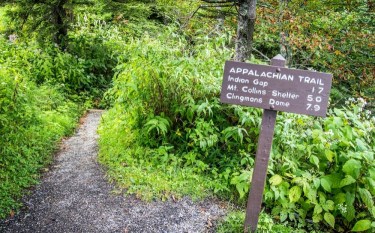
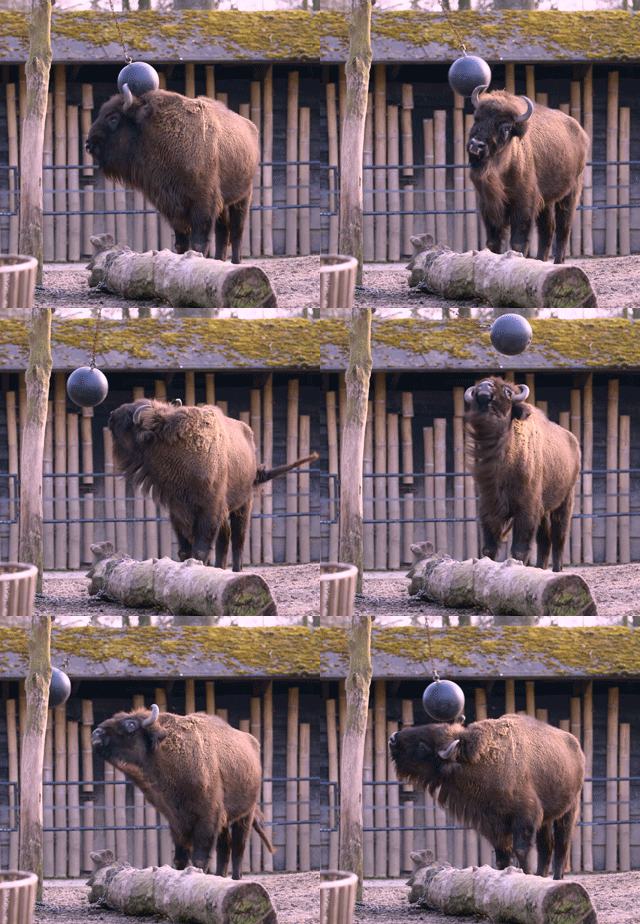
    Before starting graduate school at Appalachian State, I seriously considered becoming a bison farmer- yes, those giant looking beasts in all the Yellowstone pictures. It was between that and psychology. I honestly think I would have been happy doing either but I’m glad I’m here now. Some other random stuff… I was able to dunk a basketball in eighth grade, I once recorded an album in Chapel Hill, NC with my former folk band Foscoe, and I have hiked over 100 miles of the Appalachian Trail with my wife. That pretty much exhausts my cool facts reservoir…

    Is there anything else that you’d like to mention?

    Just that I am super excited to be at Roanoke. The psychology department is full of fabulous teacher-scholars who are also super chill and fun to be around. I look forward to getting to know the students here and being a part of the really great community that exists at RC.

    Welcome to Roanoke College, Dr. Hilton! We are glad to have you here in the Psychology Department, although being a bison farmer sounds pretty great too.


    Get connected!
    Instagram & Twitter:  #PsychRC @RC_Psychology
    Facebook:  https://www.facebook.com/rcpsychology
    Blog:  https://psych.pages.roanoke.edu/
    Linked In:  https://www.linkedin.com/groups/RC-Psychology-8140491/about
    Website:  https://www.roanoke.edu/inside/a-z_index/psychology

  • Pie A Professor TODAY!

    Today is the day. The day you get to see your professors pied! From 5pm-6pm at Sutton Terrace RCPA and Psi Chi will make your dreams come true by pieing 6 of our beloved professors for your enjoyment, all while raising money for the American Foundation for Suicide Prevention.

    Pieing will occur at 5:30pm, with the opportunity for students to pay $10 to personally pie a professor of their choice. Bring your friends!

    The current rankings are:

    1. Dr. Buchholz & Dr. Carter (tied for first)
    2. Dr. Findley-Van Nostrand
    3. Dr. Nichols
    4. Dr. Osterman
    5. Dr. Allen
  • Belated April Fools: Psychology Department Antics

    This year, April 1st fell on a Sunday.

    So, naturally, the psychology department decided to celebrate Belated April Fools the following day.

    What resulted was nothing less than genius.

    Part of this included a revenge plot that had been brewing for years.

    Dr. O tells her side of the story below:

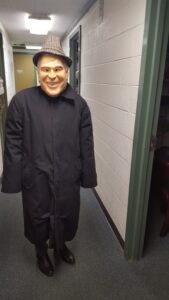
    Weeeeeell… It all started many moons ago, in Spring 2014, when Dr. Nichols was on his way to do an optical illusion demonstration in his Research Methods class and got the bright idea to don his George W. Bush mask (a prop in the demonstration), his trench coat, and his fedora (all together, a rather intimidating combination), and slowly peeked around the doorway of my office in an attempt to get me to pee my pants.

    It very nearly worked.

    After I recovered from my extreme fright, I told Dr. Nichols in no uncertain terms that wearing a mask in public on a non-Halloween day was highly illegal behavior (which we later confirmed), and that I wouldn’t tolerate it in my workplace. I also vowed, privately, to seek revenge upon him at the first opportunity.

    Months passed.

    Years passed.

    And I bided my time, quietly, patiently. Until one day, in February 2018, I walked into Life Science 502 a few minutes before the start of my Quantitative Methods class and noticed atop the “technology tower” in the corner of the room… The Mask, completely unattended (and very creepily staring at the ceiling with its vacant, soulless eye-sockets). Immediately, I grabbed The Mask and ran back to my office to conceal it until April 1st.

    A close-up

    Over the intervening weeks, I discussed with esteemed colleagues on what prank I might involve the mask. Many excellent ideas were put forward (e.g., perhaps we could dangle the mask by a string from the ceiling; perhaps one of us could put on the mask and startle Dr. Nichols as he had startled me), but eventually, we landed on the following plan:

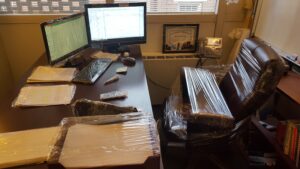
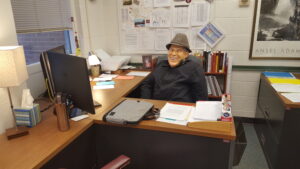
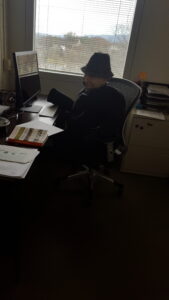
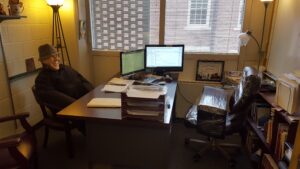
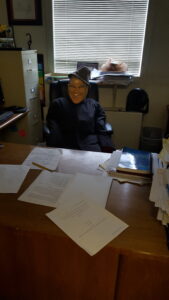
    We would construct a lifelike “scarecrow” from garbage bags, recycled paper, and dress the scarecrow in the mask, trench-coat, and fedora (the latter of which Dr. Nichols usually leaves in his office). We would sit the scarecrow in Dr. Nichols’s desk chair, and Dr. Buchholz would construct a complicated pulley system connecting the office door to the desk chair, so that when Dr. Nichols entered his office, the chair would spin around to face him, and hopefully cause Dr. Nichols to shout in alarm.

    The plan went off without a hitch, but I found Dr. Nichols’s reaction somewhat underwhelming. So, over the course of that  fine Monday, the scarecrow moved around from office-to-office, scaring a number of colleagues (including myself, somehow), and I came up with one final step in the plan.

    At the end of the day, Dr. Nichols was teaching his Neuroscience lab, and a few minutes before the end of class, I donned the scarecrow’s disguise, and seated myself, perfectly still, in Dr. Nichols’s chair. When Dr. Nichols entered his office, he thought it was just the scarecrow, and was not alarmed until my hands sprang into the air like scary claws and I yelled “RAAAAWR” and Dr. Nichols said “Ah!” and it was my very favorite moment of my entire life.

    And that is the story of the mask.

    Test One:

    Dr. Nichols confirmed the events of that fateful day, telling his side of the story:

    The mask is something that I use in PSYC 202 to tell a hopefully amusing story about some silliness my friends and I did in college. However, I scared Dr. Osterman with it in her first year at Roanoke College when I wore it down the hall on my way to class. Since then, I include in class a life lesson that apparently wearing a mask in public outside of Halloween is illegal in many states, including Virginia. Apparently, the last time I used the mask in PSYC 202, I left it in the classroom and Dr. Osterman found it, planning a frightening surprise when the chance arose.

    On Monday morning, April 2nd, I came into the office a little bit later than I usually do since my kids were on Spring Break and I didn’t have to get up as early as I normally do. I said ‘hi’ to Dr. Buchholz, who ‘just so happened’ to be out in the hall on my way in. I opened my door and noticed that someone seemed to be sitting in my chair with a hat and trench coat on and remembered thinking something like ‘That’s weird that there is someone sitting in my office chair in the dark. Huh, how about that?’. Then when I opened the door completely, the chair swung around and it looked quite realistic. I started slightly before realizing it was my mask. I was quite impressed by the system of fishing line that was rigged up to get the chair to move that way!

    Then, at the end of the day after the dummy had been moved around to the offices of other department faculty, I came back to my office after my afternoon class was over. The day had not gone well at all because of technical difficulties preparing for Neuro lab, so I was feeling exhausted but glad that the lab had gone alright in the end. Dr. Allen was waiting out in the hall and took out her camera to film me entering my office, which seemed suspicious. I remember saying something like ‘I’ve seen it already’ because I expected the dummy to be back in my office, though suspected something else to possibly be going on.

    When I entered the office, the dummy sprung to life as it jumped out of my chair! I started on the inside but didn’t have too much of a physical reaction, though it was a very good set-up with Dr. Osterman inside a padded suit so that it looked pretty much just like the original dummy, even though someone was now inside it.

    I very much appreciated the thought and planning that went into both surprises! It’s great to work in a department that enjoys one another so much. 🙂

    The Real Dill:

    Get connected!
    Instagram & Twitter:  #PsychRC @RC_Psychology
    Facebook:  https://www.facebook.com/rcpsychology
    Blog:  https://psych.pages.roanoke.edu/
    Linked In:  https://www.linkedin.com/groups/RC-Psychology-8140491/about
    Website:  https://www.roanoke.edu/inside/a-z_index/psychology

  • Pie a Prof!

    It’s that time of the year!

    Stop by the table outside of Colket or by the box in the hallway of the 5th floor to choose your victim(s) to get pied! The professor with the most money in their jar will get a special pie, with sprinkles.

    All proceeds will go to The American Foundation for Suicide Prevention.

    Hope to see you there!

    Get connected!
    Instagram & Twitter:  #PsychRC @RC_Psychology
    Facebook:  https://www.facebook.com/rcpsychology
    Blog:  https://psych.pages.roanoke.edu/
    Linked In:  https://www.linkedin.com/groups/RC-Psychology-8140491/about
    Website:  https://www.roanoke.edu/inside/a-z_index/psychology

  • Mr. Dane Hilton is Looking for Student Research Assistants!

    Dr. Dane Hilton, a new faculty member in the Department of Psychology, is recruiting student research assistants to start in the fall.

    The research conducted in the lab will focus on:

    • Cognitive mechanisms of social encoding
    • Mindfulness meditation and other alternative treatments for self-regulatory deficits
    • Improving measurement of social information processing
    • The use of technology in psychotherapy research/intervention
    • Treatment mechanisms in ADHD Parent Training

    He is looking for research assistants who:

    • Are conscientious and hard-working
    • Have excellent time-management skills
    • Are intellectually curious
    • Interested in ADHD, executive function, or social interaction (preferred, not required)
    • Are familiar with MS Office/Google Docs
    • Have some familiarity with research methods and statistics (preferred, not required)
    • Interested in applying technology (e.g., smartphones, activity trackers, etc.) to research (not required)

    Research assistants will be involved with many aspects of the research process, including developing experimental materials, data collection (in and outside of the lab), data entry, and literature reviews. Highly motivated students will have opportunities for more involvement in study design, statistical analysis, and other more advanced aspects of the research process.

    Interested students from all class years are encouraged to contact Dr. Hilton for an application (dchilton@crimson.ua.edu).

    Get connected!
    Instagram & Twitter:  #PsychRC @RC_Psychology
    Facebook:  https://www.facebook.com/rcpsychology
    Blog:  https://psych.pages.roanoke.edu/
    Linked In:  https://www.linkedin.com/groups/RC-Psychology-8140491/about
    Website:  https://www.roanoke.edu/inside/a-z_index/psychology

  • Welcome Dr. Dane Hilton!

    The Psychology Department would like to welcome Dr. Dane Hilton as our newest tenure-track professor starting this upcoming fall semester. Dr. Hilton obtained his Masters in Clinical Health Psychology from Appalachian State University and his PhD in Clinical Child Psychology from the University of Alabama.

    At Roanoke, Dr. Hilton will be teaching courses such as Abnormal, Personality, and Clinical Psychology. His research interests focus specifically on social encoding, executive functioning, and mindfulness. Dr. Hilton has conducted research on social skills in youth and emerging adults, especially those with ADHD, and on psycho-social interventions for those with executive functioning deficits.

    Dr. Hilton is currently looking for student research assistants to start next semester. If you’re interested, follow this link to learn more.

    Welcome again to Dr. Hilton! We are excited for him to be joining the department!

    Get connected!
    Instagram & Twitter:  #PsychRC @RC_Psychology
    Facebook:  https://www.facebook.com/rcpsychology
    Blog:  https://psych.pages.roanoke.edu/
    Linked In:  https://www.linkedin.com/groups/RC-Psychology-8140491/about
    Website:  https://www.roanoke.edu/inside/a-z_index/psychology
  • Dr. Stacy Wetmore is Looking for Research Assistants!

    Dr. Stacy Wetmore, a new faculty member in the Department of Psychology, is recruiting student research assistants to start in the fall.

    The research conducted in the lab will focus on: 

    • Intersections between cognition and the legal system
    • Factors that influence eyewitness identification accuracy and confidence
    • Underlying processes of memory for recognizing faces
    • Examining the perceptions of cooperating witnesses (including jailhouse informants and accomplice witnesses)
    • Examining and understanding the safeguards that are in place to help jurors evaluate cooperating witnesses

    Looking for research assistants who: 

    • Are conscientious and self-motivated
    • Are able to juggle a variety of tasks at once
    • Are intellectually curious (ideally with knowledge of cognitive psychology)
    • Share some level of interest in the above topics
    • Are familiar with MS Office/Google Docs
    • Have some familiarity with research methods and statistics (preferred, not required)

    Research assistants will be involved with many aspects of the research process, including developing experimental materials (e.g., mock crime videos and mugshots), data collection (in and outside of the lab), data entry, and literature reviews. Highly motivated students will have opportunities for more involvement in study design, statistical analysis, and other more advanced aspects of the research process.

    Interested students from all class years are encouraged to contact Dr. Wetmore for an application (stacy.wetmore@gmail.com).

    Get connected!
    Instagram & Twitter:  #PsychRC @RC_Psychology
    Facebook:  https://www.facebook.com/rcpsychology
    Blog:  https://psych.pages.roanoke.edu/
    Linked In:  https://www.linkedin.com/groups/RC-Psychology-8140491/about
    Website:  https://www.roanoke.edu/inside/a-z_index/psychology
  • Welcome Dr. Stacy Wetmore!

    Dr. Stacy Wetmore

    The Psychology Department would like to welcome Dr. Stacy Wetmore to our faculty as our newest tenure-track professor. She will be joining in the fall of 2018 and will teach Research Methods, Cognitive Psychology and other topics in the cognitive domain.

    Dr. Wetmore received her PhD in Cognitive Psychology from the University of Oklahoma with minors in biological and quantitative psychology. She worked as a postdoctoral researcher at Royal Holloway, University of London from 2015-2016 and, most recently, taught at Butler University.

    Dr. Wetmore’s research interests are focused primarily on studying the complexities and  implications of the psycho-legal field. Her current research involves comparing the performances of lineups and show-ups, in addition to studying the cross-race bias in recognition memory.

    She is also seeking student research assistants of all class years. To learn more, follow this link.

    We are excited to have Dr. Wetmore joining the department next semester!

    Get connected!
    Instagram & Twitter:  #PsychRC @RC_Psychology
    Facebook:  https://www.facebook.com/rcpsychology
    Blog:  https://psych.pages.roanoke.edu/
    Linked In:  https://www.linkedin.com/groups/RC-Psychology-8140491/about
    Website:  https://www.roanoke.edu/inside/a-z_index/psychology