Category: Job

  • Local Organization Highlight: Mainstream Mental Health Services

    Who are they?

    Mainstream Mental Health Services provides goal-directed training to individuals who have been diagnosed with a serious mental illness. Their services are intended to support the individual in achieving and/or maintaining independence within their community in the most appropriate and least restrictive environment. It is Mainstream’s mission to enable eligible older adolescents and adults to acquire life skills and develop stronger family and community relationships that will enhance their quality of life in the mainstream community.

    Mainstream’s three main areas of service include mental health skills building, psychosocial rehabilitation, and an outpatient crisis stabilization and outpatient psychotherapy unit. Roanoke College students have previously held internships with the psychosocial rehabilitation (PSR) program.

    What do they do?

    Mental Health Skills Building: a Qualified Mental Health Professional provides individual – one to one service – focused on the individual client’s personal goals and individual service plan. Mainstream follows a supportive strength-based approach to helping individuals recognize personal strengths and natural supports that help support a happier, fulfilling life.

    PSR: person-centered service emphasizing a continuum of psychoeducational programming, daily life skills training, socialization opportunities, and satisfying recreational activities in a group setting. Provides an individual with an opportunity to move from social isolation to interacting with others in a positive, supportive environment.

    Bridges to hope: Mainstream Outpatient Crisis Stabilization and Outpatient Psychotherapy Services, also referred to as Bridges to Hope, aims to provide quality, immediate interventions and ongoing support focused on stability with the least restrictive treatment possible. Programming will vary from day to day, depending on the needs of individuals in the program.

    How can YOU get involved?

    Mainstream values the opportunity to provide undergraduate and graduate level internships for individuals pursuing a career in the mental health field. Internships are centered around learning experiences and supervision that provide a basic, yet fundamental skill set that is the root of all direct mental health service practices. Students seeking an internship with Mainstream Mental Health Services, Inc. should be pursuing a Bachelor’s or Master’s degree in one of the following areas:

    • Psychology
    • Human Services
    • Sociology
    • Social Work
    • Counseling

    More information about internship opportunities can be found here on their webpage. You can also reach out to psychology department professors and fellow students who have had experience working with Mainstream. The Internship Director for Psychology is Dr. Danielle Findley-Van Nostrand, findley@roanoke.edu, office 509-B Life Science.

    Cat Reaction GIF


    You can find more information on Mainstream Mental Health Services’ website: https://mainstreammh.com/ If you are interested in volunteering and not committing to a full internship experience, try reaching out to Bobbi Cook at bcook@mmhservices.com to see what alternative opportunities they have available. Make sure you tell her that you are from Roanoke College!

    .

    .

    .
    Get Connected!

    Bloghttps://psych.pages.roanoke.edu/
    Facebookhttps://www.facebook.com/rcpsychology
    Twitter: @RC_Psychology
    Linked In: https://www.linkedin.com/groups/RC-Psychology-8140491/about
    Website: https://www.roanoke.edu/inside/a-z_index/psychology
    Instagram: rcpsychology
  • Specialties in Psychology: Sports Psychology

    Nova Scotia Sport Hall of Fame announced 2019 inductees - HalifaxToday.ca

    There are many interesting fields of psychology that cater to different interests! An example of this is sports psychology. In this field, the interaction between psychology and sports is studied. Sports psychology includes a broad array of topics including athlete well-being, the relationship between sports and social interactions, and the issues associated with sports and their respective organizations. Sports psychology can be used to help many different people including kids and Olympic athletes. Additionally, sports psychology is a complex field with many different areas of reach. For example, sports psychologists may work with participants with eating disorders, a team that is struggling to work together, or even assist with concentration and attention techniques. This field is incredibly interesting and limitless!

    To view the American Psychological Association’s post click here!

    To learn about a career in Sports Psychology click here!

    Sports Psychology. (2008). Retrieved September 30, 2020, from https://www.apa.org/ed/graduate/specialize/sports

    Nova Scotia Sport Hall of Fame announced 2019 inductees. (2019, June 3). Retrieved September 30, 2020, from https://www.halifaxtoday.ca/local-news/nova-scotia-sport-hall-of-fame-announced-2019-inductees-1487559

    .

    .

    .

    Get Connected!

    Bloghttps://psych.pages.roanoke.edu/
    Facebookhttps://www.facebook.com/rcpsychology
    Twitter: @RC_Psychology
    Linked In: https://www.linkedin.com/groups/RC-Psychology-8140491/about
    Website: https://www.roanoke.edu/inside/a-z_index/psychology
    Instagram: rcpsychology
  • Welcome Dr. Anthony Cate!: An Interview

    Dr. Anthony Cate, Psychology Professor at Roanoke College


    The Psychology Department would like to welcome Dr. Anthony Cate to our faculty as our newest professor.  The following is an interview with Dr. Cate where he answers some questions about himself, his interests in psychology, and what he’s looking forward to in terms of teaching at Roanoke College.

    Where are you from?

    I was born in New Jersey, and I moved a lot when I was young.  I have lived in every state between Washington, D.C. and Boston, except for Delaware.  After I got my Ph.D. I also lived in Canada (Ontario) and northern California.

    Where did you receive your undergraduate degree from and what did you study in undergraduate? What was that experience like?

    I got my undergraduate degree from Yale University.  I began as a religious studies major, but I thought that those classes involved too much memorization of names and dates, so I switched to psychology.  Actually, I switched to being a triple major, at least on paper: psychology, linguistics, and East Asian studies.  I shed majors when I figured out that psychology interested me the most.

    I was lucky that I was able to help out in three research labs that had different missions and lab cultures.  I learned that I was bad at doing brain surgery in a rat lab.  I lost some patients.  Everyone there seemed anxious all the time too, which was poignant because anxiety was part of what they studied.  I conducted my first research project in a lab that studied human fear conditioning.  My advisor was a very kind scientist who helped me feel like an important part of the lab, but I disliked having to give participants electric shocks.  I also frequented the lab of my favorite professor, who had taught my perception course.  That lab was very welcoming.  People could just walk in to say hi and check out the experiments, there was a dog, and the students were very productive.  All of those experiences taught me to consider the social environment when I was choosing a graduate program.

    Have you received any other additional degrees? Where did you receive them from?

    I went to Carnegie Mellon University to get my Ph.D. in psychology, which was part of a joint neuroscience program with the University of Pittsburgh.

    Have you taught anywhere else besides Roanoke College?

    I first taught when I was a postdoctoral researcher at Western University in Canada.  My advisor talked me and two other postdocs into teaching one third of a course each, which seemed like a lot at the time.  Later I taught at Virginia Tech, where I worked for nine years before moving here to Roanoke.

    What are you most excited about teaching at Roanoke College?

    I am very excited to teach at Roanoke for many reasons!  It has been hard for me not to talk a mile a minute while teaching during these first few weeks.  It is exciting when students ask me questions, including when I don’t know the answer, because then I get to track the answers down later.  I was very eager to start teaching smaller class sizes.  I think personal interactions form the most effective ways to learn, and instructors get to learn from their students this way, too.  It is also a privilege to join an excellent psychology department where the faculty and staff are so engaged in their mission.

    Dr. Cate in front of MRI machine at Veterans Affairs Northern California Health Care System in Martinez, CA (2007)

    What are your research interests? Why are you interested in this/these field(s)?

    My research investigates how visual perception works, and how it influences other cognitive skills like memory and reasoning about numbers.  I am particularly interested in understanding how different parts of the brain work together.  I have studied techniques for visualizing computer models of brains in order to make maps of which cognitive skills are associated with different brain regions.

    Can you tell us about any research you have already completed in these areas?

    I have published some research about how we perceive the 3D structure of objects, and about how brain damage can alter these perceptions.  I enjoyed learning how to make 3D images using computer graphics, and I especially liked getting to learn what people living with brain damage had to teach me about perception.

    What course or courses are you currently teaching?

    I am teaching Introduction to Psychology and Cognitive Psychology this semester, which is a great combination.  I have been teaching Cognitive Psychology for over nine years, and it is so familiar to me that I get excited when my favorite topics are about to come up in class.  I have never taught Intro Psych before.  It feels like a big responsibility to introduce the entire field.

    Are you interested in taking on students as research assistants?

    Yes!  Students make research better.  I realized a few years ago that when undergraduates helped me with a project, we considered the problems less narrowly.  The projects were much more enjoyable because of all the conversations we got to have.

    What qualities are you looking for in any students who are interested in joining your lab?

    Mainly curiosity, and an appreciation of research for its own sake.  My research questions are usually less about “how can we apply this science?” and more about “how does this work?”  I have had wonderful contributions from students with backgrounds in art and design, but that’s because we had similar interests, and not because students need any particular artistic abilities.  The same has been true for students who are interested in neuroanatomy and computer science.  A passion for those topics makes for a good fit, but students definitely don’t need to have expertise already.

    Welcome to Roanoke College Dr. Cate! Thank you again for taking the time to answer our questions. We are excited to have you here and look forward to learning more about you in the semesters to come!

    .

    .

    .

    Get Connected!

    Bloghttps://psych.pages.roanoke.edu/
    Facebookhttps://www.facebook.com/rcpsychology
    Twitter: @RC_Psychology
    Linked In: https://www.linkedin.com/groups/RC-Psychology-8140491/about
    Website: https://www.roanoke.edu/inside/a-z_index/psychology
    Instagram: rcpsychology


  • SUMMER INTERNSHIP AND EMPLOYMENT OPPORTUNITIES!

    Image result for psychology
    © Iowa State University

    With spring break being only one week away the thought of summer may still seem distant in some mind’s, but it is quickly approaching. Summer break is a great time to explore opportunities in psychology and get experiences that go beyond the classroom. With the multitude number of research or internship opportunities available to students it can sometimes be challenging to figure out where to begin. Likewise, with summer comes graduation and the rush to find jobs begins. However, this website has got your back!  

    Whether it be a summer opportunity or a long-term job, this website is regularly updated with information on psychology opportunities. Not only does this website offer a numerous amount of resources but it is also easy to navigate. By providing filtering options such as the type of position you are looking for and what state you are looking to be in, there are options that would align with each students needs and interests. Moreover, this website also filters the positions on areas of psychology and includes opportunities in clinical, cognitive, cultural, developmental, educational, health, neuroscience, positive, and social psychology. 

    While you may not know quite yet what you want to do this summer or after graduation, this website is a great place to start searching and a great starting point to familiarize oneself with the endless opportunities that those studying psychology have! This website is updated frequently so if you don’t find a position that suits your needs or interests now, check back later! 

    .

    .

    .

    Get Connected!

    Bloghttps://psych.pages.roanoke.edu/
    Facebookhttps://www.facebook.com/rcpsychology
    Twitter: @RC_Psychology
    Linked In: https://www.linkedin.com/groups/RC-Psychology-8140491/about
    Website: https://www.roanoke.edu/inside/a-z_index/psychology
    Instagram: rcpsychology
  • RC Psychology Offers Clinical Psychology Class

    Beginning this semester, Roanoke College’s Psychology Department began offering a class on Clinical Psychology taught by Dr. Hilton for those interested in learning more about the field.

    Image result for seinfeld happy gif

    Goals for the class include: 

    1. Clearly delineate the field of clinical psychology from all related professions
    2. Help students understand the unique skills and abilities of clinical psychologists and how these things can be used across the many settings we work in
    3. Give students the basic tools to think like clinical psychologists and learn how to approach things systematically and scientifically to be informed consumers and ethical providers in the future

    When asked about his hopes and expectations for the class, Dr. Hilton responded:

    I think the class is beneficial for anyone with an interest in the field of mental health broadly. Even if you don’t pursue a clinical doctorate, the clinical psychologist’s approach to studying and treating mental health problems can (and should) be applied to any other field.

    As part of the course, students will regularly be asked to apply their knowledge in the form of reaction papers, discussion, and research. Students will have the opportunity to speak with a licensed psychologist regarding their education, training and work life and will learn the basic skills of the assessment and therapy process, later applying these in a role play with the instructor.

    In recognition of this new course offering, a series of blog posts focusing on exploring what clinical psychology is, the process of becoming a clinical psychologist, and what other, similar career options will be posted over the new few weeks.

    We look forward to and are excited about this new opportunity for students at Roanoke College to learn more about what clinical psychology as, as well as hope that our future blog posts will also help aid students in learning more about what careers are available post-graduation.

    If you have any questions about the field of clinical psychology, or about the class at Roanoke, you are encouraged to contact Dr. Dane Hilton at hilton@roanoke.edu.

    .

    .

    .

    Get Connected!

    Bloghttps://psych.pages.roanoke.edu/
    Facebookhttps://www.facebook.com/rcpsychology
    Twitter: @RC_Psychology
    Linked In: https://www.linkedin.com/groups/RC-Psychology-8140491/about
    Website: https://www.roanoke.edu/inside/a-z_index/psychology
    Instagram: rcpsychology
  • 2020 SUMMER PROGRAM STAFF POSITIONS!

    The Center for Children and Families at Florida International University announces Summer Treatment Program Counselor, Research Assistant, and Teacher/Classroom Aide positions for 2020. The Summer Treatment Program (STP) provides services to children with Attention-Deficit Hyperactivity Disorder (ADHD), Conduct Disorder, Oppositional-Defiant Disorder, learning problems, and related behavior problems. The program provides treatment tailored to children’s individual behavioral and learning difficulties. The Center for Children and Families is directed by William E. Pelham, Jr., Ph.D., who is a Distinguished Professor of Psychology and Psychiatry at Florida International University.

    By participating in the STP, students will:

    ·  Learn evidence-based techniques for working with children who have disruptive behavior disorders

    ·  Gain valuable clinical and research experience to prepare for career and graduate school

    ·  Help children to improve their social skills, sports skills, and academic skills

    ·  Network with faculty members at the Center for Children and Families, as well as students from across the country.

    Positions are available in three related programs serving children between the ages of 3-12. In each program, children and counselors are assigned to groups of four or five counselors and 10 to 15 children of similar age. Children participate in a variety of classroom-based and recreational activities. Staff members implement an extensive behavior modification treatment program during all program activities. The behavior modification program includes feedback and associated consequences for positive and negative behaviors, daily and weekly rewards for appropriate behavior, social praise and attention, appropriate commands, and age-appropriate removal from positive reinforcement. Staff members will also be responsible for recording, tracking, and entering daily records of children’s behavior and response to the treatment. Staff members will work under the supervision of experienced faculty and staff members and will receive regular feedback about their performance.

    Experience in the STP may be helpful to prepare students for further study or employment in the fields of education, mental health, physical education, pediatrics, psychiatry, recreational therapy, behavior analysis, social work, counseling, and related areas. Staff members have uniformly reported the experience to be the most demanding but also the most rewarding clinical experience of their careers.

    More than 100 positions are available across the three programs. Positions are available for undergraduate students, postbaccalaureate students, and graduate students. Detailed descriptions of each program, position descriptions, and application instructions are available at this link!

    . 

    . 

    . 

    Get Connected!

    Bloghttps://psych.pages.roanoke.edu/
    Facebookhttps://www.facebook.com/rcpsychology
    Twitter: @RC_Psychology
    Linked In: https://www.linkedin.com/groups/RC-Psychology-8140491/about
    Website: https://www.roanoke.edu/inside/a-z_index/psychology
    Instagram: rcpsychology
  • MAINSTREAM MENTAL HEALTH SERVICES INTERNSHIP/JOB OPPORTUNITIES!

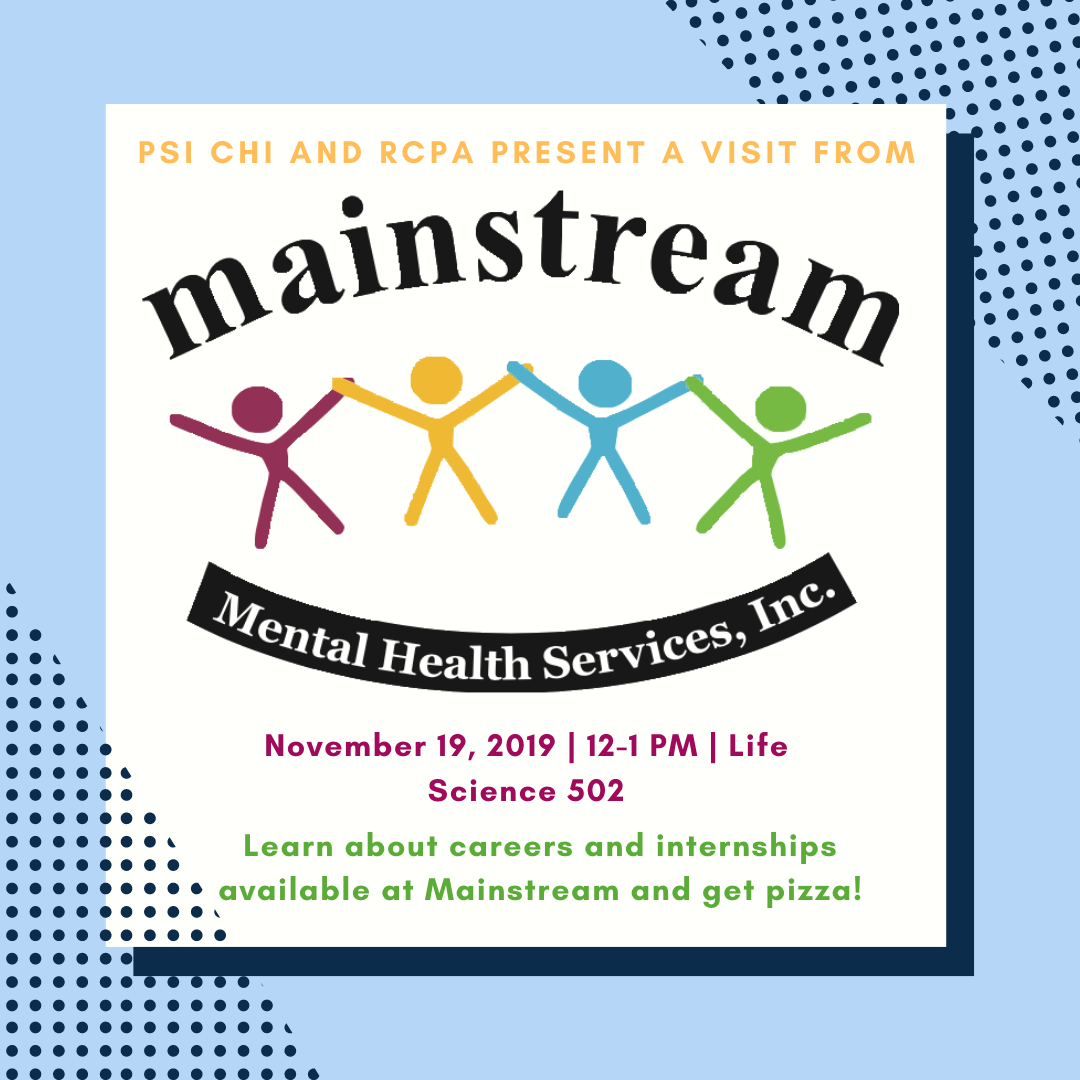
    On Tuesday, November 19 from 12:00-1:00 PM Mainstream Mental Health Services will be in LS 502. They will be discussing internships (which can start this coming spring or summer) and job opportunities that their organization offers, as well as careers in mental health in general.

    According to their website, Mainstream Mental Health Services, INC. believes in providing goal directed training to individuals in need to achieve and maintain independence in the most appropriate and least restrictive environment. It is our mission to enable eligible older adolescents and adults to acquire life skills and develop stronger family and community relationships that will enhance their quality of life in the mainstream community.

    If mental health interests you then stop by on Tuesday and check out the opportunities that Mainstream Mental Health Services has to offer!

    P.S. There will be pizza!

    Image result for dog pizza gif
    ©GIPHY

    .

    . 

    . 

    Get Connected!

    Bloghttps://psych.pages.roanoke.edu/
    Facebookhttps://www.facebook.com/rcpsychology
    Twitter: @RC_Psychology
    Linked In: https://www.linkedin.com/groups/RC-Psychology-8140491/about
    Website: https://www.roanoke.edu/inside/a-z_index/psychology
    Instagram: rcpsychology
  • ENHANCING YOUR RESUME, CV, AND LINKEDIN ONE SKILL AT A TIME!

    Naufel, K. Z., Appleby, D. C., Young, J., Van Kirk, J. F., Spencer, S. M., Rudmann, J., …Richmond, A. S. (2018). The skillful psychology student: Prepared for success in the 21st century workplace. Retrieved from: https:// www.apa.org/careers/resources/guides/transferable-skills.pdf

    “The Skillful Psychology student” guide shown above lays out skills that could be listed on a resume, CV and LinkedIn.  The graphic separates skills into five categories and lays out some of the most valued skills in each category.

    If you are looking to enhance the way you look to possible employers or future graduate schools then check it out!

    . 

    . 

    . 

    Get Connected!

    Bloghttps://psych.pages.roanoke.edu/
    Facebookhttps://www.facebook.com/rcpsychology
    Twitter: @RC_Psychology
    Linked In: https://www.linkedin.com/groups/RC-Psychology-8140491/about
    Website: https://www.roanoke.edu/inside/a-z_index/psychology
    Instagram: rcpsychology
  • The Literacy Lab

    Written by Rachel Harmon, edited by Brittney Rowe

    Interested in doing a year of service? Continue reading to learn more about the Literacy Lab!

    What? The Literacy Lab is an AmeriCorps partner program that helps to build strong readers in the Greater Richmond area, Hampton Roads, and other cities across the country. The Literacy Lab works to ensure that all students receive the help they need to read at a proficient level. The Literacy Lab trains and places full-time literacy tutors in schools to assess and coach students.

    When? Full-time capacity for 11-months from August 2019-July 2020.

    Why? The benefits of completing a year of service with the Literacy Lab include a modest living allowance, federal student loan forbearance, earning the Segal Education Award, transferable professional development skills and more!

    How? If you fit all of the requirements, and wish to apply for the Literacy Lab click here and hit the green APPLY button in the top right corner!

    To learn more about the Literacy lab click here or email recruitment@theliteracylab.org.

    .

    .

    .

    Get Connected!

    Bloghttps://psych.pages.roanoke.edu/
    Facebookhttps://www.facebook.com/rcpsychology
    Twitter: @RC_Psychology
    Linked In: https://www.linkedin.com/groups/RC-Psychology-8140491/about
    Website: https://www.roanoke.edu/inside/a-z_index/psychology
    Instagram: rcpsychology
  • CFF Summer Treatment Program Internship Opportunity

    Interested in gaining experience this summer working with children with ADHD and related behavioral, emotional and learning challenges?

    The Center for Children and Families at Florida International University offers training opportunities for both undergraduate and graduate students through their Summer Treatment Program to learn and help children improve their ‘problem-solving, academic functioning, and social skills.’

    The Summer Treatment Program focuses on providing evidence-based intensive treatments through group and tailored individual programs in a therapeutic summer camp style. The program is eight weeks. The children are divided into two programs according to their ages: STP Pre-K and STP Elementary.

    https://ccf.fiu.edu/opportunities/summer-treatment-program-opportunities-and-training/

    Available Spring 2019 positions include: 

    Things to Consider:

    There is no application deadline but CCF recommends applying early due to the program’s popularity.

    Room, board, and travel expenses are not covered by CCF. Accepted staff members interested in finding a roommate will have to do so themselves through social media.

    Dates, hours, salary, and responsibilities are subject to the different positions. According to CFF, once positions have been filled, applicants will be placed on a waiting list.

    Application: 

    Step 1: Online Application

    Step 2: Three (3) Letters of Recommendation from those indicated on the Online Application.

    Step 3: Official College or University Transcripts

    Have questions or want to know more? Please email stpjobs@fiu.edu.

    .

    .

    .

    Get Connected!

    Bloghttps://psych.pages.roanoke.edu/

    Facebookhttps://www.facebook.com/rcpsychology
    Twitter: @RC_Psychology

    Linked In: https://www.linkedin.com/groups/RC-Psychology-8140491/about
    Website: https://www.roanoke.edu/inside/a-z_index/psychology

    Instagram: rcpsychology