Category: Research

  • Casa de Esperanza: Hands of Hope Internship

    Interested in working with children after graduation?

    Casa de Esperanza, a non-profit in Houston, Texas, provides residential care to children from birth through six years of age. These children are in crisis due to abuse, neglect, or the effects of HIV. Among their different programs is the Hands of Hope internship.

    These interns, most of whom are recent college graduates, join the organization for a year working full-time. Interns live with the children they are caring for in agency homes, alongside generally three other interns who all share the responsibility of taking care of the children. One intern is designated the foster parent. Interns come from all across the United States. In addition to taking care of household needs, making sure they get to their appointments, and other such responsibilities, these interns also work with “case workers, psychological staff and community volunteers”.

    Other program benefits include:

    • Monthly stipend of $600
    • Health insurance
    • Life insurance
    • Two weeks paid vacation per year
    • Successful completion of internship award

    In order to apply, one must be 21 years old, willing to work full-time for a year, a valid U.S. Driver’s License, and a college degree is preferred. Furthermore, one must be in good physical shape and be flexible and patient.

    To learn more about Casa de Esperanza, their programs, and the requirements for Hands of Hope, click here to visit their website.

    Applications are open year-round. 

    .

    .

    .

    Get connected!
    Instagram & Twitter:  #PsychRC @RC_Psychology
    Facebook:  https://www.facebook.com/rcpsychology
    Blog:  https://psych.pages.roanoke.edu/
    Linked In:  https://www.linkedin.com/groups/RC-Psychology-8140491/about
    Website:  https://www.roanoke.edu/inside/a-z_index/psychology

  • Mental Health in Rural Appalachia

    Dr. Dane Hilton will be discussing mental health in rural Appalachia tomorrow (Wednesday, October 3rd) at 7:00 pm in Life Science 502.  Specifically, in terms of prevalent mental health diagnoses and problems with accessibility to treatment in these areas.

    This talk is sponsored by the Roanoke College Honors Program.

    All are welcome.

    Hope to see you there!

    .

    .

    .

    Get connected!
    Instagram & Twitter:  #PsychRC @RC_Psychology
    Facebook:  https://www.facebook.com/rcpsychology
    Blog:  https://psych.pages.roanoke.edu/
    Linked In:  https://www.linkedin.com/groups/RC-Psychology-8140491/about
    Website:  https://www.roanoke.edu/inside/a-z_index/psychology

  • Mindfulness Meditation: What It Is, What It Isn’t, and Why You Should Care

    Dr. Dane Hilton was asked by a student assistant to discuss mindfulness meditation, specifically about what mindfulness is and the many misconceptions regarding it. Thank you, Dr. Hilton, for taking time to write this post. Enjoy!

    ___________________________________________________________________________

    Mindfulness meditation is a topic that has exploded into the popular culture in the past 10-15 years. In 2018 alone, dozens of books have been published with Mindfulness as the main subject, with titles including Mindful Me: Mindfulness and Meditation for Kids by Whitney Stewart, Falling Awake: How to Practice Mindfulness in Everyday Life by Jon Kabat-Zinn, and the cutely illustrated A Sloth’s Guide to Mindfulness by Ton Mak. A quick search of Google Scholar for the term “mindfulness meditation” included in anything published in 2018 gets you 129,000 hits. I will admit I did not filter through all of those results to verify but the point is this: mindfulness is getting a lot of attention.

    As a researcher of mindfulness meditation, I am glad that this topic is getting its time in the limelight. Mindfulness has the potential to improve the lives of humans in a variety of ways, though the questions of how, in what ways, for whom, and under what circumstances are still up for debate and empirical examination. While I am happy on one hand, on the other hand I do worry about issues that arise with the rapid increase in interest surrounding mindfulness. As we all know, popular things are marketable things. They generate buzz, get people to click on your article or blog post (like this one!), and make publishers excited when you come to them with a “cutting edge” book that claims to cure all that ails you. When demand increases, everyone is more than happy to contribute to the supply. Unfortunately, that increased quantity doesn’t equal quality. Quite frankly- you may not even get what you think you are getting…So I want to briefly talk about what mindfulness is, clarify what it is not, and present some literature supporting why I still believe you should care.

    Let me be clear: mindfulness meditation is not new. It is not “cutting edge.” It is not a product of new technology or “third-wave” psychology or even a better understanding of human nature. Mindfulness is actually quite old. The mindfulness that most folks think of today is actually rooted in thousands of years of history in Eastern religions, including Judaism, Hinduism, and Buddhism. The practice itself is not new. What is new is the recognition by researchers in health and medicine that meditation can have profound physical and psychological effects on the body. I will mention some of these toward the end of this post. Regrettably, the influx of passengers on the mindfulness bandwagon- that, I must admit, includes me- has sometimes led to a watering down, or even total misrepresentation, of mindfulness.

    So what is mindfulness? Mindfulness, simply put, is an open and nonjudgmental stance toward one’s present moment experiences. In other words, mindfulness is an approach to existence marked by awareness and acceptance of the full spectrum of human experience- including all the things we think of as positive (e.g., joy, surprise, laughter, love), negative (e.g., sadness, fear, loss, anger), and anything in between. We can be mindful of physical sensations (e.g., breath, pain, fatigue), thoughts (e.g., “I’m awesome,” “I feel so stupid right now”), emotions (e.g., sadness, happiness, irritation), interactions with others, experiences of the outer world, and even our relationship to ourselves via our inner world. It is an approach to living that allows you to experience fully- embracing, rather than fighting, all the things that come with being human.

    So what is mindfulness not? It is not a “tool.” It is not one more technique you pull out of your grab bag of breathing exercises, stress relief tactics, and progressive muscle relaxation scripts to use when life starts getting to you. It is not a shield from the tension and busyness of this thing we call life. Despite the fact that mindfulness is clearly not meant to beat back hectic schedules, difficult relationships, troubling inner thoughts, or anxiety about impending deadlines, much of the information you will find on mindfulness presents as just that- a tool to guard against the horrors of 21st century life. Decreased stress, increased sense of well-being, better clarity of thought, and improved psychological functioning are certainly potential byproducts of regular mindfulness practice but to say that you should engage in mindfulness with those things as the goal is to totally miss the point. All the cool effects of mindfulness that make for attention grabbing headlines are, in fact, just side effects of a more open, aware, and accepting approach to the stuff life slings our way.

    Another thing that mindfulness is not is a religion. I think this is an important distinction because in my short time practicing mindfulness and talking with others about it, the issue of whether mindfulness is indicative of a specific religious group or set of beliefs is often a sticking point and potential barrier to individuals looking further into it. While mindfulness meditation certainly does have roots in religion and can even be traced back to specific religious teachings, as I mentioned a few paragraphs back, the basic tenets of mindfulness meditation can fit within any number of worldviews and beliefs. If you believe that life happens now- not 5 seconds ago or 5 seconds from now- then mindfulness might just be for you.

    So now that we have a brief outline for what mindfulness is and what it is not, we still have the question of why you should care. The first reason I will suggest is simply an opinion- and probably a philosophical one at that. Life is happening now. Life is happening in this present moment and once that moment passes, it is gone for good. A mindful stance to life helps us to experience these moments more fully- in essence, living more fully. Maybe it’s just me but I don’t want my life to pass by not having had the chance to truly live it. The second reason comes from my practical and scientific side- mindfulness appears to be immensely beneficial to those who practice it. As I said earlier- health and wellness are not the explicit goals of mindfulness practice, but it does have some super nice side effects.

    Mindfulness practice has been associated with improved cognitive functioning (Zeidan et al., 2010), fewer depression and anxiety symptoms (Chiesa & Serretti, 2011; Hofmann et al., 2010), improved adjustment to major health problems (e.g., cancer diagnosis; Ledesma & Kumano, 2008), less pain and improved functioning in those with chronic pain (Zeidan et al., 2012), greater engagement in positive health behaviors (Jacobs et al., 2016), improved self-regulation and greater resilience in children (Coholic et al., 2012; Semple et al., 2010), and functional brain changes in areas associated with self-regulation/emotion regulation, higher cognitive function, and memory, among other functions (Gotnik et al., 2016; Gartenschläger et al., 2017). This isn’t even close to a comprehensive list but you can check this article for a well-written overview of some of the benefits of mindfulness practice. There is a reason so many people are studying mindfulness and other forms of meditation. It is an exciting time in research as we come to better understand the numerous effects of mindfulness and the mechanisms by which these effects occur.

    I will end this post with a final thought on our conceptualization of mindfulness. You may have seen a picture depicting a cartoon human whose thought bubble is “mind full” while his cartoon dog’s thought bubble is “mindful.” The dog is supposedly more mindful because his thought bubble reflects the environment he is in- sun, grass, trees- while the human’s mind is filled with busyness- thoughts of other people, cars, music, bills, etc. I get the artist’s intention but I still think this misses the mark. Part of being human is that our minds are often wild and out of control. Even in this state, we can be mindful of our experience. It is when we stop fighting against the experience of the moment that we can start to appreciate living in the moment. This is mindfulness.

    .

    .

    .

    Get connected!
    Instagram & Twitter:  #PsychRC @RC_Psychology
    Facebook:  https://www.facebook.com/rcpsychology
    Blog:  https://psych.pages.roanoke.edu/
    Linked In:  https://www.linkedin.com/groups/RC-Psychology-8140491/about
    Website:  https://www.roanoke.edu/inside/a-z_index/psychology

  • A Brief Interview with Dr. Stacy Wetmore

    The following is a brief interview with Dr. Stacy Wetmore, a new tenure-track professor at Roanoke College. A student assistant was recently able to interview her to learn more about her, her interests, and some cool facts that readers may not know. There’s a picture of a cute puppy at the end of this interview: keep reading to see it.

    So, how do you like Roanoke so far? Is it very different from what you’re used to?

    So far, I’m loving it!! I’m excited that the semester is underway and I get to teach some really interesting topics. I like that I have fairly small class sizes and I will know all of my students’ names in no time. RC is similar in a lot of ways to where I most recently taught, so now it’s just a matter of learning the little quirks about how about things work here.  One thing that is a little different are the class times, so I’m always a bit nervous I’m going to be late!

    Where did you go to undergraduate and graduate school?

    University of Oklahoma

    For my undergraduate (BA in Psychology) and Master’s degree (Experimental Psychology) I was at The University of Alabama in Huntsville. And I got my PhD from the University of Oklahoma. (Dr. Osterman and I actually met there many years ago!!!).

    What classes are you teaching right now and what types of courses will you be teaching in the future?

    Currently, I’m teaching two sections of the INQ 260 Psychology in the Media, and one PSYC 101 Introduction to Psychology. In the near future, I’ll be teaching Cognitive Psych and Research Methods.  I will also be developing (over the upcoming years) a new INQ 110, a Memory course, and a Psychology and Law/Forensic Psych course as well.

    What are some of your past and current research experiences and interests?

    Founders Building, Egham, England.

    My most exciting research experience was getting to be a Postdoctoral Researcher at Royal Holloway, University of London, in Egham, England. I hadn’t yet finished my dissertation, but accepted a position overseas to work on a project evaluating the U.K.’s eyewitness identification system/technique. I got to be a researcher, without any teaching responsibilities for 1.5 years and learned a lot of new stuff, as well as did research that could inform policy abroad.

    In terms of research interests, Dr. Wetmore explains…

    The overall focus of my research examines the intersection between cognition and the legal system. Research that I have been involved in, thus far, has been in three major areas.

    Dr. Wetmore

    The first is research on jailhouse informants. Jailhouse informants are a leading cause of wrongful conviction, yet very little is known about this form of evidence, including how jurors perceive and weigh this information, and if there are effective safeguards against it.

    Another cause of wrongful conviction that I have studied are eyewitness identifications. Specifically, my research focused on show-up identification procedures, in which the individual must make a decision from a single face. My colleagues and I found that the show-up was a more unreliable memory test than a more traditional six-pack lineup. I’m interested in developing other procedures or methods of evaluating eyewitness memory in order to make it a more effective source of evidence at trial.

    Lastly, related to eyewitness identifications, I’m interested in facial processing and memory in general. Humans are made specially to be able to process faces super-fast and efficiently, however there are still instances when this mechanism breaks down and I’m interested in examining these instances when it falters. For instance, a well-known phenomenon is the cross-race effect, or own-race bias, in which we are better at identifying someone from our own race better than from another race. Although we know the phenomenon exists, little is known about what cognitively could be different in the processing so I want to investigate this issue further.

    What are some random/cool facts about you?

    • I was a collegiate athlete in tennis.
    • I lived abroad for 2 years in England as a postdoctoral researcher.

      Dr. Wetmore’s adorable puppy, Daisy.
    • Super allergic to 100% grape juice – but can drink the not healthy stuff, wine, and eat grapes… I think this fits under random.

    Is there anything else that you’d like to mention?

    I have the cutest (I might be biased) 7 month old puppy, Daisy, that I walk around campus every morning between 6-7 (depending on when I can drag myself out of bed) and every evening, so anyone who runs into us is welcome to say hello. 🙂

    Thank you Dr. Wetmore for taking your time to answer our questions, and welcome again to Roanoke College! We are glad to have you here (and Daisy too)!


    Get connected!
    Instagram & Twitter:  #PsychRC @RC_Psychology
    Facebook:  https://www.facebook.com/rcpsychology
    Blog:  https://psych.pages.roanoke.edu/
    Linked In:  https://www.linkedin.com/groups/RC-Psychology-8140491/about
    Website:  https://www.roanoke.edu/inside/a-z_index/psychology

  • A Brief Interview with Dr. Dane Hilton

    A student assistant for the psychology department recently interviewed Dr. Dane Hilton, a new faculty member this semester, about himself, his interests in psychology, and some other little-known facts.

    The following is the interview:

    So, how do you like Roanoke so far? Is it very different from Alabama?

    I have really enjoyed settling into the Roanoke area. It is a good bit different from Alabama geographically, as Alabama is fairly flat where I lived in Tuscaloosa. At the same time, I’m from western North Carolina originally and spent five years in Boone for school, so being back in the Appalachian region is kind of like coming home. The area reminds me a lot of some of the cooler places I’ve visited in the south east- it’s a bit like Chattanooga, Birmingham, and Asheville, NC all rolled into one compact and livable place. The college is beautiful and I’ve really loved how down to earth and friendly everyone is. That is one thing that is not different from Alabama- everyone is super friendly!

    Where did you go to undergrad and grad school?

    I did my bachelor’s at Appalachian State University in psychology and then stayed for two more years to get my master’s in Clinical Health Psychology. I then moved to Tuscaloosa, AL and did three years at The University of Alabama for my PhD in Clinical Child Psychology. Finally, I did my pre-doctoral internship- a year-long clinical residency- at the WVU-Charleston Division School of Medicine in Charleston, WV. It’s been a long road…

    What classes are you teaching right now and what types of courses will you be teaching in the future?

    Right now I’m teaching Psychology in the Media and Personality Psychology. I think both of these courses will stay in my rotation for a few years but I will also be teaching Intro to Psychology, Abnormal Psychology, Clinical Psychology, and hopefully a course in Applied Behavior Analysis at some point in the future.

    What are some of your past and current research experiences and interests?

    My research has always been related to individuals with Attention-Deficit/Hyperactivity Disorder (ADHD) in some way, and I will likely continue this line of research for many more years. My primary research program is focused on understanding the relationship between executive function- an important set of cognitive skills- and social functioning in folks with and without ADHD. I also do intervention research- again, primarily in the area of ADHD. I am currently working with the WVU Department of Behavioral Medicine to study the mechanisms of treatment outcome in group-based behavioral parent training for ADHD. I was awarded a grant while on internship to conduct this research and our group plans on applying for a larger grant to continue studying these processes in the next year or two. Lastly, I study mindfulness meditation. I have been leading mindfulness meditation groups for about 5 years and studying the effects regular mindfulness practices have on ADHD symptoms, anxiety, depression, and mind-wandering. I’m currently talking with individuals at RC to begin developing various ways to integrate mindfulness practice into curriculum, wellness programs, and intervention groups.

    What are some random/cool facts about you?

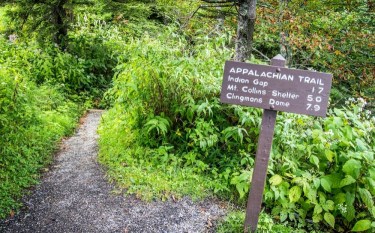
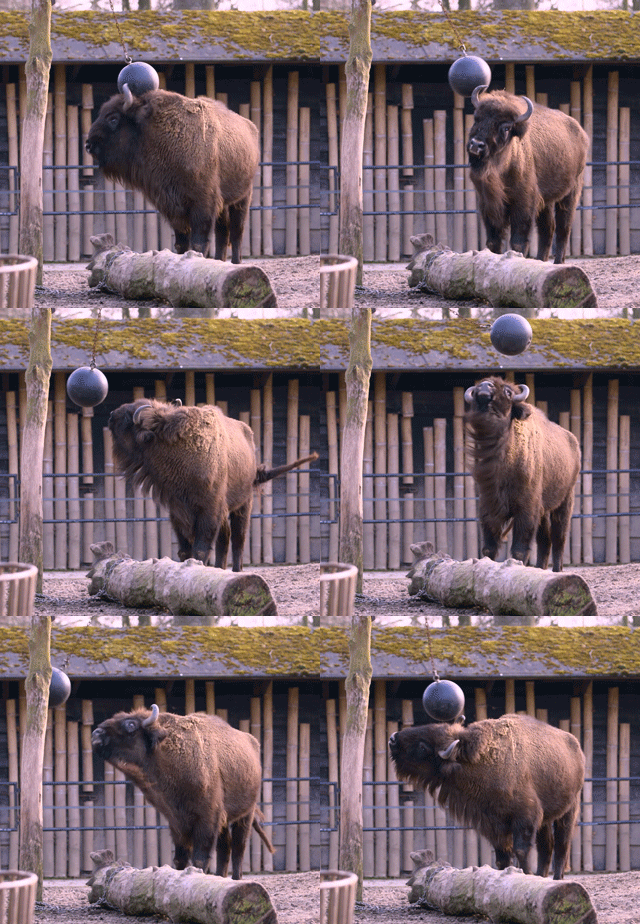
    Before starting graduate school at Appalachian State, I seriously considered becoming a bison farmer- yes, those giant looking beasts in all the Yellowstone pictures. It was between that and psychology. I honestly think I would have been happy doing either but I’m glad I’m here now. Some other random stuff… I was able to dunk a basketball in eighth grade, I once recorded an album in Chapel Hill, NC with my former folk band Foscoe, and I have hiked over 100 miles of the Appalachian Trail with my wife. That pretty much exhausts my cool facts reservoir…

    Is there anything else that you’d like to mention?

    Just that I am super excited to be at Roanoke. The psychology department is full of fabulous teacher-scholars who are also super chill and fun to be around. I look forward to getting to know the students here and being a part of the really great community that exists at RC.

    Welcome to Roanoke College, Dr. Hilton! We are glad to have you here in the Psychology Department, although being a bison farmer sounds pretty great too.


    Get connected!
    Instagram & Twitter:  #PsychRC @RC_Psychology
    Facebook:  https://www.facebook.com/rcpsychology
    Blog:  https://psych.pages.roanoke.edu/
    Linked In:  https://www.linkedin.com/groups/RC-Psychology-8140491/about
    Website:  https://www.roanoke.edu/inside/a-z_index/psychology

  • Research Poster Session Spring ’18

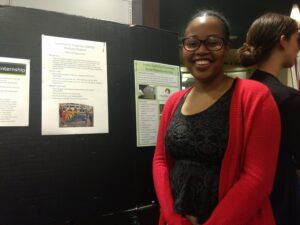
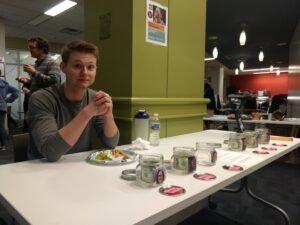
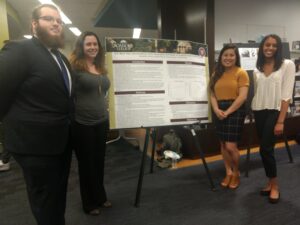
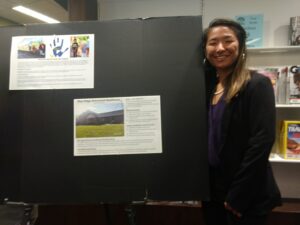
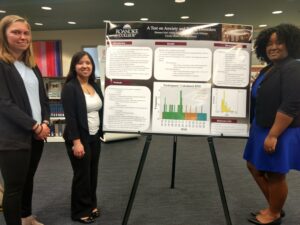
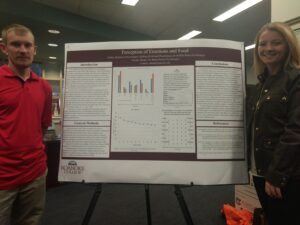
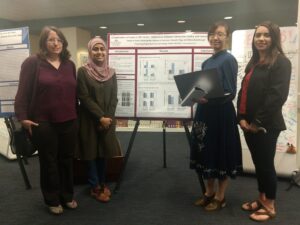
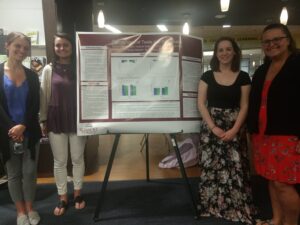
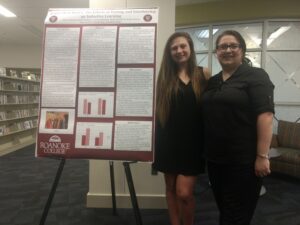
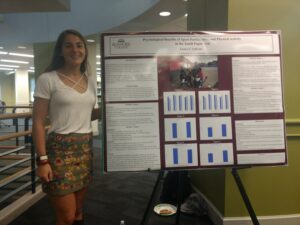
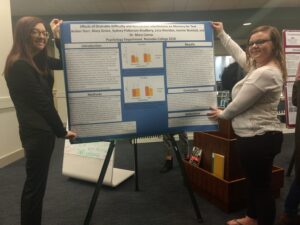
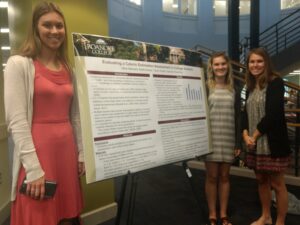
    The Psychology Department hosted their research poster session on Thursday, April 19th 2018. Many students presented on their research projects and internships; students were also able to donate to the American Foundation for Suicide Prevention while choosing which professor they’d like to see pied with whipping cream and sprinkles. Great job to everyone who presented and thanks to everyone who came!

    Get connected!
    Instagram & Twitter:  #PsychRC @RC_Psychology
    Facebook:  https://www.facebook.com/rcpsychology
    Blog:  https://psych.pages.roanoke.edu/
    Linked In:  https://www.linkedin.com/groups/RC-Psychology-8140491/about
    Website:  https://www.roanoke.edu/inside/a-z_index/psychology

  • Pie a Prof!

    It’s that time of the year!

    Stop by the table outside of Colket or by the box in the hallway of the 5th floor to choose your victim(s) to get pied! The professor with the most money in their jar will get a special pie, with sprinkles.

    All proceeds will go to The American Foundation for Suicide Prevention.

    Hope to see you there!

    Get connected!
    Instagram & Twitter:  #PsychRC @RC_Psychology
    Facebook:  https://www.facebook.com/rcpsychology
    Blog:  https://psych.pages.roanoke.edu/
    Linked In:  https://www.linkedin.com/groups/RC-Psychology-8140491/about
    Website:  https://www.roanoke.edu/inside/a-z_index/psychology

  • Mr. Dane Hilton is Looking for Student Research Assistants!

    Dr. Dane Hilton, a new faculty member in the Department of Psychology, is recruiting student research assistants to start in the fall.

    The research conducted in the lab will focus on:

    • Cognitive mechanisms of social encoding
    • Mindfulness meditation and other alternative treatments for self-regulatory deficits
    • Improving measurement of social information processing
    • The use of technology in psychotherapy research/intervention
    • Treatment mechanisms in ADHD Parent Training

    He is looking for research assistants who:

    • Are conscientious and hard-working
    • Have excellent time-management skills
    • Are intellectually curious
    • Interested in ADHD, executive function, or social interaction (preferred, not required)
    • Are familiar with MS Office/Google Docs
    • Have some familiarity with research methods and statistics (preferred, not required)
    • Interested in applying technology (e.g., smartphones, activity trackers, etc.) to research (not required)

    Research assistants will be involved with many aspects of the research process, including developing experimental materials, data collection (in and outside of the lab), data entry, and literature reviews. Highly motivated students will have opportunities for more involvement in study design, statistical analysis, and other more advanced aspects of the research process.

    Interested students from all class years are encouraged to contact Dr. Hilton for an application (dchilton@crimson.ua.edu).

    Get connected!
    Instagram & Twitter:  #PsychRC @RC_Psychology
    Facebook:  https://www.facebook.com/rcpsychology
    Blog:  https://psych.pages.roanoke.edu/
    Linked In:  https://www.linkedin.com/groups/RC-Psychology-8140491/about
    Website:  https://www.roanoke.edu/inside/a-z_index/psychology

  • Welcome Dr. Dane Hilton!

    The Psychology Department would like to welcome Dr. Dane Hilton as our newest tenure-track professor starting this upcoming fall semester. Dr. Hilton obtained his Masters in Clinical Health Psychology from Appalachian State University and his PhD in Clinical Child Psychology from the University of Alabama.

    At Roanoke, Dr. Hilton will be teaching courses such as Abnormal, Personality, and Clinical Psychology. His research interests focus specifically on social encoding, executive functioning, and mindfulness. Dr. Hilton has conducted research on social skills in youth and emerging adults, especially those with ADHD, and on psycho-social interventions for those with executive functioning deficits.

    Dr. Hilton is currently looking for student research assistants to start next semester. If you’re interested, follow this link to learn more.

    Welcome again to Dr. Hilton! We are excited for him to be joining the department!

    Get connected!
    Instagram & Twitter:  #PsychRC @RC_Psychology
    Facebook:  https://www.facebook.com/rcpsychology
    Blog:  https://psych.pages.roanoke.edu/
    Linked In:  https://www.linkedin.com/groups/RC-Psychology-8140491/about
    Website:  https://www.roanoke.edu/inside/a-z_index/psychology

  • Alumni Career Fair!

    Are you looking for internships? Job opportunities? Then consider attending to Alumni Career Fair! The event will be held on Thursday, April 12th, from 5-7 pm on the main level of Colket.

    Why should you attend? According to Director McLawhorn of Career Services, alumni from around 30 companies/organizations/career fields of various industries and geographic locations will be there to share about their career fields, as well as provide information about internships and/or job opportunities that may be available at their respective places of employment.

    Some company recruiters will be there as well.

    Things you should know before you go: 

    • Neat, but casual clothing is fine.
    • It’s highly suggested that students bring resumes, but they are not required. (Students can contact Career Services for assistance with resumes prior to April 12.)
    • There will be door prizes.

    Get connected!
    Instagram & Twitter:  #PsychRC @RC_Psychology
    Facebook:  https://www.facebook.com/rcpsychology
    Blog:  https://psych.pages.roanoke.edu/
    Linked In:  https://www.linkedin.com/groups/RC-Psychology-8140491/about
    Website:  https://www.roanoke.edu/inside/a-z_index/psychology