UVA Educational Psych – Applied Developmental Science Master’s Program is still accepting applications!
If you are interested in learning more about how developmental processes impact learning in an educational and community environment, and enjoy conducting research to improve the lives of youth, then this program would be a great fit for you!
The Applied Developmental Science Master’s Program at UVA is 12 month long and gives you the opportunity to work with and learn from their supportive faculty. You will learn more about human development, educational psychology, and research methods. As part of this program, you are expected to complete a 6 credit (200 hour) internship with a local lab or community-based organization.
What can you do with this degree? Graduates go on to become educators, researchers, or consultants working in a variety of settings including schools, labs, and non-profit organizations.
Applications are due May 15th, and the program has a new start date of June 3rd. To learn more about the program click HERE.
Click on the image to go to SRCD’s official website.
Overview:
The second part of the blog posts discussing the students and professors who traveled to Baltimore on March 21st through 23rd to present research at the Society for Research in Child Development Biennial Conference, this post will focus on Dr. Powell’s Research Lab.
Students and professors presented research through six different poster presentations, as well as one essay presentation that was part of a symposium. Dr. FVN and Dr. Powell presented one poster together, titled “Variations on a Lifespan Development Project Intended to Enhance Quality of Student Outcomes and Reflection of Reality.” Dr. Buchholz’s and Dr. FVN’s labs collaborated to present their work on “Early Adolescent Cognitive and Affective Empathy: Direct and Interactive Ties to Social-Emotional Adjustment.”
The students who traveled include: Taylor Kracht ’18 (alumna; Dr. Powell’s lab), Cody Dillon-Owens ’19 (worked with both Dr. FVN and Dr. Buchholz; officially part of Dr. Buchholz’s lab), Aislinn Foutz ’19 (Dr. FVN’s lab), Kiah Coflin ’19 (Dr. Powell’s lab), Ciprianna Azar ’19 (Dr. FVN’s lab), Rachel Harmon ’20 (Dr. Powell’s lab) , and Alaina Birkel ’21 (Dr. Powell’s lab).
Descriptions of the presentations have been included to learn more about the types of research the two labs are doing.
Left to right: Dr. Powell. Alaina Birkel, and Taylor Kracht
Dr. Powell’s Research Lab
Statements:
Dr. Powell:
The first disciplinary conference that I attended was SRCD during my senior year of college. I was not presenting that year, but rather I tagged along with the faculty member and graduate students with whom I was working. I am very appreciative that Roanoke College also supports undergraduates to attend and present at disciplinary conferences! Hearing the students enthusiastically discuss the scholars they heard from and the ideas it provoked related to their research between sessions and over group dinners is exactly why I encourage my research assistants to attend a disciplinary conference.
SRCD’s biennial conference is quite large and so it can be difficult choosing between sessions to attend, as so many overlap at a single time. However, I was able to attend several that are related to my research agenda as well as a few related to topics that I teach in my Life-Span and Child Development courses. Another thing that I make it a point to do at conferences is to reconnect with colleagues. My Alma mater, WVU, hosted a social for current students and alumni of their developmental program, and I was able to grab lunch with a few other colleagues. It was enjoyable catching up with them and updating each other on the status of our careers.
Left to right: Dr. Powell, Rachel Harmon, and Kiah Coflin
Kiah Coflin ’19:
This year’s biennial SRCD conference was held at the Baltimore convention center and it was huge! I have attended a poster presentation before, but my expectations were exceeded by SRCD, its number of intriguing speakers and talk topics, and its overall expanse across the convention center. It was certainly unique to see so many approaches to childhood and development, and an incredible experience to network with other students, professors, and scholars!
Personally, I presented a poster with my fellow lab mate, Rachel Harmon, on preliminary data exploring the impact of short-term, study-abroad programs on the Intercultural Competencies (ICCs) of Emerging Adults (EAs)… AKA I got to talk about my amazing May Term! We discussed the changes my May Term class perceived in our ICCs from a month before our trip, the middle of our trip, and a week after we returned. Our poster was well received and many were interested in how the data collection will progress when Dr. Powell continues to bring more students on future May Terms to Thailand!
Who says conferences can’t be fun? – Left to right: Kiah Coflin, Rachel Harmon, Alaina Birkel, and Dr. Powell
Posters:
Overall, there were three posters presented from this lab, though one was presented by Dr. FVN and Dr. Powell.
This particular poster was presented at the “Developmental Teaching Institute pre-conference on possible modifications to the life-span paper project.”
Left to right: Dr. Powell and Dr. FVN
The other two posters were presented by students and Dr. Powell. As mentioned above, Kiah Coflin, Dr. Powell, and Rachel Harmon discussed their findings in conjunction with Dr. Nipat Pichayayothin of Chulalongkorn University “on the development of students’ intercultural competencies” during their May Term course to Thailand in 2017.
The other poster was presented by Taylor Kracht (an alumna, now studying at William & Mary), and Alaina Birkel, who presented a poster based on Kracht’s “Honors in the Major project at the conference on how emerging adults’ implicit theories of relationships can be modified after watching certain types of romantic media.”
Interested in doing a year of service? Continue reading to learn more about the Literacy Lab!
What? The Literacy Lab is an AmeriCorps partner program that helps to build strong readers in the Greater Richmond area, Hampton Roads, and other cities across the country. The Literacy Lab works to ensure that all students receive the help they need to read at a proficient level. The Literacy Lab trains and places full-time literacy tutors in schools to assess and coach students.
When? Full-time capacity for 11-months from August 2019-July 2020.
Why? The benefits of completing a year of service with the Literacy Lab include a modest living allowance, federal student loan forbearance, earning the Segal Education Award, transferable professional development skills and more!
How? If you fit all of the requirements, and wish to apply for the Literacy Lab click here and hit the green APPLY button in the top right corner!
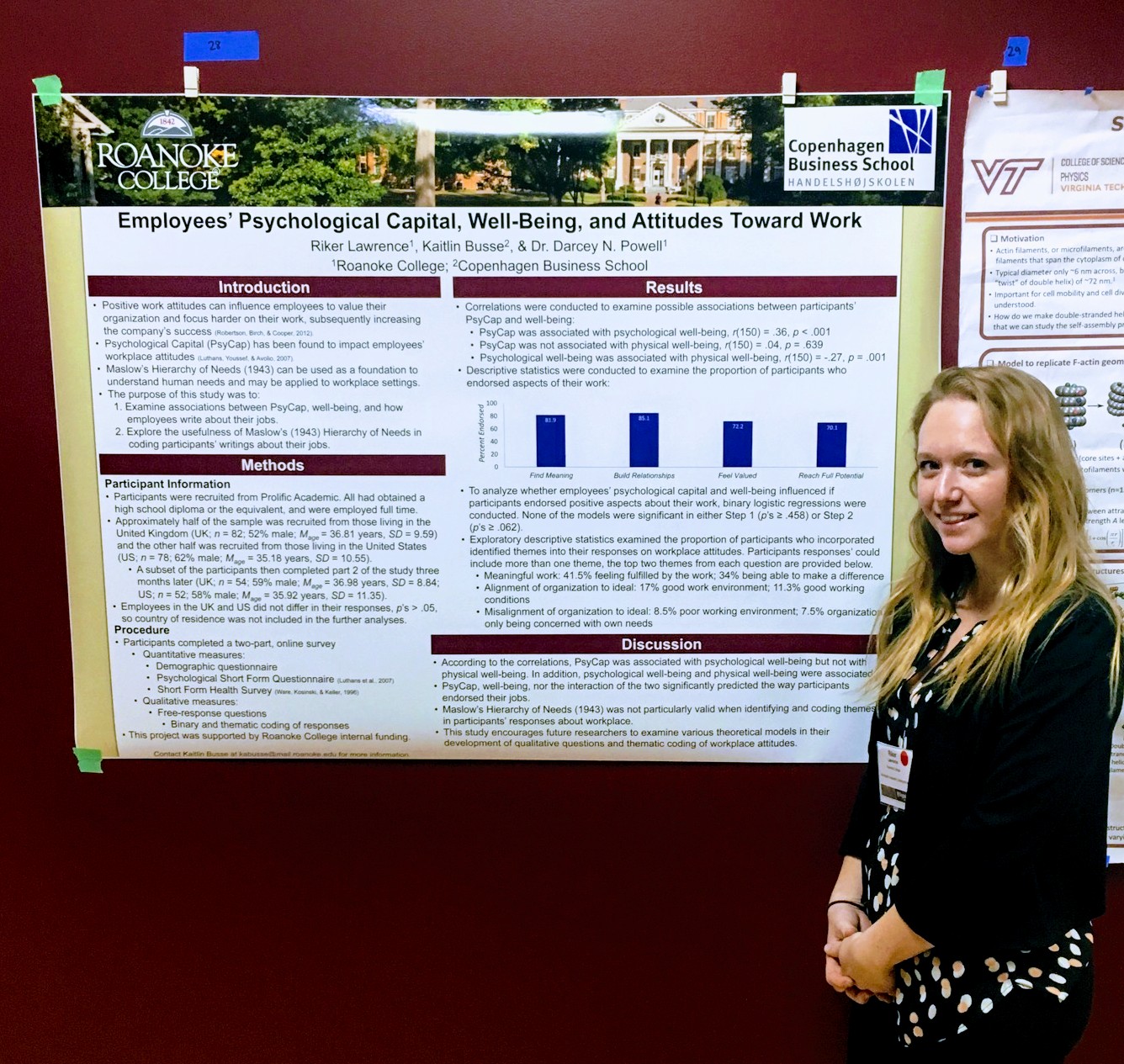
Riker Lawrence ’21 discusses her experience presenting at the Mid-Atlantic Undergraduate Research Conference below.
Attending the Mid-Atlantic Undergraduate Research Conference last weekend was an interesting experience for me. In the past, I have attended conferences that mainly focused on behavioral science. This conference included multiple different fields of research, so I learned many new concepts in fields such as physics, wood science, and chemistry. I enjoyed learning about information that I wouldn’t normally research on in my specific field. My poster presentation focused on Psychological Capital (PsyCap) and workplace attitudes. Specifically, my lab mate and I examined associations between PsyCap, well-being, and how employees write about their jobs. We also explored the usefulness of Maslow’s (1943) Hierarchy of Needs in coding participants’ writings about their jobs, because his theory can be used to explain human needs. Overall, I thought the conference was well organized and provided a good research experience to undergraduates.
Congratulations to Lawrence for her successful presentation on Psychological Capital and workplace attitudes!
Molly Zydel discusses her recent presentation at JMU for the 10th Annual MadRush Undergraduate Conference below.
I presented part of my Honors in the Major/Distinction Project at the 10th Annual MadRush Undergraduate Conference hosted by James Madison University on Saturday, March 16th. The presentation focused on part of the larger project, which seeks to understand foster parents’ perceptions of former foster care youth, former foster care youth’s perceptions of themselves, and college students perceptions of former foster care youth on different aspects of their academic identity, specifically academic self-efficacy, resiliency, and academic expectations and attainment. The presentation at MadRush focused on the data I have collected from foster parents concerning their perceptions of foster care youth on these constructs.
Rather than your typical poster presentation session, I had the chance to give an actual presentation in front of a room concerning the project. The presentation went very well, as did the following discussion. The session consisted of 3 total presentations, all from different disciplines, that all in some way focused on populations of youth who are not the normal. There was a presentation on juvenile sex offenders, one on the orphan trains, and my presentation. It went very well, and it was interesting to see how different disciplines connect together to engage in a conversation about youth from different perspectives. Overall, I enjoyed the conference!
Thank you to Molly Zydel for taking time to tell us about her research and presentation at MadRush! Congratulations on your successful presentation and we look forward to seeing what you will do in the future!
Interested in gaining experience this summer working with children with ADHD and related behavioral, emotional and learning challenges?
The Center for Children and Families at Florida International University offers training opportunities for both undergraduate and graduate students through their Summer Treatment Program to learn and help children improve their ‘problem-solving, academic functioning, and social skills.’
The Summer Treatment Program focuses on providing evidence-based intensive treatments through group and tailored individual programs in a therapeutic summer camp style. The program is eight weeks. The children are divided into two programs according to their ages: STP Pre-K and STP Elementary.
There is no applicationdeadline but CCF recommends applying early due to the program’s popularity.
Room, board, and travel expenses are not covered by CCF. Accepted staff members interested in finding a roommate will have to do so themselves through social media.
Dates, hours, salary, and responsibilities are subject to the different positions. According to CFF, once positions have been filled, applicants will be placed on a waiting list.
Application:
Step 1: Online Application
Step 2: Three (3) Letters of Recommendation from those indicated on the Online Application.
Step 3: Official College or University Transcripts
Have questions or want to know more? Please email stpjobs@fiu.edu.
Beth Macy, Fintel Library on 5 February 2019 (c) Brittney Rowe
On Tuesday, February 5th in Fintel Library as part of Psi Chi’s Q&A, Beth Macy, author of Dopesick, spent some time answering questions and talking with students and faculty.
Snacks and drinks were provided.
The video encapsulates the event, but read on to learn more from Dr. Angela Allen’s perspective.
Beth Macy, the author of the 2018 nonfiction book Dopesick, visited the Roanoke College community for several days in early February. Dopesick is a compelling read about the impact of opioid addiction in several communities and the struggle of those who try, often repeatedly, to cease use. Much has been written about addiction, but this book really brought home the human impact and reminded the reader that the addicts are sons, daughters, parents, siblings who are loved and valued. The book also illustrated how frustrating the treatment process is for the users and their families, especially given that medication-assisted treatment has demonstrably the best outcome but yet meets with a great deal of opposition from many quarters. As a mom myself, I really felt for the parents of users who loved their children and wanted to help them, yet often found themselves overwhelmed and feeling helpless in the process.
Beth Macy talking with group about the opioid crisis, Fintel Library, 5 February 2019 (c) Brittney Rowe
Beth met informally with a group of our psychology students on February 5. She presented a heartfelt account of the opioid crises and how it has impacted the lives of so many Americans. She spoke about the fact that opioid addiction is something that can and does happen to people from every background, illustrating this point with stories of a young local woman from a well-off family who became addicted after taking opioids medicinally and ultimately met a tragic end. She spoke passionately about how misconceptions of addiction and of medication as treatment for addiction are limiting the options for people who are addicted, and that it is often literally a life or death situation. Students asked her what they could do to help, and she talked about being politically involved, educating people about medication as a treatment for addiction, and even learning how to carry and use the opioid antagonist Narcan. My own students later commented that they had not realized how difficult treatment can be to access and that drug courts and needle exchanges could have real benefits to users as well as the communities around them. While reading about these addiction and treatment is very informative, it was a great experience to hear directly from Beth and to be able to ask questions. It would be fantastic if the community can use the information from this experience to improve the lots of users and their families.
Beth Macy and a student, Fintel Library on the 5 February, 2019 (c) Brittney Rowe
Interested in interning somewhere but not sure where to start? Come to the Psychology Internship Information Session on Tuesday, February 26th from 11:45 – 1:00 pm in Life Science 502 to learn more.
As always, pizza will be provided, but please bring your own drink.
If you are interested, please RSVP by Monday, February 25th at noon by either calling (540)375-2462 or emailing Mrs. Ellen Dyer at dyer@roanoke.edu. This is so that we know how much pizza to order.
Congratulations to Aislinn Foutz ’19 for her successful Honors in the Major and Honors Distinction Project defense last semester! Her project was titled “Parental and Peer Factors in Children’s Theory of Mind Development” and Dr. Findley-Van Nostrand was her advisor. Foutz is now working towards building off of this work and applying to graduate programs to continue studying Theory of Mind. She also has a presentation under review to present this work at the Society for Research on Child Development in the Spring.
Aislinn Foutz describes her project and how she felt about defending it below:
For my Honors in the Major/Distinction Project, I collected parent-reports of children’s theory of mind and various other parental and peer/social variables and found a number of significant associations. For instance, theory of mind was positively associated with variables such as parental willingness to serve as an attachment figure, closeness in parent-child relationships, mind-mindedness, and pro-social behavior, whereas theory of mind was negatively associated with conflict in parent-child relationships and various peer difficulties (e.g., peer problems). Follow-up analyses revealed child age, closeness, and mind-mindedness seem to be especially important to children’s theory of mind development, and that, although these associations were significant throughout early, middle, and late childhood, the closeness-theory of mind relationship was strongest in early childhood. I am aiming to extend this research in several ways, primarily by examining how various sub-types of theory of mind (e.g., belief and desire) may relate differently to these parental and peer factors.
Dr. Findley-Van Nostrand was my research mentor for this project and working with her was a great experience. Whenever I needed help, she was always readily available. She also helped me sharpen my research skills while challenging me to learn new ones.
Although I was nervous for my defense, I was also excited for the opportunity to share my research. Successfully defending my distinction/honors in the major project was a rewarding experience, and now I’m looking forward to continuing to extend this research.
Congratulations again to Aislinn Foutz ’19! Thank you for taking time to answer our questions! We look forward to seeing what you will accomplish in the future.
Last semester, psychology students gathered on the first floor of Fintel Library to present their research findings as well as to discuss their internship experiences from that semester.
The first floor was packed with students and professors milling around, listening to students’ presentations during the open block.
Student Lauren Furlow reported that all sixteen boxes of pizza disappeared within eleven minutes of the event’s start.
Mrs. Ellen Dyer, secretary of the Biology and Psychology Departments, confirmed this report.
Overall, the Fall 2018 Psychology Research Poster Session was a great success! Thank you to everyone who presented or came to listen. We look forward to seeing what interesting projects will be presented in the semesters to come!








 peer problems). Follow-up analyses revealed child age, closeness, and mind-mindedness seem to be especially important to children’s theory of mind development, and that, although these associations were significant throughout early, middle, and late childhood, the closeness-theory of mind relationship was strongest in early childhood. I am aiming to extend this research in several ways, primarily by examining how various sub-types of theory of mind (e.g., belief and desire) may relate differently to these parental and peer factors.