Category: Advice/Tips

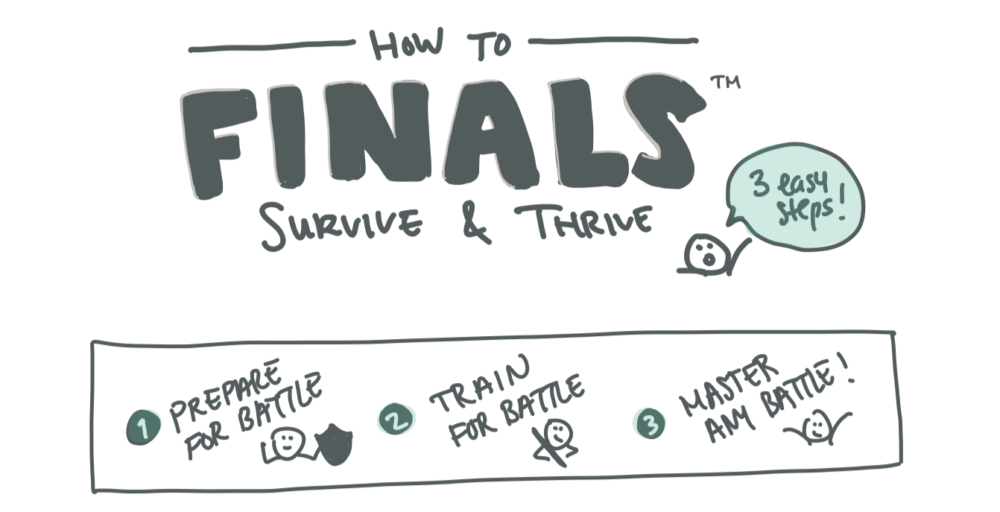
  • How to Finesse Finals Week

    © MIT ADMISSIONS

    It is that time of the year again: Finals! Albeit much earlier in the year, next week marks the finish line for the fall semester. This is both a very exciting and stressful time because you are so close, but you may have so much more left to do.

    A few days ago, we reached out to students on Instagram to ask how they prepared for finals. We received some great advice such as “Prioritizing sleep and eating over late-night study cramming” and “Organizing printed notes and making physical notecards”.

    Keep reading for more helpful advice about stress management and how to succeed during finals next week!College-wide events:

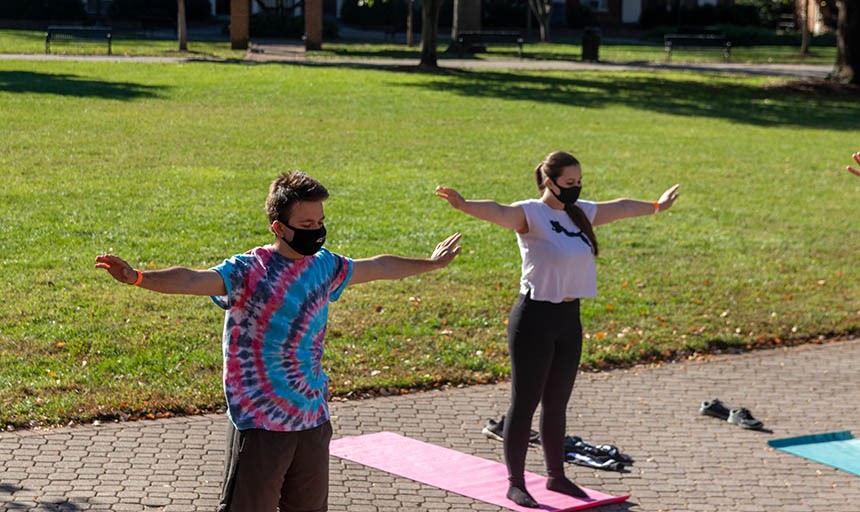
    Yoga for Stress Relief

    There will be an online via zoom and in person yoga session.

    When: Monday November 16th, 2020

    Time: 3:00 PM to 4:00

    Where: Bast 138 and on zoom

    To learn more contact Colleen Quigley, cquigley@roanoke.edu.

    In the Moment: Creative Practices for Medication and Wellness

    Amy Herzel, a visual artist whose work is focused on meditative practice is hosting a workshop about using creative practices as a method of meditation.

    When: Saturday November 21st, 2020

    Time: 2:00 to 3:00 PM

    Where: Online via Zoom (will be recorded)

    Contact: Lacey Leonard, leonard@roanoke.edu (540-354-6282) to register, for questions, or if there is difficulty joining. Each registered user will receive a kit.
    Roanoke College Wellness

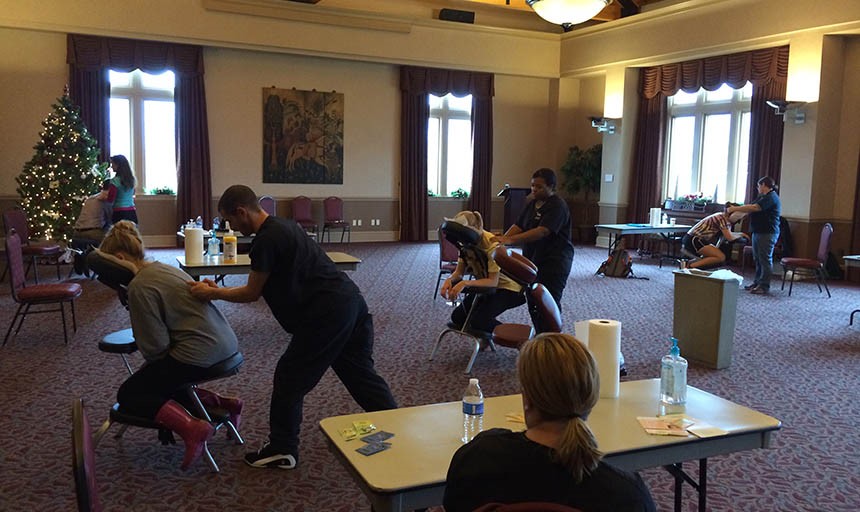
    There are still some spots for chair massages for students provided by Health Services. You can find open slots and sign up here .

    College Resources

    As always our student health and counseling services are still available to all students through telemedicine services.

    Students can drop into counseling for a short duration through Let’s Talk on Tuesdays from 3:00 PM to 4:00 PM, Thursdays 12:00 PM to 1:00 PM, and Fridays 2:00 PM and 4:00 PM.

    If you’re interested in talking in a group about stress or anxiety, Love Your Selfie is on Mondays via Zoom from 4:00 PM to 5:00 PM.

    Other Organizations and the college may also have events that pop up this week or the next so watch out for those!

    Below are some tips on completing projects and how to study to avoid stress and turn in quality work.

    Study Schedules

    The best way to make sure you have adequate time to start and complete all of the assignments coming up is to plan.

    1. Marking down all due dates for finals assignments/projects and dates and times of final exams.
    2. Schedule times to study or complete parts of the project and make sure to to the schedule. Getting in the habit makes sure that you’re not waiting until the last minute.
    3. During scheduled times make a plan on what you want to accomplish. Breaking large assignments or studying for finals in smaller sections, not only reduces stress but for studying, it makes it easier to remember.
    4. For studying, always review what you studied the day before. If on day one, you studied chapters 1 and 2, on day two, you would quickly review chapters 1 and 2 but focus on the next chapters.
    5. Make sure that you start early enough so you have ample time.

    Take Breaks

                The best rule to follow for work/life balance is 80/20 where 80% is focused on academics and 20% is focused on having fun. Studying for long periods of time can be draining and isn’t efficient in the long run. Breaks can be as simple as meditating or going for a walk. Just remember to come back to studying when you’re mentally prepared.

    Group Sessions

                This doesn’t work for everyone but sometimes it can be really helpful to talk with other classmates for clarification. This can also apply to professors. It’s better to ask before to make sure you’re prepared for the test. In addition, being able to explain material to someone else and having them understand it is a good strategy for understanding and remembering the material.

    Study Strategies

                Using a variety of different studying strategies such as retrieval, elaboration, organizational, and rehearsal strategies makes it easier to remember and understand the material.

    • Retrieval- Testing yourself is a great way of making sure you understand and remember material. This can be answering questions from textbooks, using flashcards, practicing using formulas and solving problems, or recreating charts/timelines/and diagrams from memory.
    •  Elaboration- Linking new information with information you already know or creating learning mnemonics like acronyms and analogies.
    •   Organizational- Making your own charts and graphs to visualize information.
    • Rehearsal-Repeating information out loud or repeatedly writing information. It works better if paired to strategies listed above rather than if used by itself.

    These are just some tips and not all of these work for everyone. This is also by no means a comprehensive list. Starting early will help you figure out which strategies work best for you. Remember the psychology department is cheering you on!

    Good luck with finals and be sure to revel in the two-month break that follows!

    .

    .

    .
    Get Connected!

    Bloghttps://psych.pages.roanoke.edu/
    Facebookhttps://www.facebook.com/rcpsychology
    Twitter: @RC_Psychology
    Linked In: https://www.linkedin.com/groups/RC-Psychology-8140491/about
    Website: https://www.roanoke.edu/inside/a-z_index/psychology
    Instagram: rcpsychology 
  • Getting the most out of your time in RC Psychology

    Even as this semester draws to a close, it’s a great time to start thinking about next semester (and future semester) pursuits. There are a variety of ways students can apply concepts learned in the classroom with real-life examples, as well as hone their skills outside of the classroom and learn new skills. Here are some of the ways you can make the most of your time in the Roanoke College Psychology department.

    Research Labs

                Putting time into research can give you a great experience applying the information you learn in the classroom and experiencing the research process firsthand. Students even have published their research and presented at psychology conferences around the country. Research opportunities are strongly encouraged for students planning to continue their education in either graduate or doctoral programs in psychology.

    Research experience and research practicum are great for students to get a foot in the door and learn more about research in psychology. Work-study also allows eligible students to assist with faculty research for an hourly wage. Students can talk to a faculty member with who they share research interests with. Looking at the faculty’s past presentations and research papers is another great way to get an idea of who you would most like to work with. You can find information on faculty research interests here and here are recent student conference presentations and publications with faculty.

    For less directed student work, Independent Study (Empirical Study) and Honors in the Major allow students to conduct their own empirical study under a faculty member. It is common for students to take research practicum prior to enrolling in an Independent Study as they have already completed a research proposal but it is not required to do it in this way. For Honors in the Major, the results are required to be presented to a committee during a defense. Independent studies can be used to fulfill the Intensive Learning (May Term) requirement.

    Students can also conduct research during the summer through the Summer Scholar Program where they can be paid $3000, receive housing, and a summer course credit to conduct research with a faculty member. Projects are presented during Family Weekend. More information can be found here.

    For more details about all avenues to become involved in research click here.

    Some comments from students currently involved in research  

    “Getting involved in research within the psychology department has been one of the best decisions I’ve made in my college career – not only do I get to actually use what I have learned throughout my courses, but I get to explore my research interests while working one-on-one with a knowledgeable professor. This experience of conducting and presenting my own independent study will give me a bit of an extra boost as I enter the next stage of grad school.”

    “I got into research for the chance to be able to dive into a topic that I was really interested in. I learn skills every day that I am able to take and use in my other classes to improve my academic performance. On top of this, I have gained peers who I can share things with and get helpful feedback from people who I trust.”

    “After several assignments in classes where I was required to write a research proposal, I found myself writing a similar proposal every time about a topic I really enjoyed reading about and I wanted to see if I could actually translate my ideas from paper into the real world. With research in the psychology department, I found I could and not only do I feel fulfilled, but research has also provided me with great time management skills.”

    Sign up for research studies

    Some classes have a research participation requirement in which 5 participation amount credits need to be earned for a percentage of students’ final grade. However, signing up for research studies through SONA is a great way to get firsthand experience of how studies operate and possibly get some ideas for research studies you would like to run in the future. A lot of these studies are student studies that are needed for courses such as independent studies, so it also benefits your fellow classmates. More information about how and where to sign up for these studies can be found here.

    Internships

    Internships take place in a variety of places from community agencies to businesses and students have the chance to see how their knowledge of psychology is applied in work settings. Internships can be used for credit (.5 for 60 hours or 1 unit for 120 hours) and can be used to satisfy the Intensive Learning (May Term) requirement. Reflections will be completed throughout the internship leading up to a reflection paper and poster presentation on the experience. The experience and skills gained from it can be added to resumes or crriculum vitaes (CV). Click here to learn more about internships and how to be contacted about opportunities.

    Psychology Student Organizations

                Both the psychology club Roanoke College Psychology Association (RCPA) and the psychology honor society Psi Chi host several social, academic, and philanthropic events throughout the semester. Some examples of these include a Veteran Affairs Medical Center Talk, Pie-a-Prof, and Toy-like-Me. However, while RCPA is open to all students, those eligible to join Psi Chi need at least four units of psychology and at least a 3.0 GPA and be in the upper 35% of their class. Both usually set up tables at the activities fair. To learn more information about each click here.

    Student Assistant Job

    If you’re interested in helping the department behind the scenes, students with a 2.5 GPA overall and a 2.5 GPA in psychology are selected to be departmental assistants where they work for an average of 5 hours a week. Common jobs include grading multiple-choice tests and running errands. Student assistants are also in charge of posting to the psychology department blog and Instagram page. You can learn more by clicking on this link.

    Some comments from recent student assistants

    “I became a psychology department student assistant to become more involved in psychology and to build relationships with the faculty in the department. Through this position, I have had the chance to interact with all the professors, learn new skills, keep the community updated on all that is happening in our department, and have had fun decorating the fifth floor as well as being involved with pranks on the professors.”

    “Becoming a psychology department student assistant has allowed me to interact with more psychology faculty than I might have interacted with just taking classes. I had never paid much attention to social media but being in charge of the blog and Instagram for the psychology department has provided me with new skills. Being able to help faculty in the department is also satisfying.”

    Participating in even just one of these activities can make your time in the RC psychology more meaningful and it may make a difference in you falling in love with the subject even more.

    .

    .

    .

    Get Connected!

    Bloghttps://psych.pages.roanoke.edu/
    Facebookhttps://www.facebook.com/rcpsychology
    Twitter: @RC_Psychology
    Linked In: https://www.linkedin.com/groups/RC-Psychology-8140491/about
    Website: https://www.roanoke.edu/inside/a-z_index/psychology
    Instagram: rcpsychology
  • Graduate Programs and Advice

    Tackling Trauma And Anxiety This Holiday Season | North Jersey Health & Wellness

    With October nearing to an end and November on the horizon, for those graduating in the coming months, it is time to start considering graduate programs. Whether you already know where you are going to be applying to graduate school, or aren’t quite sure if graduate school is for you, follow this blog as a way to learn more about the programs available and for resources on where to find more information.

    Talk with your advisors/professors

    Over the next few weeks, it would be best to reach out to your advisor(s) and professors for advice or guidance, especially if you are still uncertain about what post-graduate option appeals to you the most.

    Look into programs

    There is a multitude of graduate programs available to psychology students. While having a variety is nice, it can also be overwhelming, so you may want to reduce what you are looking at.

    Some options:

    • Degree – Determine what type of degree you are seeking (M.A., Ph.D., Psy.D., etc). and limit your search to just those programs offering those degrees
    • Area/Specialization – Limit by areas/specialization- i.e., Clinical, Counseling, Neuroscience, etc.
    • Search – Google can also be your friend, in which you can search
      “(degree) graduate programs in (area)” and find a variety of programs. Do your research on these programs though as some are not always legitimate.
    • State – if there is a specific state you want to work as a psychologist in/go to school in, you can also limit your search to just those programs
    • Psychology Website – refer to the Roanoke College Psychology page on graduate schools to find more information

    Exploring is key, so whether you are not sure where to begin or know the program, state, and area you want to go to graduate school in, explore your options and come up with a list of 10-20 programs that interest you.

    Moreover, while you look at programs you should also make note of professors that align with your interests and that are accepting students for the coming academic year. Especially if you choose to go into a Ph.D. program, you will likely need to declare which professor you wish to research alongside, so making this list early is helpful.

    Start Planning

    Once you have determined that graduate school is for you, start planning when and how you will get everything done. Here are some common items to complete before application deadlines:

    • CV/Personal Statement – make sure your CV is up to date and create a general personal statement that can be revised/edited to fit a specific program later
    • Transcript – Request and send your official transcript to the programs you are applying to
    • Letters of Recommendation  – reach out to the professors that you want to write your letters of recommendations and be sure to follow up with them during the month prior to the application deadline
    • GRE – If your program requires the GRE, GRE subject test, or other standardized tests, take it a few months before the application deadline. Moreover, if you have already taken the GRE/other tests, be sure to send your scores to any schools that require it.
      • *Note – In response to the COVID-19 pandemic, many schools have made the GRE optional/waived so be sure to check each program for their requirements.
    • The Programs Application – Each school requires different items to be included in their application. Therefore, check early to ensure you have enough time to send everything to the schools and to fill out the application/provide any supplemental writing/other items.

    Finalize Your List

    By the time it comes to applying to programs, you should limit yourself to applying to between 10-15 programs. While it will not hurt you to apply to more, the cost of graduate school applications vary and can add up quickly. Therefore, having a few reach programs, a few middle of the road programs and a few safety programs tend to be best practice.

    Seek Advice

    Seek advice from your professors and advisor(s) throughout the application process. Moreover, seek the advice of other graduate students. Don’t be afraid to continue to ask questions, the process can be daunting, but relying on the help of others can make it doable.

    For more information, check out some of our other blog posts highlighting graduate programs and providing more graduate advice here.

    Applying to graduate programs can be stressful, but by reaching out to your professors/advisors and starting to do some research on different programs, you will soon find yourself generating a list of potential programs and beginning the application process.

    Best You Can Do It GIFs | Gfycat

    .

    .

    .

    Get Connected!

    Bloghttps://psych.pages.roanoke.edu/
    Facebookhttps://www.facebook.com/rcpsychology
    Twitter: @RC_Psychology
    Linked In: https://www.linkedin.com/groups/RC-Psychology-8140491/about
    Website: https://www.roanoke.edu/inside/a-z_index/psychology
    Instagram: rcpsychology
  • Course Highlight: PSYC 110 Pursuing your Purpose

    PSYC 110 – Pursuing your Purpose is a 1/2 credit course that assists students in considering career paths and informs them of the opportunities available to them within the Psychology Department and across the College. The course is particularly well-suited for sophomores or others who have recently declared the major, but all are certainly welcome and have benefited from the course. The course will meet virtually one time a week on Tuesday evenings with part of the class being synchronous and the rest of the work being asynchronous.

    Three students that recently took this course, Kristianna Jenner, Emily Gabrielian, and Kristi Rolf took some time to answer questions regarding this course:

    Why did you decide to take PSYC 110?

    Kristianna Jenner: I decided to take PSYC-110 because I needed a little more direction and guidance. Psychology is just so broad and I felt like I needed a different perspective on the field as well as to gain more practical information for my future.

    Emily Gabrielian: After the fall semester of my sophomore year, I decided to switch my major from biochemistry to psychology. I really enjoyed the psychology courses that I had taken before, but I had no idea what I wanted to do with a psychology major. Right after I declared my major in psychology, Dr. Allen recommended this class to me. Dr. Allen emphasized that this class would help me find my path in psychology and would allow me to learn more about the amazing opportunities that Roanoke College and the psychology department has to offer. I decided to take PSYC 110 because I really wanted some guidance on what I wanted to do with my psychology major.

    Kristi Rolf: I decided to take PSYC 110 on a friend’s recommendation because I had just declared it as my major and was totally in love with psychology, but had no idea what discipline or career path I wanted to pursue.

    What did you and other students do in the class?

    Kristianna Jenner: So in the class, we get to learn more about the practicality of the science of psychology. We do our own research to find out what things we are interested in and to find the degree requirements, location of the prevalence of jobs, and also the salaries. All of these are super important for making decisions on where you want to go to school, where you may end up living, and what things you’re genuinely interested in. There is also a community-Based learning aspect of the course, where we go out into the real world here in Salem and the surrounding towns to shadow people who are working in the fields (or are adjacent) you are interested in.

    Emily Gabrielian: One of the reasons why I loved this class so much was because of the other students in the class. During this class, the students really get to know one another and become more comfortable with sharing their goals and dreams. Everyone in the class was motivated to learn more about the opportunities that Roanoke has to offer. Also, everyone in the class wanted to discover the potential paths they could go after graduating from Roanoke. It was clear that everyone in the class wanted to grow and develop. I am thankful for this class because it gave me the opportunity to connect with my peers and create new friendships.

    Kristi RolfEach week Dr. Powell assigned readings and/or activities on a certain topic that we discussed in class that ranged from potential career choices to resources at Roanoke College. Everything we discussed was backed up by empirical articles and Dr. Powell brought guest speakers in for many classes which really enriched our learning. In the second half of the semester, Dr. Powell and Jesse Griffin from the office of civic engagement helped match each of us to a location for job shadowing where we would complete 20 hours before the end of the semester (sadly last semester we had to cut the job shadowing short due to COVID-19).

    How has PSYC 110 helped you and what did you get out of it?

    Kristianna Jenner: I learned about aerospace psychology, which might just be the coolest thing ever. I never would have found this entire subfield had I not been in this class. Aerospace psychologists work with airline personnel, airplane manufacturers, engineers, and airlines themselves. They work to help make the skies safer for everyone and the interfaces easier for those working in the airline industry. I found this to feel like it was something I could see myself doing with my life and I found the guidance I wanted out of the class.

    Emily GabrielianAlthough our time was cut short due to the Coronavirus, I still got so much out of this class. This class helped me figure out that after Roanoke, I want to go to graduate school in order to further my learning and work towards becoming a counselor. After every class, I was so giddy about all of the opportunities that Roanoke has to offer. I was so excited about the opportunity to study abroad, complete an internship, and conduct research. Also, from my volunteer experience at the West End Center, I realized that in the future I want to work with children. Overall, I got so much more out of this class than what I was expecting. This class truly made me more motivated with my studies and more excited about what the future holds.

    Kristi RolfPSYC 110 helped me the most by providing clarity on my degree path at Roanoke and all the resources that are available for me in the department and throughout the College.

    Why would you recommend PSYC 110?

    Kristianna Jenner: I definitely think that if you’re struggling while considering the future or even if you’re like me, where all you want is just a little more guidance on life, this is the class to take. Overall, I think that this class will only help, never hurt.

    Emily Gabrielian: I would recommend PSYC 110 because this class gives you the opportunity to learn more about yourself, but also learn more about what Roanoke has to offer. When I would talk with my friends about this class, they all emphasized how they wished their majors offered a class like this. Even if you know what you are going to do after Roanoke, I still encourage you to take this class because you may discover that there is another path that is more interesting. Also, this class gives you the opportunity to give back to the community and meet new people. I fully recommend taking this class because it will be so beneficial for you and your future.

    Kristi RolfI would recommend PSYC 110 because it is a fantastic tool for getting more involved in the department and absorbing lots of wisdom from Dr. Powell which has been invaluable for me!

    If you are interested in taking this course or would like to know some more information, please reach out to Dr. Darcey Powell at dpowell@roanoke.edu.

    .

    .

    .

    Get Connected!

    Bloghttps://psych.pages.roanoke.edu/
    Facebookhttps://www.facebook.com/rcpsychology
    Twitter: @RC_Psychology
    Linked In: https://www.linkedin.com/groups/RC-Psychology-8140491/about
    Website: https://www.roanoke.edu/inside/a-z_index/psychology
    Instagram: rcpsychology
  • Interview with alumni Brice Hinkle ’20

    In this post, recent alumni Brice Hinkle discusses what she has been up to since graduating from Roanoke College. After graduating in the midst of the pandemic, Brice has some great insight to share with current Roanoke College students and soon-to-be graduates!


    Tell us about yourself. What are you up to now?

    I got a job at a local Health Food store called Nature’s Outlet back in March. Even though it’s not in the counseling or social work vein I want to go into, I haven’t left because I was learning so much there, but now I actually feel it is time to move on to other things, so I’ll be sending out applications to other places over the next few weeks. Between school and work a lot of my free time was taken up in my undergrad, so I wanted to take some time between undergrad and graduate school to focus on my personal goals that I hadn’t had time for. I’m really into making sample- and synth-based music and yoga as a spiritual practice and lifestyle, so I’ve been trying to dedicate more time to those. I’m searching for jobs through Career Services, my network of friends and family, and Indeed.

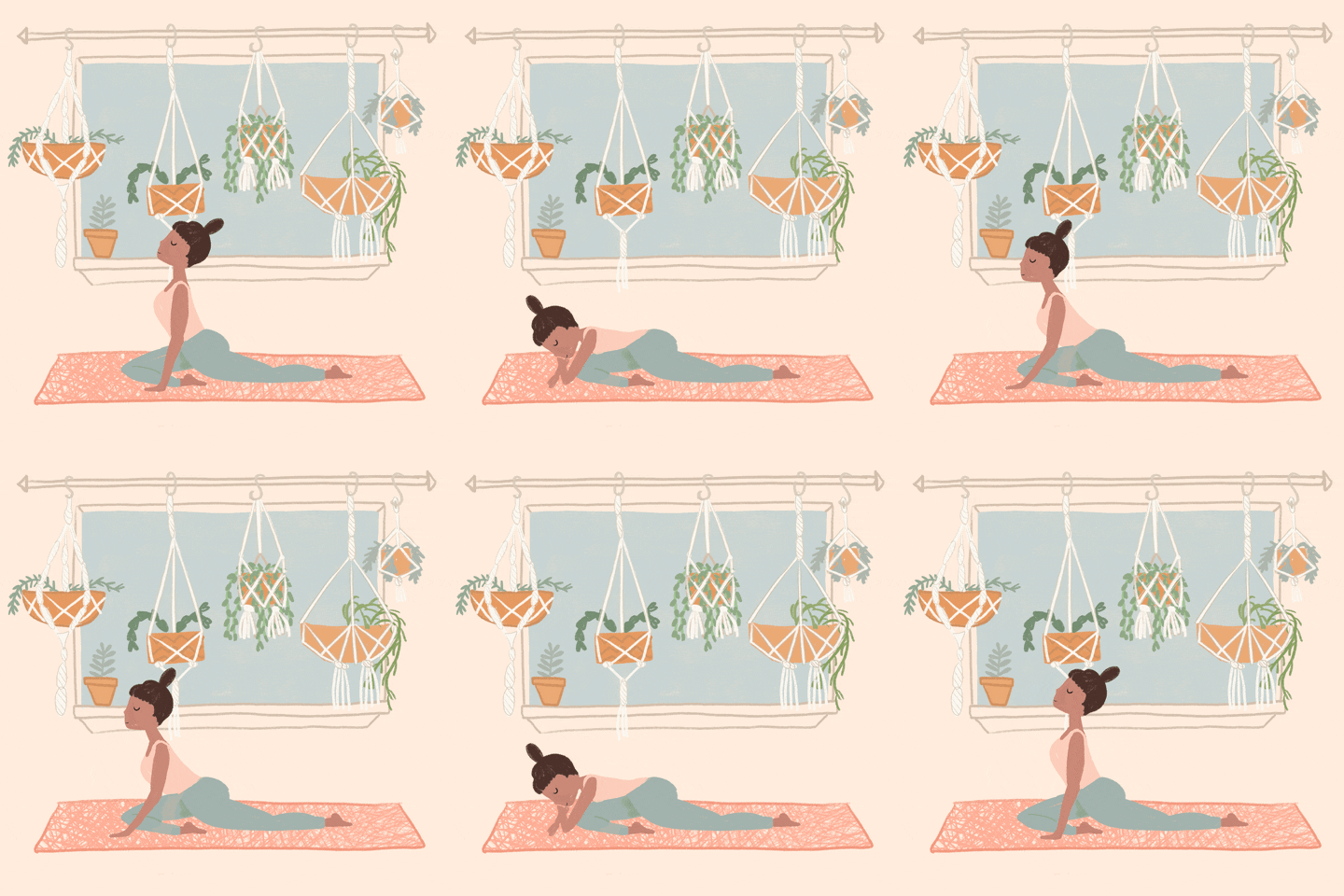
    Yoga Plants GIF by Ash Sta. Teresa
    GIPHY

    How did the pandemic impact your plans for after Roanoke College?

    The pandemic has been interesting. A group of friends and I were looking for a place to live and the pandemic put us all on a time crunch to do so and cut my friends jobs temporarily, so being able to make rent was scary for a while.

    What was your graduation like? Did you get to step on the seal?

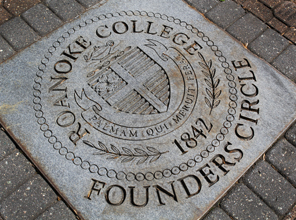
    I graduated this past May so I didn’t get much more than a Zoom call, which was still great. But I had already stepped, sat, and even danced on the seal I can’t count how many times every year since my freshman year.

    History & Tradition | Roanoke College
    https://www.roanoke.edu/images/About/Seal.jpg?width=382

    What do you miss about Roanoke College? 

    I recently walked around campus again with a friend and I really missed the late nights out with my friends there and the gorgeous campus and views of the sunset. I am happy to have the time to dedicate to exploring other interests now though.

    What has been your favorite part of life since graduation?

    Honestly, the time I’ve been able to spend on music has really improved my mood stability. I recommend everyone pick up an instrument of some sort.

    sad piano GIF by Freddy Arenas
    GIPHY

    Where do you hope to be in the future?

    I hope to be living somewhere out west, up north, or abroad working with the mentally ill or the youth.

    Do you have any advice for students at Roanoke College now?

    Don’t do something that you feel your parents or society or your peers expect you to do. Do what you are passionate about and work your tail off for it. Manage your time well and make the most of it, because you only have so much time. Be good to yourself and to others; everyone deserves to be heard and met with patience, compassion, and understanding.

    Is there anything else you’d like to add?

    I honestly am saddened by my high school’s attempt at education. I don’t feel that way about Roanoke. You are in a good place, take advantage of it, and revel in it.


    Thank you, Brice, for taking the time to answer our questions and congratulations on starting your post-grad life. We look forward to hearing about how you are in the future and will continue to cheer you on! A special thanks for the  kind words you had to share with current Roanoke College students.

    .

    .

    .

    Get Connected!

    Bloghttps://psych.pages.roanoke.edu/
    Facebookhttps://www.facebook.com/rcpsychology
    Twitter: @RC_Psychology
    Linked In: https://www.linkedin.com/groups/RC-Psychology-8140491/about
    Website: https://www.roanoke.edu/inside/a-z_index/psychology
    Instagram: rcpsychology
  • Registration 101

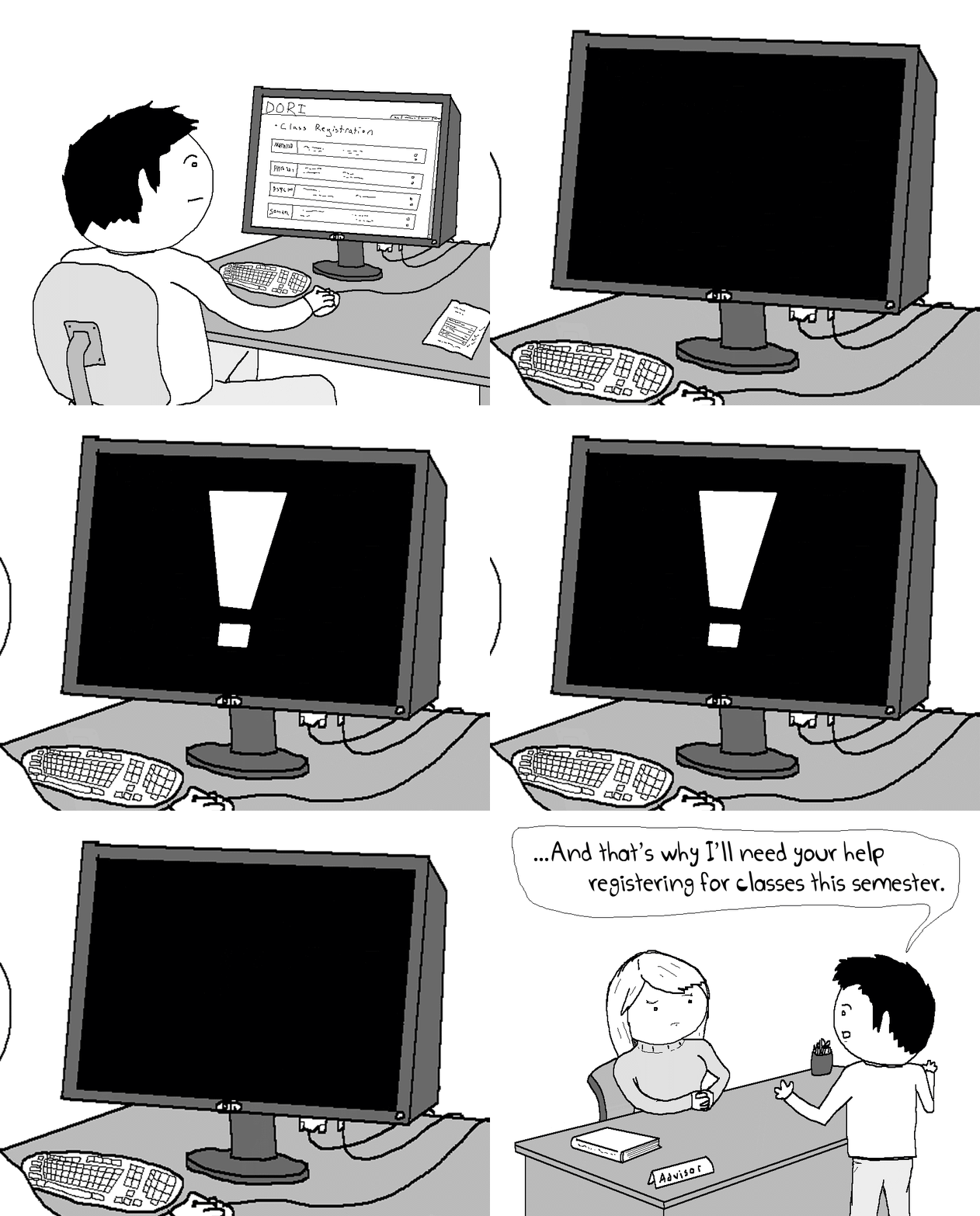
    It’s almost that time of year again: registration time! Pre-registration advising will begin next week on Monday, October 26 and registration will begin on Monday, November 9. Students should be notified about their registration time in the next few weeks through email and it should be visible on self-service as well. Thus, this post will provide a simple step-by-step guide on how to register for classes as well as some helpful reminders!

    How to Register

    Self Service helps to organize and visualize your class schedule. Typing in this link https://selfservice.roanoke.edu/Student/ should bring you to the self-service login page. Your username and password is the same for self-service as it is for inquire.

    After you log in, you should see the student home page seen below. Click on Student Planning near the bottom left, above Grades.

    This should bring you to the student planning page where you can either check your academic progress or register for classes. Click on Plan for your Degree & Register for Classes on the right side of the screen.

    Finally, you’ve reached the page where you can schedule your courses. You can use the arrows near the top left to change between terms. To add courses to your schedule, you can search for courses at the top right search bar.

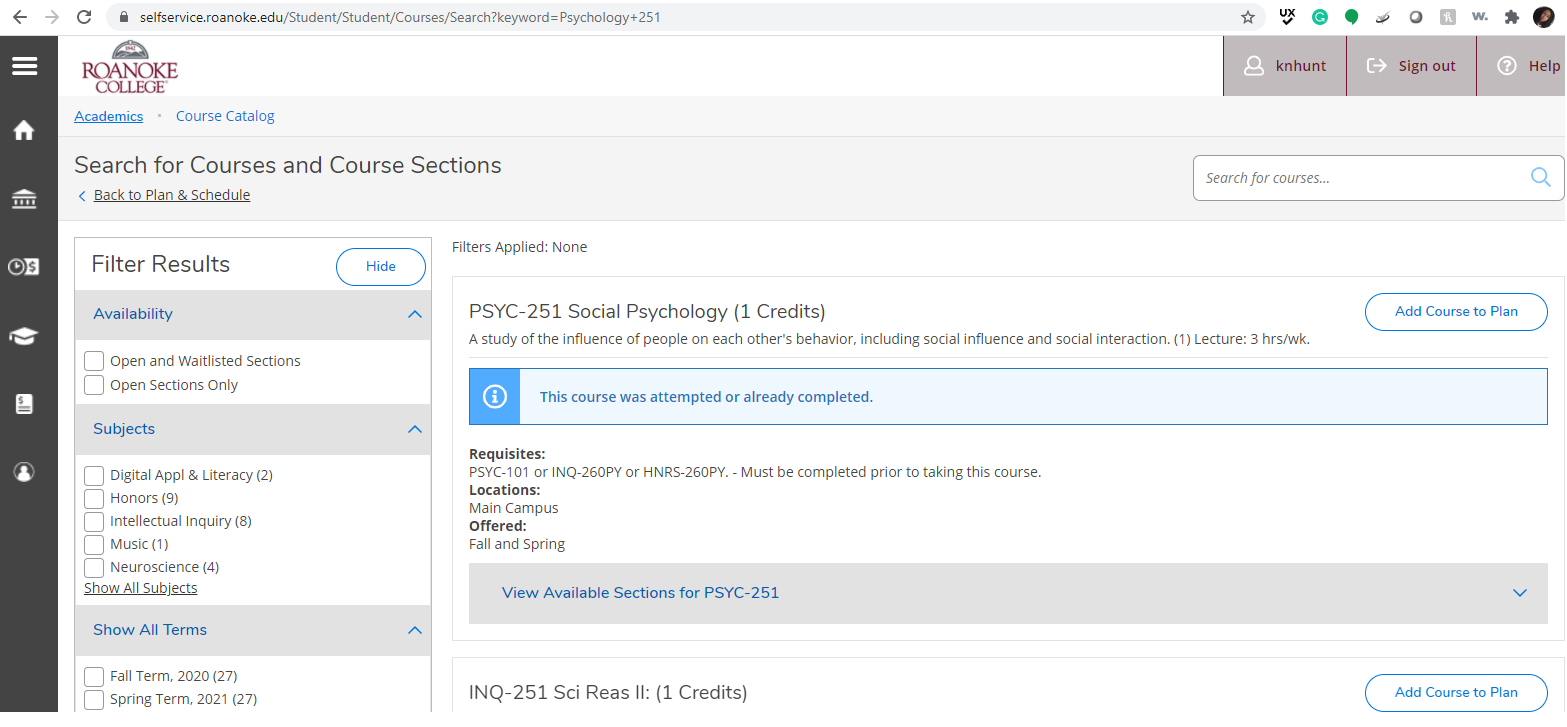
    Let’s say you wanted to add psychology 251 to your schedule. You would type it into the search bar and you should be brought the course catalog seen below. Clicking on “Add Course to Plan” and selecting a term won’t put an available class section on your schedule, it will only show the class on the left side bar in the planned classes. You’ll have to manual add a section by clicking view other sections.


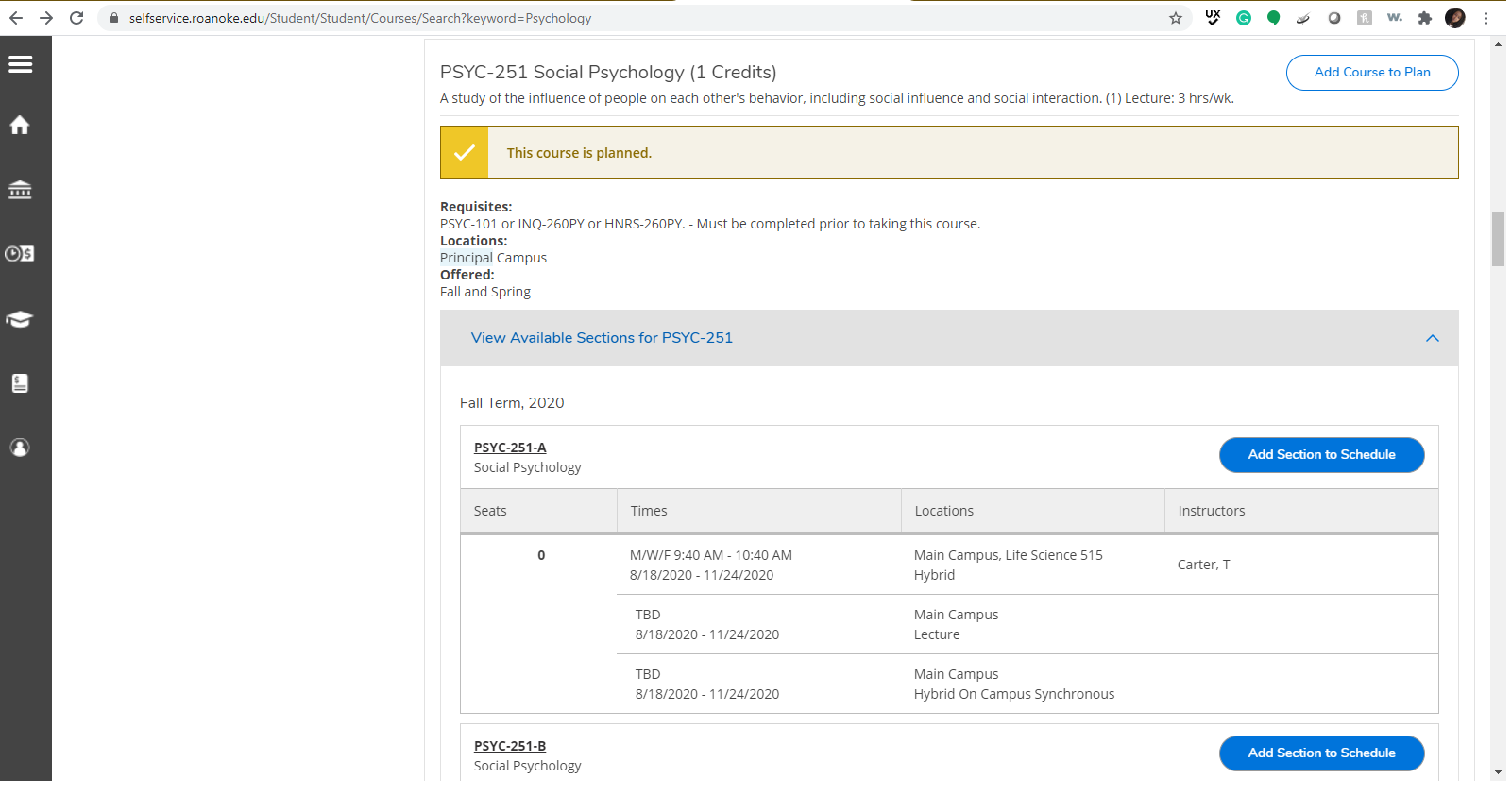
    If you click on “View Available Sections for PSYC-251” you’ll see all sections available for both the current and next term as shown below. Make sure you scroll down and click on “Add Section to Schedule” on a section under Spring Term, 2021.


    You can also follow this post for instructions on how to register on Ellucian Go app.

    On the day of your registration time, a button should appear that says “Register Now” near the top right that if pushed should register you for all classes currently on your course schedule. A confirmation email should be sent that notifies you what classes you have registered for.

    If you would like to see these steps in action, Roanoke College provides two videos found here and here on using Self-Service to plan schedules.

    Other Tips

    Advising Meetings

    Meet with your advisor. Some advisors should be reaching out to you this week if they haven’t already for a pre-registration advising meeting. If not, it might be a good idea to reach out to them first. It’s always a great idea to meet with your advisor just to check in with them to make sure you’re taking the right classes and that you’re on the right track to graduate on time.

    Your advisor can help you indicate what classes are available next semester but you can (and should) look what is being offered through self-service by typing in the class name or number in the search bar in self-service. You can also search courses through the course catalog on self-service or in the directory.

    Plan Ahead

    Before you meet with your advisor, pick classes that are required and/or that you want to take and make a draft of your schedule using self-service. Class registration goes in order with those who have the most credits prior to the current term picking their classes first so it is possible that you may not get your first choices. That’s okay! Having a plan B and sometimes even a plan C helps reduce disappointment and worry about not taking classes that are interesting to you but also meet requirements. Here you can check the requirements for majors and concentrations in the psychology department.

    Be Early

    Remember being early is being on time. Opening self-service a few minutes before your designated time and making sure you’re ready to push that register button may be the difference in you getting your first choice or second choices or not.

    Registration can be stressful but your advisors are a great resource and are willing to help. In addition, it gets easier the more times you do it and in no time you’ll be a pro. Good luck Maroons!

    .

    .

    .

    Get Connected!

    Bloghttps://psych.pages.roanoke.edu/
    Facebookhttps://www.facebook.com/rcpsychology
    Twitter: @RC_Psychology
    Linked In: https://www.linkedin.com/groups/RC-Psychology-8140491/about
    Website: https://www.roanoke.edu/inside/a-z_index/psychology
    Instagram: rcpsychology
  • How to “stand out”

    No matter what year you are, it is never too early or too “late” to begin considering what you want to do during your time at Roanoke College, in order to stand out to potential future employers or graduate programs. Therefore, whether you are a first-semester freshman or a first-semester senior, there are always things you can be doing on and off campus to prepare you for your future post-grad studies or jobs in psychology.

    If you plan to pursue a career or graduate program in psychology then follow this post as a guide to begin building up your resume or CV with experiences that will help you stand out to future employers or programs.

    Plan ahead

    You do not need to have your future plans set in stone at any point during your college career, but it may be good to start considering different options and creating plans around those options. That is, look at what courses you will need to take to complete your major/minor/concentration and roughly layout when you will take them. Moreover, consider what you do and do not want to do while in college (e.g., internships, research, study abroad, etc.). This initial planning stage will help you in the long run but is not limited to those in their freshman year.

    Seniors, planning may look different, but consider different post-grad options and begin looking at what they require. From here, plan out what to do during your final two semesters and post-undergrad to help you get into the job/programs that you are looking into.

    Explore options

    When considering what you want to do in psychology consider the multiple options available to you. Look into different career paths, graduate programs, or post-grad internships and research opportunities. Do not be afraid to take a gap year after graduating from Roanoke College to explore these options and to gain some more work experience or research/internship experience. There is no specific plan that you need to follow to become a successful psychologist, so look into options to find a plan that works best for you.

    Look at expectations/requirements

    If you are looking to enter into a graduate program or a specific job, look at the application requirements and deadlines early on. Even if you have no idea where you want to go or what you want to do, looking into different programs and seeing what they require of applicants is a good start. In doing so, you may find that multiple programs are expecting similar requirements such as research experience or a GRE score. In noticing these commonalities, you can adjust what you are doing to ensure you complete these items on time.


    Get involved

    It goes without saying, but getting involved is important to all employers and graduate programs. Whether it be gaining world-experience in the form of internships, study abroad, or jobs, or gaining academic experience in the form of research, honor societies, and a variety of courses, or through being apart of outside activities such as sports teams, and other clubs and organizations, it is beneficial to get involved both on and off-campus.

    Consider an internship

    An internship is one of the best ways to gain work experience while in undergrad. Not only are internships a way to build connections, they also give you real-world experience, and introduce you into the field you may be interested in. Moreover, they are also beneficial as they can lead you to realize you want to pursue a different path. Do not feel discouraged if an internship leaves you wanting to explore a new area as this is equally as beneficial as an internship that proves to you that you are on the right path.

    All in all, internships can help guide you in solidifying your interests as well as showcase to you what your interests may not be.

    More information on internships can be found here

    Consider research

    If you plan to enter into a graduate program, specifically a Ph.D. track, considering research is highly important. Most graduate programs suggest or require that you have some research experience at hand. While taking quantitative methods and research methods is a good introduction to research, conducting research alongside a psychology faculty or other students is a way to further enhance those skills. Moreover, conducting research can lead you to present at conferences or getting published, which as an undergraduate is a major accomplishment.

    More information on the research can be found here!

    Consider studying abroad

    While studying abroad is not for everyone, it is a great experience that not only enhances cultural knowledge but leads to self-development. Studying abroad offers a lot of self-development that can be beneficial and will look notable when applying to jobs or graduate programs. There are a variety of study abroad options available, and if you plan ahead early, you can ensure that courses you take while abroad can fill requirements you may need, as well as find a semester where studying abroad works best for you.

    More information on studying abroad can be found here!

    Reach out to Professors/Advisors

    After reading all of these options you may feel lost, which is completely normal! That said, you are not alone and your professors and advisors can be a great resource in guiding you towards your next steps. Reach out to your advisors if you are struggling with where to begin or on what you can achieve during your semesters at Roanoke College. Moreover, reach out to professors that share similar interests to learn more about how they went about applying to programs, finding jobs, or for advice on what specific things you should or could be doing.

    Here are current professors specialties and interests:

    Dr. Allen: Psychopharmacology and abnormal psychology

    Dr. Buchholz: Self, consciousness, evolutionary psychology, and moral decision making

    Dr. Carter: Social and personality psychology

    Dr. Cate: Cognitive and neuroscience

    Dr. FVN: Developmental, social, and educational psychology

    Dr. Hilton: Clinical and cognitive psychology

    Dr. Nichols: Cognitive neuroscience

    Dr. Osterman: Social psychology and evolutionary psychology

    Dr. Powell: Developmental psychology

    Dr. Wetmore: Experimental psychology and cognitive psychology

    More information about specific professors’ interests can be found here!

    Start drafting your Resume and cover letter, and/or your CV and purpose statement

    If you are interested in pursuing a career or graduate school in psychology then you want to start drafting your CV and purpose statement. On the other hand, if you are looking to go into more general work, you should have an updated resume and cover letter. Whether it be your CV or Resume, these items should be updated when major changes are made, or at least at the beginning and end of each semester, or before they are to be submitted to someone.

    Cover letters and purpose statements can be made quite broad to begin with but should always be specified to match the program you are going into.

    More information on how to write a CV can be found here!

    Refer to the Roanoke College Psychology page for more information

    You may still be feeling a bit overwhelmed on where to begin and where to go for information. While the blog will continue to share advice and information on graduate school or post-grad career information, you may also refer to the Roanoke College Psychology Page for more resources and information.

    Best of luck to all of you as you continue on your journey towards becoming a psychologist and know that the fifth floor is always cheering you on and here to help (even if virtually)!

    .

    .

    .

    Get Connected!

    Bloghttps://psych.pages.roanoke.edu/
    Facebookhttps://www.facebook.com/rcpsychology
    Twitter: @RC_Psychology
    Linked In: https://www.linkedin.com/groups/RC-Psychology-8140491/about
    Website: https://www.roanoke.edu/inside/a-z_index/psychology
    Instagram: rcpsychology
  • HNRS 260 Creates Flyers to Stop the spread of Covid-19

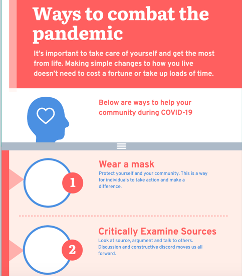
    As a part of Dr. Powell’s HNRS 260 – Psychology in the Media course, students read Van Bavel and colleagues’ (2020) article, Using social and behavioural science to support COVID-19 pandemic response, and created flyers that they thought would grab RC students’ attention to reduce the spread of COVID-19 on campus.

    See what some students came up with below!

    Do the Right Thing

    Graphic designed by Madi Nuckles

    Uncle Sam

    Graphic designed by Hunter Haskins and Snigdha Somani

    Combatting the Pandemic

    Graphic designed by Ben Nelson

    COVID Practices

    Graphic designed by HNRS 260 student

    Great job to all the students who completed this project and created new graphics to share on campus!

    Continue to stay safe, and remember, keep wearing a mask, wash your hands, and social distance to help stop the spread of COVID-19 and keep all of the Roanoke College community safe!

    .

    .

    .

    Get Connected!

    Bloghttps://psych.pages.roanoke.edu/
    Facebookhttps://www.facebook.com/rcpsychology
    Twitter: @RC_Psychology
    Linked In: https://www.linkedin.com/groups/RC-Psychology-8140491/about
    Website: https://www.roanoke.edu/inside/a-z_index/psychology
    Instagram: rcpsychology
  • STRESSED DURING MIDTERMS? HERE’S SOME TIPS

    https://giphy.com/gifs/BareTreeMedia-dying-cactusboi-anvil-drop-lokbyan8C3VQMU1zqa

    ©GIPHY

    With mid-terms fast approaching (sadly with no relief of a fall break), it can be easy for stress to quickly overcome the life of a college student. Here are some simple reminders and helpful tips on how to reduce stress in your life.

    College resources

    As always, our student health and counseling services are still available to all students through telemedicine services.

    • Students can drop into counseling for a short duration through Let’s Talk on Tuesdays from 3:00 PM to 4:00 PM, Thursdays 12:00 PM to 1:00 PM, and Fridays 2:00 PM and 4:00 PM.
    • If you’re interested in talking in a group about stress or anxiety, Love Your Selfie is on Mondays via Zoom from 4:00 PM to 5:00 PM.

    Click here for the full counseling services schedule where you can also find meeting information.

    Using your school email address, you also have access to Therapy Assistance Online (TAO) Self-Help which is a private online library of behavioral health resources. Modules and practice tools can assist in learning how to manage stress and mindfulness skills.

    Organizations and the college may also have events that pop up this week or the next so watch out for those!

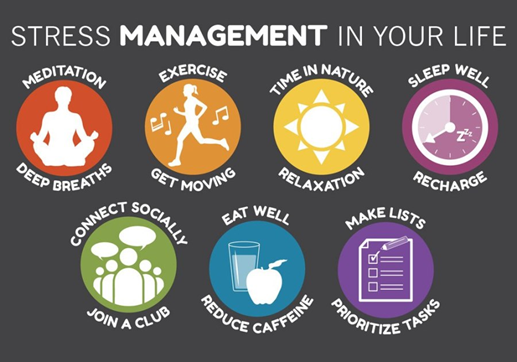
    ©THRIVEGLOBAL

    • Manage your time – Placing all required assignments and due dates on a calendar is only half the battle. Setting up a schedule and setting time aside to study and complete assignments reduces stress because it makes procrastination way less likely. Breaking large assignments into smaller, more manageable parts also helps.
      •  Learn to say no – This doesn’t just mean to fun things. In fact, having fun during stressful times can be beneficial if you are accounting for work you do have to complete. Sometimes smaller assignments that aren’t worth as much can be put aside.
      • Make Time for Yourself- Make sure when you’re building a schedule, you block in breaks throughout the day. Spending thirty minutes studying and taking a one to two-minute break is great for focusing. Outside of studying, make sure you’re doing things you enjoy as well. Even when socially distancing, you can still have fun on campus. Kaelyn Spickler ’21 has written a great resource about some ideas on the Roanoke College’s website.
    • Get more (and better sleep)- Sleep is a great stress reducer but also helps the brain and body run at full power. It is recommended that we get 7 or more hours of sleep per night. Putting down electronics thirty minutes before bed and allowing the mind to rest from stimulation can help you get a better night’s sleep. If you do use electronics at night, try using a blue light filter as blue light can affect your sleep.
    • Exercise- Exercise is another great stress reducer as it releases endorphins. Don’t think you have to exercise for too long, thirty minutes is enough to reap these benefits. Regular exercise also has cognitive benefits especially related to memory and learning.
    • Mindfulness/Deep Breathing- Even taking two minutes to sit with yourself free of distractions and allowing your mind to drift to more calming things will reduce stress. Mindfulness can also be used in tandem with deep breathing where you only focus on your breath.

    Remember midterms are just a reminder that you are halfway through the semester and you have come so far! This list of some potential stress reducers is simply a reminder but there are way more. Feel free to share any other ideas of stress relief during midterms week in the comments below!

    . 

    . 

    . 

    Get Connected!

    Bloghttps://psych.pages.roanoke.edu/
    Facebookhttps://www.facebook.com/rcpsychology
    Twitter: @RC_Psychology
    Linked In: https://www.linkedin.com/groups/RC-Psychology-8140491/about
    Website: https://www.roanoke.edu/inside/a-z_index/psychology
    Instagram: rcpsychology
  • Undergrad Advice from the Psych Department!

    We are so excited to have so many familiar faces back on campus, and all of the new ones as well! This semester is going to look far different than any before, so some of the professors in the psychology department are here to offer up their best advice from when they were undergraduates!

    Dr. Buchholz

    -Get organized. Build a schedule but leave plenty of extra time because things often take longer than you may expect. 

    -Ask for help, even if it is embarrassing. 

    -Prioritize assignments and other things that you want to accomplish. That way if something comes up and you can’t do it all, you will know what to focus on. Relatedly, pay attention to the syllabus and how much each assignment is worth. If time is short, don’t waste time on things that are not worth that much, focus on doing a good job on the things that count.

    -Have fun. Most of you will look back on this time as one of the best times of your life. Get out there, make friends, take risks (safely). 

    Dr. Allen

    -Talk to your professors, and don’t wait until the situation is desperate.  We are human.  

    -Try to set good habits from the beginning.  It’s a lot easier to form a good habit than to break a bad one, and I say that as someone who is trying to break a couple of them.

     -And something I often find myself telling students who’ve messed up, even in a big way: admit you made a mistake, ask what you have learned from this (I sometimes learn that I need more sleep) and then move forward.  Don’t keep beating yourself up about the mistake other than to remind yourself that you don’t want to make it again. 

    Dr. Hilton

    -Say yes to more things that make you nervous/a little scared. I have learned so much from doing things that initially scared me. Sometimes fear is trying to help us learn things about ourselves and the only way to learn it is to lean into that discomfort (within reason obviously)

    -Invest more in other people. I was very driven (as I know our psych students are as well) and sometimes I chose to pursue academic/career goals over relational goals. I have come to recognize that relationships provide meaning to everything else we do and I sometimes wish I had said yes more often to late nights, last minute trips, coffee meetups, etc., instead of working.

    -Be kind to yourself. Set lofty goals but also be nice to yourself when you fall short. Failing is part of learning and growing…not something to be avoided but a step along the way.

    Dr. Nichols

    -Go to class! Even if you think you can keep up with the readings and learning on your own, it’s helpful to keep yourself on track and keep up to date on any announcements if you go to class every day. Honestly, sometimes I would sit in class and do homework for other classes, balance my checkbook, or write love letters to my girlfriend (it was easier to get away with such things at a large state school), but I felt better prepared for each of my classes when I attended them regularly.

    -Talk to your professors! At first I didn’t speak to my professors, then I pestered them with questions after class that challenged half of the psychology studies presented in the slides, and finally I learned to attend office hours and have a more civil conversation. Your professors are passionate about the topics they teach and would love to help you learn the material better and most likely know some other ways to present the material than what was done in class, so use office hours to chat and/or learn.

    -Talk to students in your class! As a student I was a weird mix of quiet/shy/isolated thinker who tended to sit in the back and not talk to anyone combined with class-clown/passing notes/whispering jokes, depending on the topic and whether I had friends in class. However, I learned to enjoy the friendships that developed by talking to students before or after class that I didn’t know going into the semester. Oftentimes we ended up studying together or inviting each other to parties, but it was nice even to just chit-chat with someone to feel more connected to the class.

    Dr. Carter

    -Seek out professors who do work that’s interesting to you, and find a way to work for/with them. It’s amazing how those experiences help shape and reveal your interests, and how they can translate into opportunities later.

    -Learn how to go to bed at a reasonable hour. It turns out a lot of stuff happens before 10am.

    -Always get apartments on the top floor of the building. That way the neighbors can never stomp on the floor when you make the slightest bit of noise. That’s the worst

    This semester is uncharted, but the advice offered by some of our professors will help us all make it through! Also, remember to have grace for yourself and your professors, because we are all trying to figure this out and no one has all of the right answers. Good luck Maroons!

    . 

    . 

    . 

    Get Connected!

    Bloghttps://psych.pages.roanoke.edu/
    Facebookhttps://www.facebook.com/rcpsychology
    Twitter: @RC_Psychology
    Linked In: https://www.linkedin.com/groups/RC-Psychology-8140491/about
    Website: https://www.roanoke.edu/inside/a-z_index/psychology
    Instagram: rcpsychology