National Stress Awareness Day is on the first Wednesday in November every year and this year it is on November 5th. Chronic stress over a long period of time can lead to health problems in the long run so we need to learn how to deal with stress appropriately.
What can cause stress?
There is a wide range of things that can cause stress and they can present differently depending on the person. Some examples of causes include:
Depression
Anxiety
Chronic illness
Grief
Guilt
Violence
Natural disaster
etc.
How does stress appear?
According to the American Behavioral Clinics, stress can look like these presentations:
Constantly angry or depressed
Feelings you are unloved
No sleep or trouble sleeping
Racing thoughts, constantly worried
Indecisive or make poor decisions
etc.
How do you deal with stress?
Increase stress awareness with education and mindfulness
Create a plan of your day to conquer it
Plan a day of things to make you laugh
Get proper sleep: it is recommended to have at least 7 hours as an adult
Exercise helps reduce stress and anxiety
Meditation and mindfulness: be more mindful in your thoughts to be present in the moment
Connect with others: share your feelings and emotions whether it is a friend or a professional
Midterms are here again, bringing a whirlwind of assignments, exams, and stress. If you’re feeling overwhelmed, you’re not alone! The good news? Psychology offers some strategies to help ease your anxiety and improve focus. Here are a few unconventional yet effective techniques, taken fromDanielle Elzweig’s article for Spectrum (Elzweig, 2022).
1. Reframe Anxiety as Excitement
Feeling those pre-exam nerves? Instead of telling yourself to “calm down,” try shifting your mindset. Studies suggest it’s easier to reframe anxiety as excitement since both are high-arousal emotions. By focusing on what could go well rather than what could go wrong, you can boost confidence and performance.
2. Chew Gum for Better Recall
Your high school teachers may have banned it, but research shows that chewing gum while studying and again during an exam can enhance memory retrieval. The simple act of chewing increases blood flow and alertness while also lowering stress levels—small but significant perks when tackling tough exams.
3. Engage in Physical Activity (Yes, Even Sex!)
Any form of exercise, including sex, can help with cognitive function by increasing blood flow to the brain and stimulating cell growth in the hippocampus—an area crucial for learning and memory. Even a quick workout before studying can sharpen focus and improve short-term memory.
4. Breathe Smarter, Not Harder
The classic advice to “take a deep breath” may not be the best for reducing stress. Instead, focus on extending your exhales. Breathing in for four seconds and exhaling for eight helps slow the heart rate and relax the nervous system, leading to improved decision-making and overall calmness.
5. Laugh Away Stress
Laughter isn’t just a mood booster—it’s a physiological stress reliever. Watching a funny video or sharing a joke with a friend can lower stress hormones and leave you feeling more relaxed. So, the next time you’re overwhelmed, take a short break for a good laugh.
Midterms may be stressful, but with these psychological hacks, you can help your brain work for you instead of against you. Best of luck!
This past Tuesday, the Roanoke College Psychology Association (RCPA) hosted an engaging virtual alumni panel titled “What To Do With A Bachelor’s Degree in Psychology.” The event featured three recent alumni who are now thriving in master’s programs, offering invaluable advice and insights to students navigating their own academic and professional paths. Here’s a closer look at the panelists:
Meet the Panelists
Kristi Rolf After earning her psychology degree, Kristi took a gap year to figure out her next steps. She worked at the University of Virginia (UVA) in career counseling and later enrolled in UVA’s Master’s in Higher Education program. Her journey highlighted the benefits of gaining work experience before pursuing further education, including access to employee benefits and financial stability.
Raegan Middelthon Raegan chose Virginia Tech for its master’s track in counseling, which offered both clinical and school counseling experiences. Her personal statement was a key component of her successful application, and her diverse background in research and applied behavior analysis (ABA) gave her a strong foundation.
Eliza Bain Eliza, now a master’s student at Radford University, emphasized the importance of utilizing research opportunities during undergrad. Her distinction project at Roanoke gave her the skills needed to excel in grad school. She credits her neuroscience concentration and minor in French with helping her stand out during the application process.
Q&A Insights from the Panelists
The alumni shared their perspectives on navigating grad school, preparing applications, and getting the most out of undergraduate studies. Here are the highlights:
Feeling Prepared for Grad School
Raegan: Roanoke’s rigorous coursework and research focus prepared her well for the demands of grad school. Writing-intensive courses like Quantitative and Qualitative Methods were particularly helpful.
Eliza: Neuroscience seminar capstone boosted her ability to read and analyze literature, troubleshoot methods, and speak publicly.
Kristi: Found developmental and social psychology classes especially relevant, as well as hands-on research experiences.
The Importance of Research
Eliza: Quality matters more than quantity—be ready to explain how your experiences shape your interests and goals.
Kristi: Psych Seminar and Quantitative Methods are great introductions to research, even without extracurricular projects.
Raegan: Research is incredibly helpful in efforts to develop a strong graduate school application. Additionally, balancing research with internships provides a well-rounded skill set.
Crafting a Personal Statement
Raegan: Start with a broad draft and refine it. Bragging about achievements is great—just don’t forget to connect them to the program you’re applying to.
Kristi: Share turning points in your journey and focus on future aspirations. Always proofread!
Eliza: Seek feedback from diverse perspectives—she even had a French professor review hers!
Advice on Diverse Experiences
Eliza: Wishes she had explored more areas beyond neuroscience to diversify her perspective.
Kristi: Encourages openness to career paths outside what you may currently envision for yourself.
Raegan: Stressed the importance of self-care to avoid burnout.
Balancing Experiences in Undergrad
Eliza: Focus on the depth and relevance of your experiences, not just the number.
Raegan: It’s okay if someone has “more” experience—prioritize what works for you.
Kristi: Use experiences to learn what you do not want to do, as much as what you do.
Key Takeaways for Psychology Majors
Explore broadly: Seek opportunities across multiple fields to discover what resonates with you.
Leverage your network: Professors, peers, and campus resources (like the Writing Center) can provide critical support for applications.
Start early: Begin researching programs and drafting application materials well in advance.
Prioritize mental health: Balance academics with self-care to maintain well-being.
RCPA extends its gratitude to Kristi, Raegan, and Eliza for sharing their stories and insights. Their diverse experiences demonstrate the many pathways a psychology degree can offer. Whether you’re planning to pursue grad school or entering the workforce, their advice highlights the importance of staying curious, prepared, and open to new possibilities. If you were not able to attend the panel, we hope this summary provides you with the information and confidence you need as you continue your undergraduate studies within the psychology department.
Say hello to Professor Mandy Garcia, our newest Visiting Instructor of Psychology at Roanoke College! With a diverse background in psychology and student support, Professor Garcia is dedicated to helping students thrive, both in and out of the classroom.
A Journey into Psychology: “I initially became interested in psychology as a high school student,” shares Professor Garcia. “My younger brother was diagnosed with an Autism Spectrum Disorder in the 90s, when there was so little information and help available, especially in our rural community. That experience, along with other life events and personal interests, led me into the field of psychology.”
Her passion for teaching grew while she was an undergraduate at Concord University, where she served as a tutor and advising assistant. Later, at Radford University, she realized her true calling: working with students in higher education rather than in a clinical setting. Most of her career has involved a blend of teaching, advising, and supporting students with disabilities.
What She Loves About Teaching: “One of my favorite parts of teaching is seeing students grow in their understanding of topics and apply what they’ve learned to real-life situations,” says Professor Garcia. She enjoys helping students who may still be finding their way academically, discussing their study strategies, and finding new methods to boost their success. “There are always resources and people on campus to help with academic success—take advantage of those resources!”
Fun Fact: Outside of her role at Roanoke, Professor Garcia is an enthusiastic reader and a member of a book club that dives into sci-fi, space opera, and epic fantasy novels. “I love the world-building, the social structures, and the maps almost as much as the stories,” she says.
Want to meet Professor Garcia in person? You can catch her at her event next week!
Join Professor Garcia and other students on Tuesday, November 19, from 12:00pm – 1:00pm in Room 515, Life Science for a special workshop! This event, Successful Studying & Test Taking Techniques, will include Professor Garcia sharing her top tips and strategies for successful studying and test-taking, just in time for finals season. 🧠📚
Bring your friends, come with questions, and get ready to ace your next exam—see you there!
Making the decision to go to graduate school is a big one. It requires a great deal of research and reflection to ensure you are making the best decision for yourself and your future. On Wednesday, October 25th, Dr. Carter led a faculty panel to discuss grad school and provide tips and advice for prospective applicants. If you weren’t able to attend the panel, please review the following notes if you think they could be of interest to you!
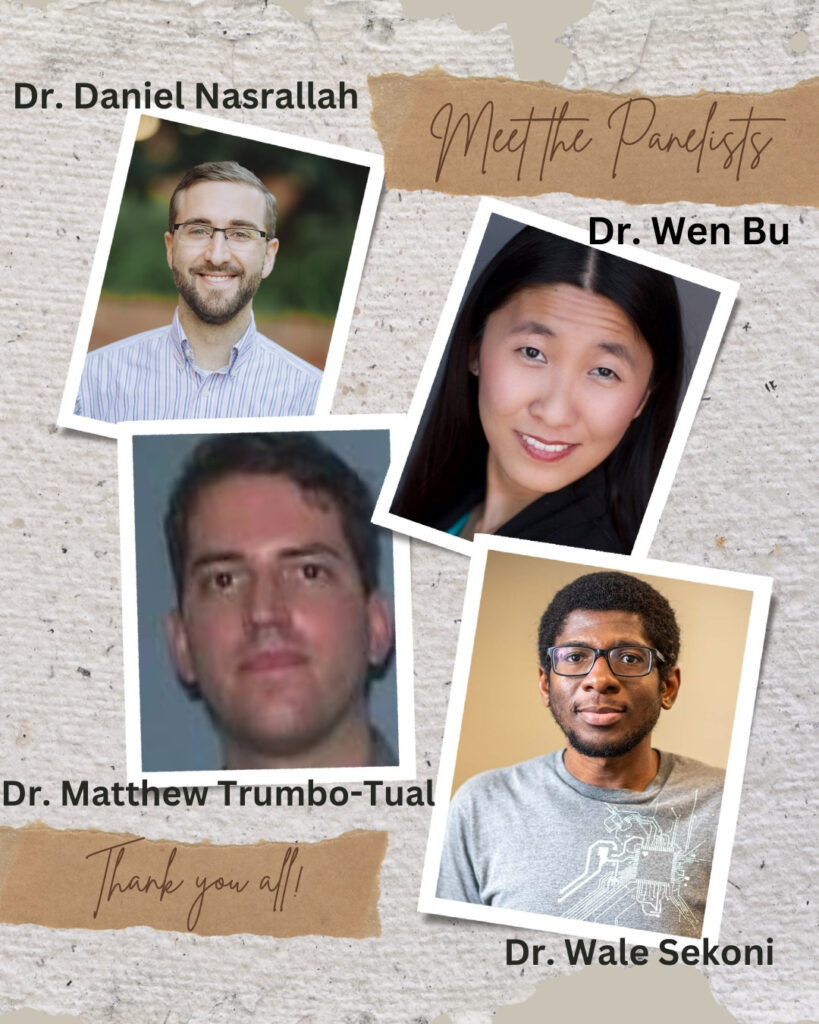
Dr. Daniel Nasrallah is an assistant professor in the Chemistry department here at Roanoke College. He applied to 11 schools nationwide and was accepted to four of them, eventually landing himself to earn a PhD from the University of Michigan. He chose the University of Michigan over other schools because there were five faculty that he was interested in working with. It is extremely important to research faculty at the schools you are looking at, because if there isn’t at least a couple that you would be happy working with, that school might not be right for you. To kick off your grad school search, he recommended researching the top 10 programs in your desired field, and then reaching out to undergraduate faculty and current graduate students in those programs to get more insight. Dr. Nasrallah suggested knowing what your end goals are, and keeping your motivations in sight throughout your time in school. He also found it important to note the differences between graduate school and medical school—in terms of money—when making your decision. Medical school acquires debt, whereas he was offered a stipend through agreeing to teach throughout his time at the University of Michigan.
Dr. Wen Bu, who went to law school and practiced as a lawyer before going back to get her PhD at the University of Minnesota, offered tips on transitioning from being a successful student to balancing coursework and producing research. Dr. Bu is now an assistant professor in the psychology department. In graduate school it is equally important to avidly complete coursework and to complete meaningful research. She also discussed the differences between a terminal master’s degree and a PhD. If you are applying for a PhD program, some schools will allow you to earn an MA on the way, and others won’t. This is important to consider because if you were to drop out after, say, 3 years, at some schools, you can leave with an MA, and at others, you would leave with no degree.
Dr. Matthew Trumbo-Tual, from the Roanoke College modern language department, earned a PhD at the University of Virginia. He provided advice for graduate school applicants interested more specifically in the humanities. He suggested taking advice from your Roanoke faculty, but also remembering that graduate school is ever-changing, meaning do your own research in addition to considering the experience of past grad school students. He also recommended getting work experience outside of academia before applying for a PhD, as this is the path that he followed. This allowed him to not feel “stuck” at any point in the process, and he knew he would have options down the line, if grad school didn’t work out, or if his goals changed. A final remark spoke to being intentional in each step of the grad school process – know why you want to be there and make progress that gets you closer to your goals.
Finally, Dr. Wale Sekoni works in the computer science department at Roanoke College. He earned a PhD from the University of Wyoming and suggested prospective applicants find someone they want to work with and be flexible with their goals. He also mentioned the importance of putting thought into your application and having strong letters of recommendation. Many of the other panelists also supported the idea that strong letters of recommendation make a big difference, so make use of your time with professionals you meet throughout your time prior to graduate school.
Overall, the panel offered insight on how to stand out in your grad school applications. In the humanities, being knowledgeable in multiple languages can help you stand out. For chemistry applicants, published work and research experience can help you stand out, as well as having strong and specific letters of recommendation. For law school, undergraduate GPA, LSAT scores, and letters of recommendation are very important.
No matter what field you are looking to pursue, doing your research and being aware of all the details of the graduate school process can help you make the best decision for yourself and your future. If you have further questions or would like to discuss any these panelists experiences with them, please find their contact information on the Roanoke College website.
Are you feeling the pressure of midterms week on the Roanoke College campus? Don’t worry, you are not alone! In this blog post, we will look at some of the resources available on campus to help manage stress and make midterms week a bit more bearable. Midterm week can be a stressful time for college students, but it doesn’t have to be. With the help of Roanoke College’s campus resources, students can practice self-care and find strategies to manage their stress levels during this hectic time. So, if you’re feeling overwhelmed, read on to find out how you can make midterms week a little less stressful.
Make your best efforts to adhere to the following reminders:
Manage your time! Whether this be in consideration of course work, exercise, sleep, mental health needs, etc., make a plan of when you’re going to set aside time for each of these to-dos and stick to your schedule!
Learn to say no! Manage your expectations for yourself and learn to prioritize certain needs/responsibilities over others.
Get quality sleep! We know that sleep is beneficial for our mental and physical wellbeing. Make it a priority this week in order to be a better version of yourself. You, and others, will be happier if you do this!
Take breaks! Studying for hours on end can become ineffective at a certain rate. Take 5-15-minute breaks when you start to catch yourself dozing off or not entirely focused on the material. Get some fresh air, go on a short walk, grab a healthy snack, chat with a friend and take a deep breath… it’s almost fall break!
Below is a schedule of events/activities being hosted on campus within the next week. While you’re creating a schedule for yourself, block out some time to attend at least 1 of the following events. Your brain and body will be glad that you did!
TOMORROW, OCTOBER 7th
Out of the Darkness Walk – A community walk to raise awareness and funding for suicide prevention and mental health awareness. Check-in is at 9:00am and the opening ceremony begins at 10:00am.
Are you an undergraduate student looking for tips and tricks to help you succeed in your studies? Look no further!
The Psychology Department at Roanoke College has gathered advice from our experienced professors to help you get the most out of your undergraduate career. In this post, we will discuss the top tips and tricks for undergraduate success, courtesy of our very own professors. We have also asked professors to advise specifically to the feat of preparing and applying for graduate schools. There is a lot of great information that will truly help you make the most out of your time and successfully prepare yourself for what is to come! You can only benefit in learning from those who have achieved before you.
Dr. Buchholz quotes Albert Einstein in saying that “Genius is 1% talent and 99% percent hard work. Thinking is hard work; that’s why so few do it.”
According to research into growth mindset and academic success, the biggest factor in academic success is effort; and effort does not always mean the amount of time you spend. While many things like writing a paper or studying for a test do take time, it is crucial that the time you spend is spent wisely—some methods of studying are more effective than others.
Reach out to your instructors and advisors for help navigating how to be both efficient and effective. Your professors spent many years figuring out how do this well and all of us chose to teach at Roanoke College because we care about helping our students thrive.
In addition to putting in the work, wellbeing is another critical component to academic success and thriving as a human being. Take care of yourself, get enough sleep, develop self-compassion for your shortcomings, try mindfulness practices like meditation, exercise, and most importantly, spend time with others.
Dr. Allen speaks to cultivating relationships, getting letters of recommendation and building a resume for yourself:
Cultivate relationships with faculty so that professors can write you a meaningful letter of recommendation when the time comes. These letters of recommendation are so important! Your quantifiable information like GPA and GREs can get you on a short list, but then it’s activities and your letter and your LORs that make the difference whether you get the nod or not.
If you can, get an internship in a relevant organization. That way you can get a LOR from someone who has seen you in a situation that’s different from what your professors have seen.
Dr. Findley-Van Nostrand provides students with numerous tips on preparing for graduate school and life after Roanoke:
Think about grad school as prep for your career… what do you want to do longer term? Make sure your program gets you there (especially in Psych, where programs have a very wide range of intended outcomes).
If you want a Ph.D. – why? Many students aim for this without recognizing that the career they want might not require a Ph.D. (for instance, counseling or social work!)
Differences between kinds of helping professions are important – talk to us about social work, counseling, psychiatry, psychology, etc.
Do well in your classes, but also think about what other experiences you can aim for to make yourself competitive. Internships and supervised research are at the top of that list for psych and psych-adjacent programs! Try not to wait until your senior year – given application timelines, the earlier you can jump on experiential learning, the better.
Make an individualized plan, and give yourself timelines to achieve different parts of the plan. Assume that applications will start being due the November prior to any Fall start date (for instance- want to start Fall 2025? Assume your materials should be together by Nov 2024). This is a conservative timeline since some programs accept applications all the way up until April or May of the same-year start – but it ensures you are prepared.
Look into what the application requires. Personal statement? Get as many professional eyes on it as possible – from career service folks, but also your professors who are in the field. GRE? Many don’t require it anymore, but some do… if they do, prep for the test and don’t take it cold (don’t waste your money with the attitude of “I can always take it again”). Do you need recommendation letters? Give your letter writers plenty of time and all details about you and the places you are applying (many require 2-3 letters, some require those letters to be from professors specifically… think about who can best evaluate your ability to succeed in the program and career you are aiming for).
Don’t apply to the shiny named schools only – some of the best experiences will be had in programs that are not in fact on a Google-able “top 10” list.
If you are aiming for a career that requires licensure, be sure to think about that process in addition to the academic components, and also pay attention to state-by-state licensing rules.
Don’t be nervous about whether you are good enough, and if you get a rejection, don’t let it derail you. It’s a numbers game that doesn’t always land in your favor and is often not at all about you. Shake off the imposter syndrome! What feels hard now will help you improve your future life.
Dr. Cate provides insightful tips, and personal experience, regarding Ph.D. programs:
Attending a Ph.D. program is free, in the sense that 1) you don’t pay tuition, and 2) you usually get paid a very modest stipend. The stipend is almost always in return for teaching courses as a teaching assistant, or doing similar work (such as research assistant for your advisor). I didn’t know this at first when I was in college, and it ended up having a big influence on my decision to get a Ph.D. versus another kind of degree.
The best thing you can do when applying to Ph.D. programs is to have some kind of personal contact with a faculty member. Applying to Ph.D. programs is not at all like applying to college. When it comes down to it, you will be accepted by one individual faculty member at your school, and not by a committee. This means that someone has to know your name, either because your application materials are outstanding, or because they talked with/read an email/heard about you.
Actually, even if your application is outstanding, there is no guarantee that anyone will read it, so I can’t emphasize getting your name into faculty inboxes enough. I think a great way to introduce yourself is to send a brief message to interesting-looking faculty, asking them whether they are planning to accept graduate students this year. (Do this before applications are due.) You don’t necessarily need to say anything else about yourself (but it wouldn’t hurt!). The point is to get the faculty member familiar with your name so that they will make the effort to look over your application later. Your application will have good things in it, and you will want people to read it!
Even if you’re not sure whom you would like to be your advisor yet, it’s good to get in touch with someone. When I worked at Virginia Tech, I accepted a great grad student based on the recommendation of a colleague who had read their application and thought we were a good match.
A couple addition notes:
Juniors – Fall Break can be a great time to begin researching graduate programs, even if you aren’t applying until next year. Plan on talking with your advisors after Fall Break about what’s involved in applying to graduate school or what would be helpful to do to prepare for a job after graduation.
All – Please reach out to your advisors or other college faculty and staff if you would like more support in your post-graduate decisions and endeavors. Roanoke College is intended to get you to graduate, but we also want each of you to succeed for years to come. Please utilize the resources available to you and speak with your experienced and knowing advisors/professors/PLACE staff, etc.
Stay informed and be on the look out for resources and opportunities! The following newsletters have information regarding research, internships, conferences, and graduate school. Joining newsletters and remaining informed is one of the best tools that you can arm yourself with as an undergraduate students. Make the most of your time and attention!
Psychology Student Network (PSN) listserv – A listserv for sharing more time-sensitive announcements about opportunities for internships, undergraduate research opportunities, and undergraduate conferences. Interested students may join through this link.
You may recognize the acronym APA as the citation style psychology students use to write papers. But who or what is APA and what do they do? This post is APA 101: a beginner’s guide. The American Psychological Association has a wealth of resources you should be taking advantage of as a student and professional. Read on and click the underlined links throughout this post to explore how APA can serve you!
Background
The American Psychological Association is a professional organization representing the field of psychology in the United States. Founded in 1892, today’s APA has more than 13,000 members who are professionals and students connected with the study and practice of psychology (source).
(Important note: APA could also stand for the American Psychiatric Association, a similar group which focusses on the related field of psychiatry. Try not to mix them up!)
Citations
Let’s start with the basics for college students: citations. As a student, you will use APA style for papers and projects for class. If you conduct research in undergrad, graduate school, or during your career, you will publish your findings using APA guidelines. All current American psychology research is published and presented in APA format, so it is important to understand it so you can read the latest findings in the field.
But APA citations aren’t just standard in psychology. This style is also widely used in other social sciences as well as the fields of engineering, nursing, and business.
Luckily the APA’s website has a guide for using this style. This page features sample papers, helpful tips, and instructions for formatting your work and citing your sources. Bookmark the guide so you can find it for your next project!
Psychology Student Network (PSN)
Are you an undergraduate student who loves psychology but is looking for direction? Click here to find the latest edition of Psychology Student Network (PSN), the APA’s publication just for undergraduates.
It’s no secret that many psychology careers require a graduate degree. If you are planning to attend graduate school, visit APA’s grad school page for information about finding and applying to graduate programs, and how to succeed once you get there.
Don’t forget to take advantage of the graduate program search tool as you prepare for the next step in your education.
Career Hub
If the student chapter of your life is coming to an end, APA is there to guide you through your career.
Start here with the career options guide to learn about potential careers in psychology. Then, read APA’sjob search tipsto guide you before diving into the job search tool to locate current job openings nationwide.
Media
Last but not least, on to the fun stuff! APA has a number of resources to satisfy your curiosity about all the current topics in psychology.
Speaking of Psychology is a podcast hosted by Kim Mills, the APA’s senior director of strategic external communications and public affairs. Each episode, Mills interviews psychology researchers and practitioners to highlight new research and practices in the field. You can listen to the podcast on APA’s website, Spotify, Apple Podcasts, and Stitcher.
To learn about the most pressing topics that connect psychology to everyday life, check out this hub of current issues featuring articles about the biggest themes in the field today.
Finally, you can read the freshest scholarly papers on APA’s current researchpage. Here you can stay current on the latest findings in psychology.
The biggest takeaway from this post? You should visit the APA website! Whether you are a student, researcher, professional or just someone who thinks psychology is cool, there’s something for everyone at APA