Congratulations to Dr. Darcey Powell and alumni Stephanie Gaines (class of 2017) on their recent publication by Psi Chi. The publication is based on one of Gaines’s projects that took place in Dr. Powell’s lab during her time at Roanoke College. More information about the information can be found here, but you can read the abstract below:
Emerging adulthood is a time of great transition, including but not limited to the commencement of “adult roles” and responsibilities. The present study examined emerging adults’ (EAs’) perceptions of transitional (i.e., cohabitating, marriage, parenting) and gradual (i.e., religious beliefs, political beliefs, managing own health) roles. Participants were recruited from a small liberal arts college (N = 88) and from Amazon’s Mechanical Turk platform (N = 181). They were surveyed on the age at which they anticipated or reported achieving the examined roles and their current self-efficacy for the roles. Female EAs reported intending to or achieving the transitional roles at a significantly later age than female EAs of the late 20th century (ps ≤ .001, ds 0.77–0.95). Additionally, female EAs anticipated role achievement for cohabitating, marriage, parenting, and religious beliefs at later ages than male EAs (ps < .05, gs 0.33–1.33). Moreover, male and female EAs differed in a few role-specific self-efficacies if they had not yet achieved the desired adult role (e.g., marriage, parenting; ps < .05, gs 0.62–0.98), but did not differ if they had already achieved the role. Lastly, the difference between EAs’ age and their role achievement largely did not predict their role-specific self-efficacies. The results provide additional insight into EAs’ expectations and current perceptions of themselves and may be useful to individuals who work regularly with EAs who are apprehensive about the extent to which they are “on time” and “ready” to engage in the examined transitional and gradual roles.
The only thing scarier than Halloween this month is mid-terms. Have you started (even thinking) about studying yet? Whether you have a color-coded plan or this is the first time you’re realizing mid-terms are a thing, here are some tips and tricks to stay calm, stay smart, and ultimately ace your quickly approaching mid-terms week. Remember, you’ve got this!
Study Smarter
Have you ever really used the school’s academic resources? Please do! In addition to going to your professors’ office hours, students should check out the Goode-Pasfield Center for Learning and Teaching, which is located in the Fintel Library and is the focal point for academic counseling and academic support on campus. The staff will assist you in identifying your academic strengths and weaknesses, designing an individual study program, and resolving your academic concerns. The Center coordinates academic advising for undeclared students, the Writing Center, the Subject Tutoring Program, the RC Success Program, and Accessible Education Services. Dr. Sue Brown directs the Academic Services. Dr Sandee McGlaun directs the Writing Center. Check out this site for instructions on how to make your own study schedule.
Mix Up Your Methods
We all know that awful feeling of sitting in your dorm room and staring at assignments for too long. It is exhausting and drain us of the little motivation we have left at this point during the semester. Try switching up your study location (the library, an open classroom, off-campus coffee shops, etc.) to add some variety into your routine.
If the way you’re studying is the problem, try using an online learning tool or asking a friend to quiz you so you get a break from reviewing your notes. In fact, ask a couple of friends if they would like to get together and set up a study session. You can work on similar tasks or completely different ones – but having someone else there may help keep you accountable for the work you’re meant to be doing.
Stay Calm
Feelings of anxiety and stress are almost unavoidable for college students as a busy week approaches, but there are plenty of things you can do for yourself that will help you remain calm and, ultimately, perform better. The main thing is to get some sleep. You might be tempted to pull an all-nighter, but a good night’s sleep is key to your success. An extra hour of sleep will take you wayyyy farther than an extra hour of cramming for an exam. Next, remind yourself that you can do this. You were smart enough to make it this far, and you are smart enough to make it through mid-terms. Remember to use your support network: friends, family, and faculty and staff are here to help you make it through stressful times.
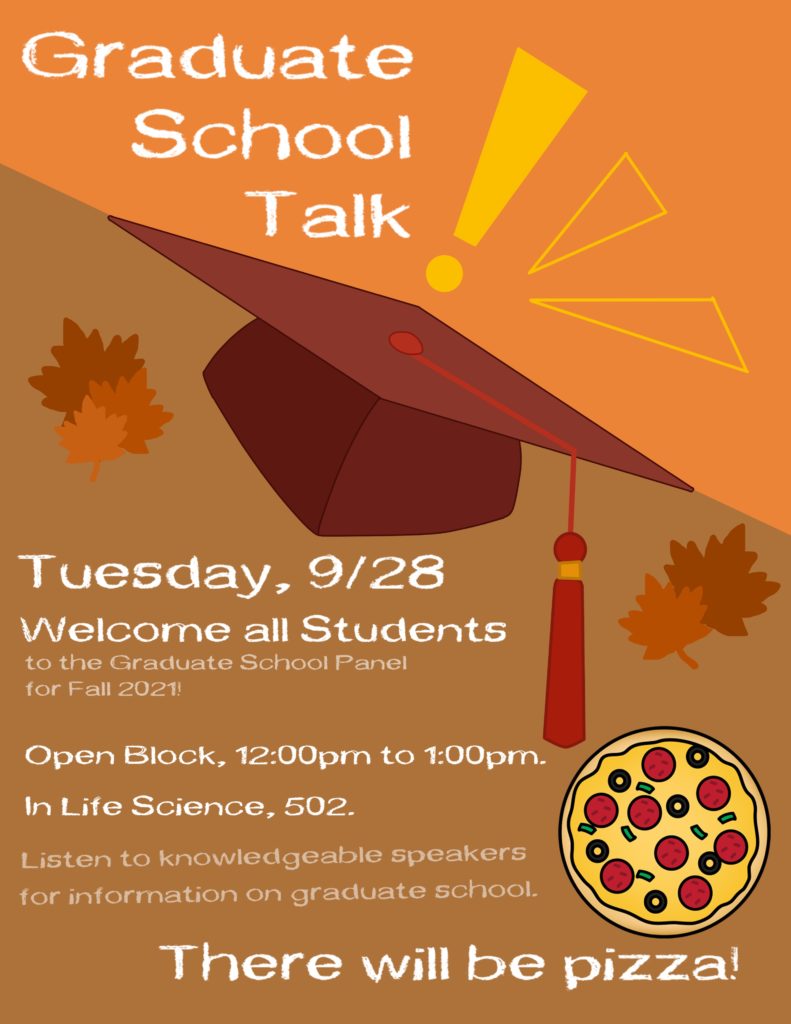
This is a great opportunity for all Roanoke students! At this panel you can ask any questions you have in regards to graduate school. This event takes place tomorrow (9/28) from 12-1 in life science 502! Bonus- there will be pizza for everyone! I hope to see you there!
The Psychology Department fondly remembers Dominique Bowers, a 2015 graduate who transferred to Roanoke College in 2014 to complete her Psychology degree. She was well liked and respected by her faculty, clearly working hard on her classes while raising young children. She died August 13, 2021, in Warner Robins, Georgia.
What you need to know about the department: Majors, minors, and concentrations
Hey new (or not-so-new) students! Have you been debating joining the Psychology Department at Roanoke College? Or maybe just wanting to know more about our programs? You’re in the right spot! Below are the basics about the department and different programs we offer. More information can always be found online or acquired through professors and student assistant staff. Let us know your questions!
Major in Psychology
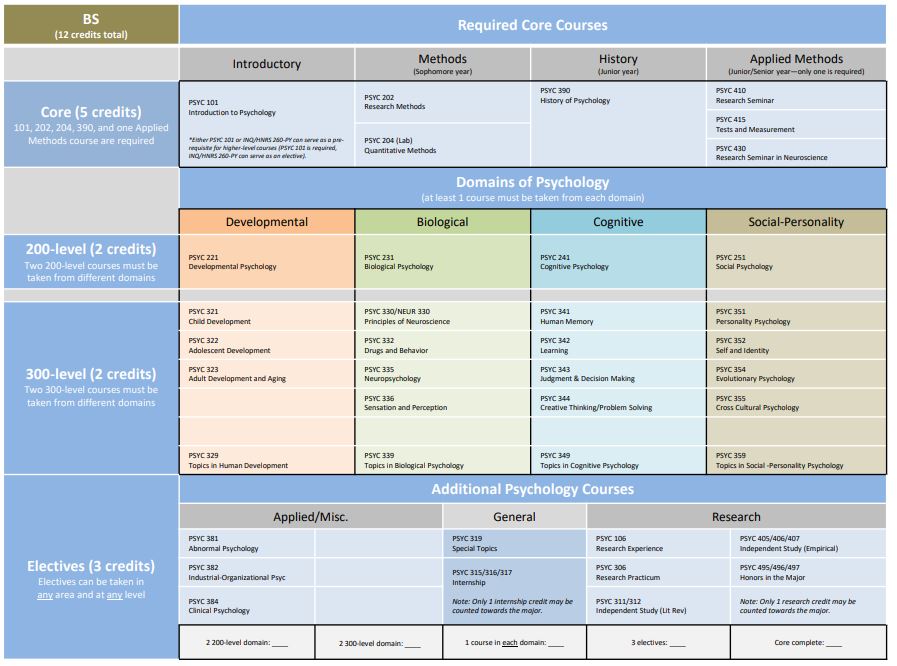
Note: The requirements listed below are for students declaring the Psychology Major anytime after 8-11-2021. To see OLD requirements for those declaring the major prior to this date, please refer to our website.
The psychology major is a bachelor of science and requires the completion of 12 units. These units include core (general and methods) classes, one class from each of the 4 domains of psychology, and three elective classes.
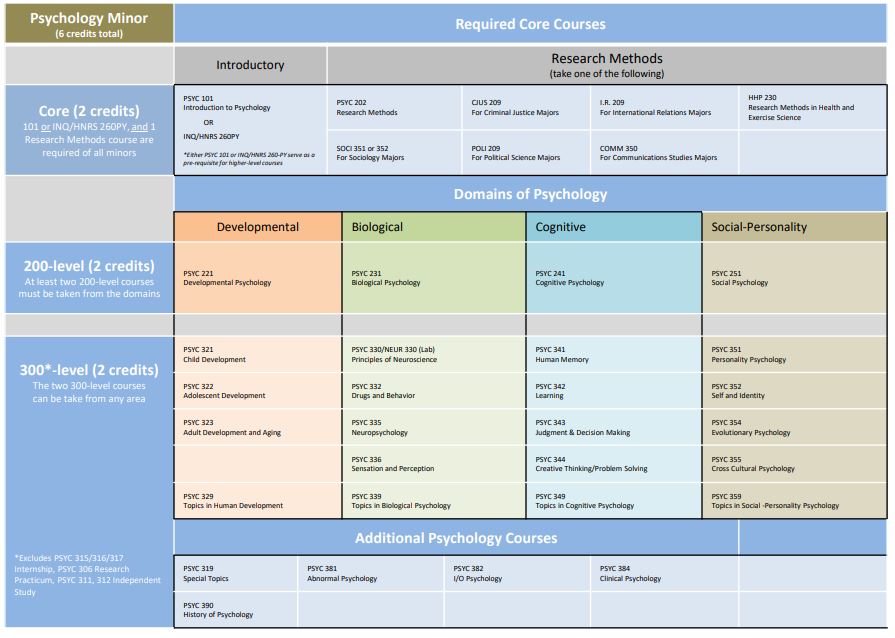
Minor in Psychology
Psychology intersects with many other areas of study in a variety of ways because of its focus on people. A minor in psychology can be a useful addition to any major with the selection of courses tailored to fit what is most relevant to the student. The minor in psychology requires the completion of 6 units.
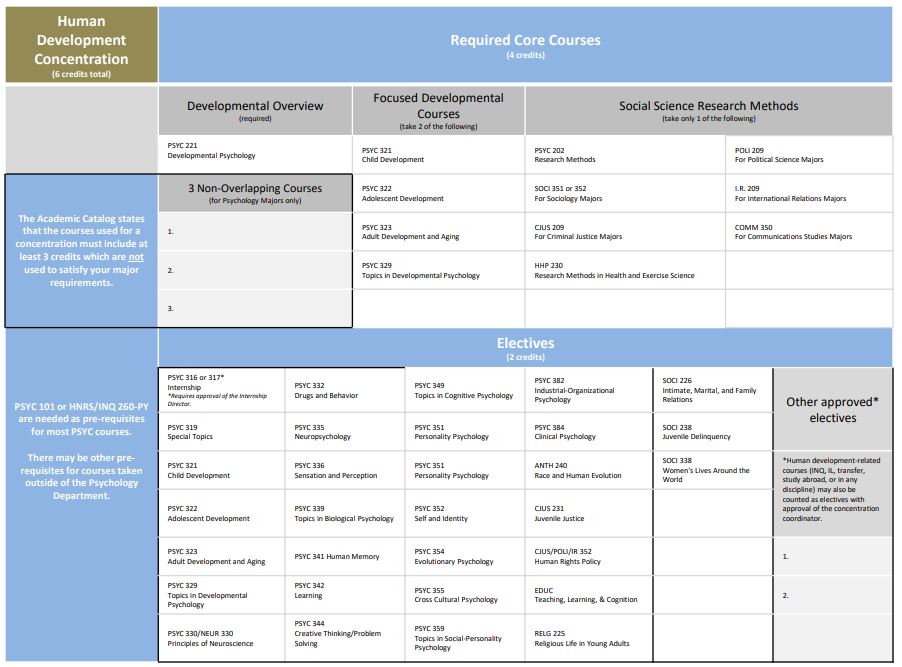
Human Development Concentration
The Concentration in Human Development exposes students to the broader life-span perspective and allows them to focus on the stages (e.g., childhood, adolescence, adulthood) and the topics most applicable to their personal or professional goals. The concentration requires six units and the faculty coordinator is Dr. Powell.
Neuroscience Concentration
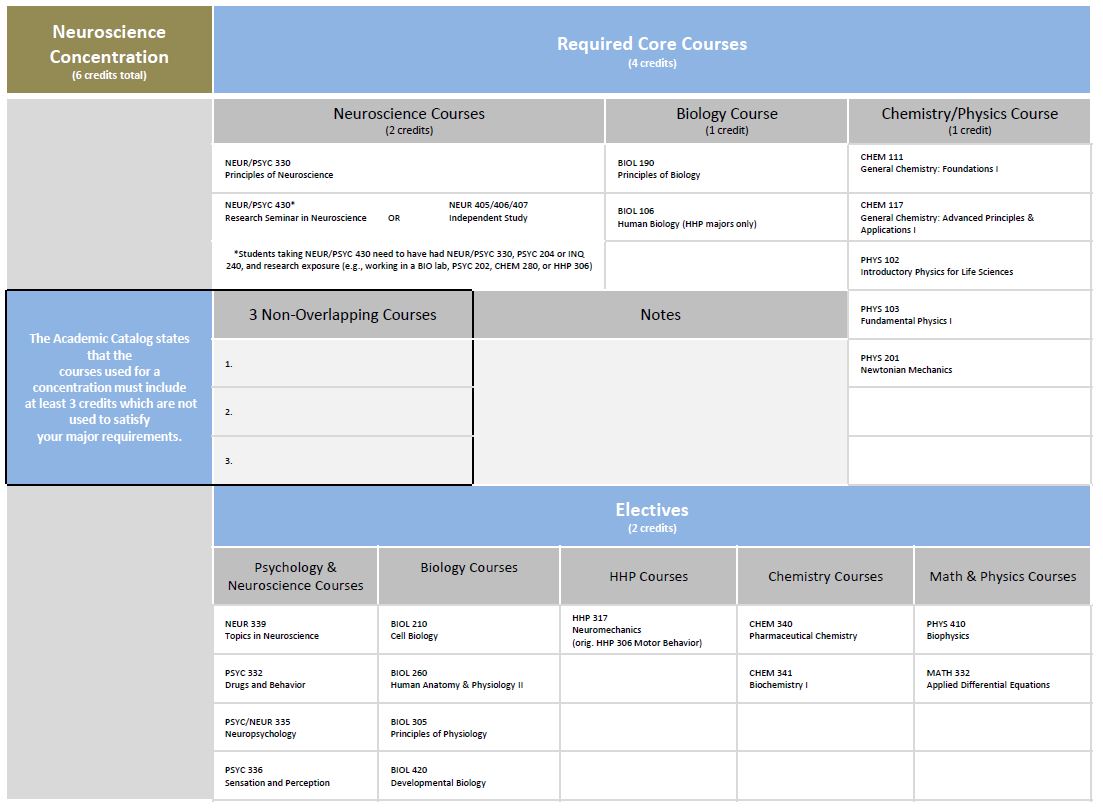
A concentration in neuroscience will offer students an opportunity to learn about theory and research on the brain and nervous system from a number of perspectives. Students will come to understand how developments in biology, psychology, chemistry and related fields alter knowledge and research techniques in the other fields. The faculty coordinator is Dr. Nichols.
Ready to declare? You can do so online here… or you can find a list of our amazing faculty members on this page. Contact one of them to find out more information on whichever program you may be interested in. And make sure to check out the spreadsheets with course information – you may be surprised by how diverse and interesting the Psychology Department’s curriculum can be. We can’t wait to have you!
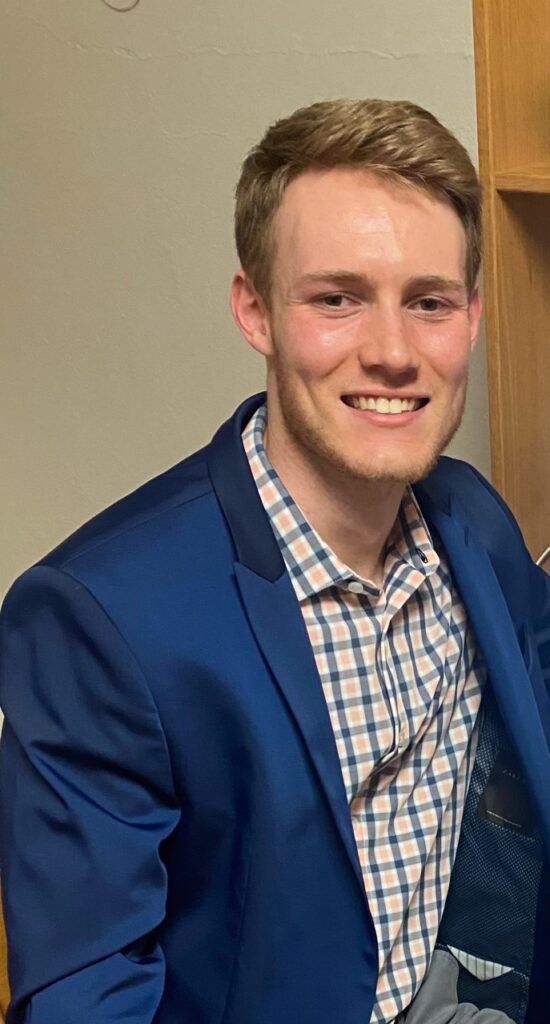
Claire McDonald and Ben Campbell, both psychology seniors at Roanoke College, were recently featured on Roanoke’s website for their research experience. You can check out the full page here.
Claire McDonald, Class of 2022
Claire wasn’t sure what degree she wanted to pursue when she first came to Roanoke College. But during the fall semester of her sophomore year, she enrolled in a developmental psychology class, taught by Dr. Danielle Findley-Van Nostrand, assistant professor of psychology. She loved the class and, consequently, found her major.
In the spring of her sophomore year, McDonald joined a lab managed by Dr. Findley-Van Nostrand, which focused on adolescent and young adult peer relationships. This sparked her interest in research within psychology. This fall, Claire plans to work as a research intern at the Veterans Affairs Medical Center in Salem. She hopes to apply to graduate school to pursue a doctorate in clinical psychology with a specific interest in research related to dementia and cognitive impairment in older adults — experience Claire said she hopes to gain at the VA Medical Center. But she’s not the only psychology student that has recently made big steps in their research experience…
“Research has played a huge role in my college career and in my development as a student. It has been the most crucial and beneficial part of my college experience.”
Ben Campbell, Class of 2022
Ben Campbell has used his interest in relational aggression, peer social dynamics and gender to formulate a study. He used the study to apply for the College’s Summer Scholars Program and received the prestigious award, enabling him to carry a project titled “Effects of elicited jealousy on masculinity and relational aggression in men.” You can check out more info on his research journey in our previous blog post, found here.
In recent years, approximately 30 students each semester have been involved in research. The experiences are important not just for information discovery, but also for deepened learning, enhanced training on specific topics or methods, and the development of skills that graduate training programs and employers in careers utilizing psychology look for and highly value. As a research assistant, students also develop professional and mentoring relationships with their faculty mentor, and refine critical thinking and statistical reasoning skills.
“The experience to contribute to a discipline in a larger way is a special opportunity,” Dr. Findley-Van Nostrand said. “Apart from the professional skills developed, the research experiences students at Roanoke are involved in also contribute to the sense of community we have in the department.”
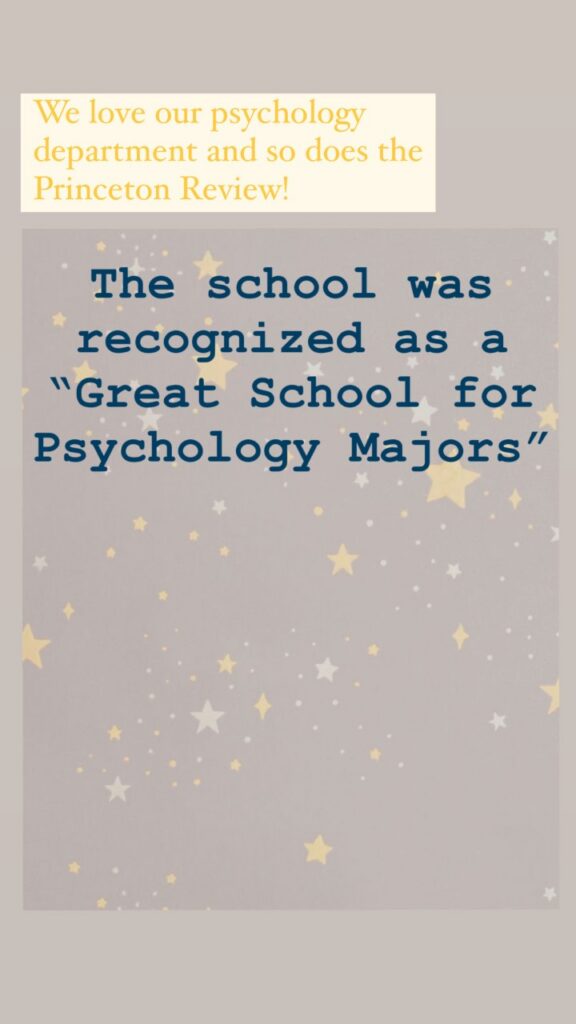
Research is the bedrock of the student experience in Roanoke College’s psychology department, which brought the College its seventh consecutive “Great Schools for Psychology Majors” recognition in The Princeton Review’s annual “Best Colleges” guidebook, released on Aug. 31.
Ben was just granted funding from Psi Chi, the International Honors Society in Psychology, for his research!
Benjamin Campbell ‘22 was recently a part of our Summer Scholars program here at Roanoke, during which he conducted a study that was built from previous work he completed in the Social Development Lab. Ben’s project is titled “Effects of Peer-Elicited Jealousy on Relational Aggression in Men: The Roles of Contingent and Threatened Masculinity”. He worked very hard on this project, supervised by Dr. Danielle Findley-Van Nostrand. Leading up to the summer, they applied for and were successfully granted $1,118 to fund this and subsequent studies including Ben’s Honors in the Major Project.
Project Abstract:
I asked Ben to give a summary of his research and he wrote,
“So, this summer I conducted a research project as a Summer Scholar at Roanoke. The study looked at how jealousy affects threatened masculinity and relational aggression use in men. In other words, does feeling jealous in a friendship context with other men also produce feeling less masculine, and thus result in using relational aggression? My results found that following jealousy provoked by male peers, men felt less masculine and used more relational aggression relative to men who were not in the jealousy condition. But, some effects did not emerge as expected. I applied for funding from the “Psi Chi Undergraduate Research Grant” and was awarded it. So, I got funding to continue my project. In my honors in the major, I plan on expanding on the summer project and potentially investigating other variables that may play into the effects I found this summer. Overall, I thought the summer scholars experience was great, and the funding from Psi Chi is amazing.”
Congratulations again to Benjamin Campbell, keep up the great work and we are excited for what your future has in store.
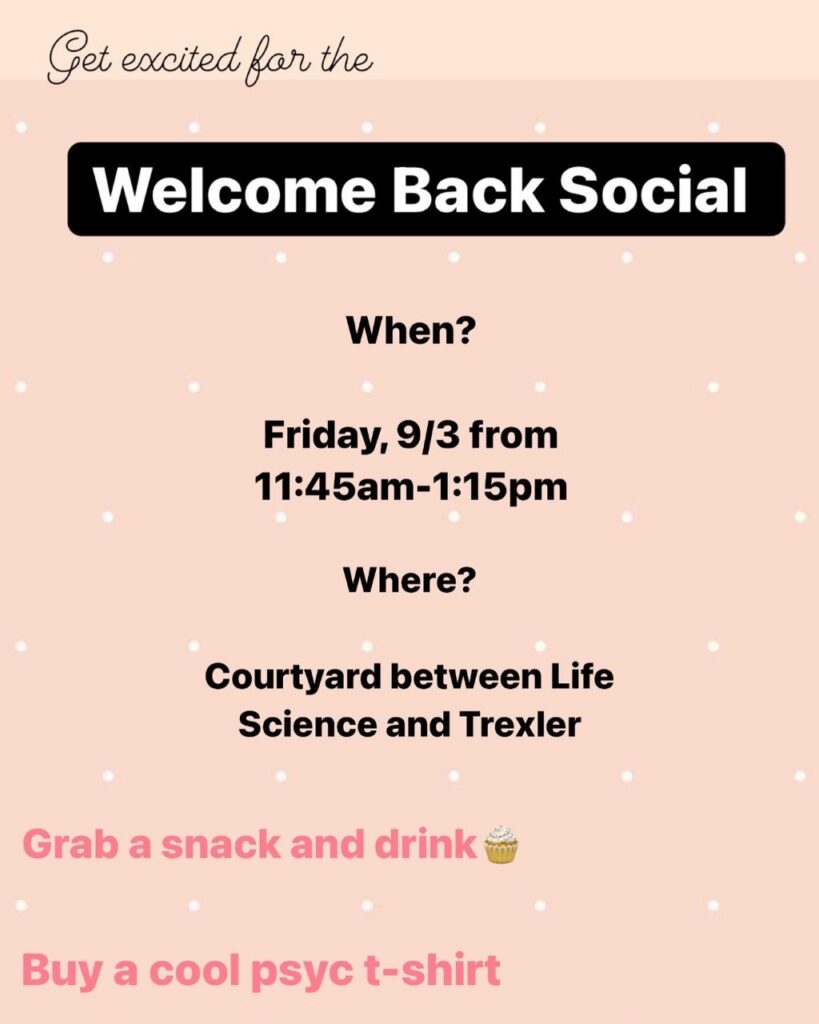
When? This Friday ! (September 3rd from 11:45-1:15)
Where? Courtyard between Life Science and Trexler!
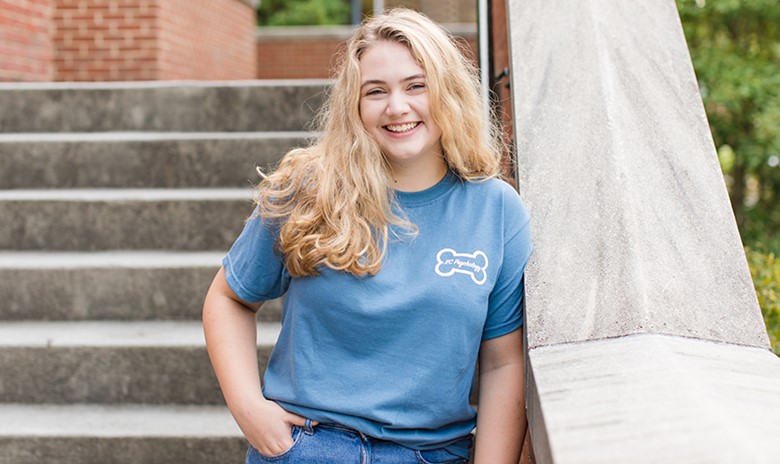
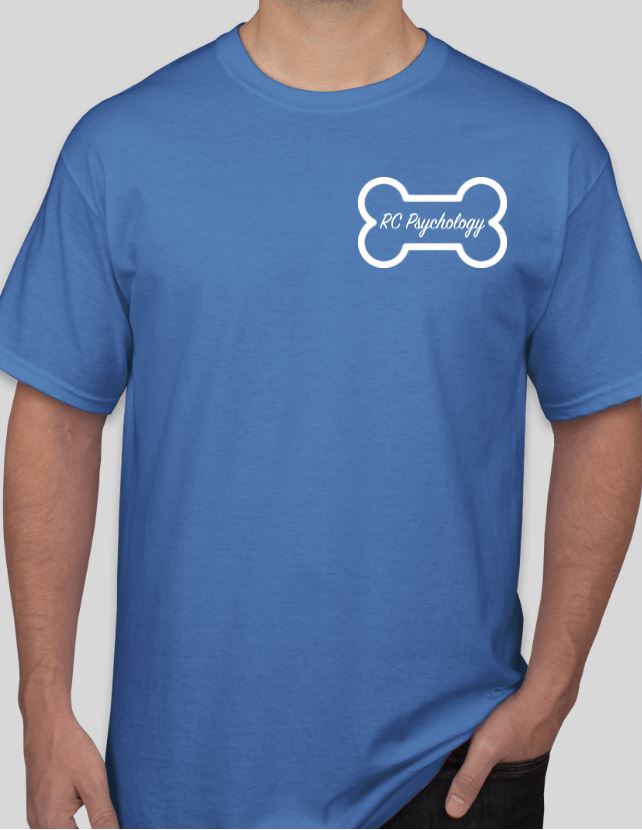
Please join your fellow Psychology students and faculty at a Welcome Back social on Friday, 9/3! We will meet in the courtyard area between Life Science and Trexler between 11:45a and 1:15p. Snacks and drinks will be provided, plus you can purchase an RC Psychology shirt! All students are welcome – majors, minors, concentrators, students currently in psychology classes, and students who may potentially take psychology classes in the future! Hope to see you there!