Category: Undergraduate News

  • How to “stand out”

    No matter what year you are, it is never too early or too “late” to begin considering what you want to do during your time at Roanoke College, in order to stand out to potential future employers or graduate programs. Therefore, whether you are a first-semester freshman or a first-semester senior, there are always things you can be doing on and off campus to prepare you for your future post-grad studies or jobs in psychology.

    If you plan to pursue a career or graduate program in psychology then follow this post as a guide to begin building up your resume or CV with experiences that will help you stand out to future employers or programs.

    Plan ahead

    You do not need to have your future plans set in stone at any point during your college career, but it may be good to start considering different options and creating plans around those options. That is, look at what courses you will need to take to complete your major/minor/concentration and roughly layout when you will take them. Moreover, consider what you do and do not want to do while in college (e.g., internships, research, study abroad, etc.). This initial planning stage will help you in the long run but is not limited to those in their freshman year.

    Seniors, planning may look different, but consider different post-grad options and begin looking at what they require. From here, plan out what to do during your final two semesters and post-undergrad to help you get into the job/programs that you are looking into.

    Explore options

    When considering what you want to do in psychology consider the multiple options available to you. Look into different career paths, graduate programs, or post-grad internships and research opportunities. Do not be afraid to take a gap year after graduating from Roanoke College to explore these options and to gain some more work experience or research/internship experience. There is no specific plan that you need to follow to become a successful psychologist, so look into options to find a plan that works best for you.

    Look at expectations/requirements

    If you are looking to enter into a graduate program or a specific job, look at the application requirements and deadlines early on. Even if you have no idea where you want to go or what you want to do, looking into different programs and seeing what they require of applicants is a good start. In doing so, you may find that multiple programs are expecting similar requirements such as research experience or a GRE score. In noticing these commonalities, you can adjust what you are doing to ensure you complete these items on time.


    Get involved

    It goes without saying, but getting involved is important to all employers and graduate programs. Whether it be gaining world-experience in the form of internships, study abroad, or jobs, or gaining academic experience in the form of research, honor societies, and a variety of courses, or through being apart of outside activities such as sports teams, and other clubs and organizations, it is beneficial to get involved both on and off-campus.

    Consider an internship

    An internship is one of the best ways to gain work experience while in undergrad. Not only are internships a way to build connections, they also give you real-world experience, and introduce you into the field you may be interested in. Moreover, they are also beneficial as they can lead you to realize you want to pursue a different path. Do not feel discouraged if an internship leaves you wanting to explore a new area as this is equally as beneficial as an internship that proves to you that you are on the right path.

    All in all, internships can help guide you in solidifying your interests as well as showcase to you what your interests may not be.

    More information on internships can be found here

    Consider research

    If you plan to enter into a graduate program, specifically a Ph.D. track, considering research is highly important. Most graduate programs suggest or require that you have some research experience at hand. While taking quantitative methods and research methods is a good introduction to research, conducting research alongside a psychology faculty or other students is a way to further enhance those skills. Moreover, conducting research can lead you to present at conferences or getting published, which as an undergraduate is a major accomplishment.

    More information on the research can be found here!

    Consider studying abroad

    While studying abroad is not for everyone, it is a great experience that not only enhances cultural knowledge but leads to self-development. Studying abroad offers a lot of self-development that can be beneficial and will look notable when applying to jobs or graduate programs. There are a variety of study abroad options available, and if you plan ahead early, you can ensure that courses you take while abroad can fill requirements you may need, as well as find a semester where studying abroad works best for you.

    More information on studying abroad can be found here!

    Reach out to Professors/Advisors

    After reading all of these options you may feel lost, which is completely normal! That said, you are not alone and your professors and advisors can be a great resource in guiding you towards your next steps. Reach out to your advisors if you are struggling with where to begin or on what you can achieve during your semesters at Roanoke College. Moreover, reach out to professors that share similar interests to learn more about how they went about applying to programs, finding jobs, or for advice on what specific things you should or could be doing.

    Here are current professors specialties and interests:

    Dr. Allen: Psychopharmacology and abnormal psychology

    Dr. Buchholz: Self, consciousness, evolutionary psychology, and moral decision making

    Dr. Carter: Social and personality psychology

    Dr. Cate: Cognitive and neuroscience

    Dr. FVN: Developmental, social, and educational psychology

    Dr. Hilton: Clinical and cognitive psychology

    Dr. Nichols: Cognitive neuroscience

    Dr. Osterman: Social psychology and evolutionary psychology

    Dr. Powell: Developmental psychology

    Dr. Wetmore: Experimental psychology and cognitive psychology

    More information about specific professors’ interests can be found here!

    Start drafting your Resume and cover letter, and/or your CV and purpose statement

    If you are interested in pursuing a career or graduate school in psychology then you want to start drafting your CV and purpose statement. On the other hand, if you are looking to go into more general work, you should have an updated resume and cover letter. Whether it be your CV or Resume, these items should be updated when major changes are made, or at least at the beginning and end of each semester, or before they are to be submitted to someone.

    Cover letters and purpose statements can be made quite broad to begin with but should always be specified to match the program you are going into.

    More information on how to write a CV can be found here!

    Refer to the Roanoke College Psychology page for more information

    You may still be feeling a bit overwhelmed on where to begin and where to go for information. While the blog will continue to share advice and information on graduate school or post-grad career information, you may also refer to the Roanoke College Psychology Page for more resources and information.

    Best of luck to all of you as you continue on your journey towards becoming a psychologist and know that the fifth floor is always cheering you on and here to help (even if virtually)!

    .

    .

    .

    Get Connected!

    Bloghttps://psych.pages.roanoke.edu/
    Facebookhttps://www.facebook.com/rcpsychology
    Twitter: @RC_Psychology
    Linked In: https://www.linkedin.com/groups/RC-Psychology-8140491/about
    Website: https://www.roanoke.edu/inside/a-z_index/psychology
    Instagram: rcpsychology
  • Specialties in Psychology: Sports Psychology

    Nova Scotia Sport Hall of Fame announced 2019 inductees - HalifaxToday.ca

    There are many interesting fields of psychology that cater to different interests! An example of this is sports psychology. In this field, the interaction between psychology and sports is studied. Sports psychology includes a broad array of topics including athlete well-being, the relationship between sports and social interactions, and the issues associated with sports and their respective organizations. Sports psychology can be used to help many different people including kids and Olympic athletes. Additionally, sports psychology is a complex field with many different areas of reach. For example, sports psychologists may work with participants with eating disorders, a team that is struggling to work together, or even assist with concentration and attention techniques. This field is incredibly interesting and limitless!

    To view the American Psychological Association’s post click here!

    To learn about a career in Sports Psychology click here!

    Sports Psychology. (2008). Retrieved September 30, 2020, from https://www.apa.org/ed/graduate/specialize/sports

    Nova Scotia Sport Hall of Fame announced 2019 inductees. (2019, June 3). Retrieved September 30, 2020, from https://www.halifaxtoday.ca/local-news/nova-scotia-sport-hall-of-fame-announced-2019-inductees-1487559

    .

    .

    .

    Get Connected!

    Bloghttps://psych.pages.roanoke.edu/
    Facebookhttps://www.facebook.com/rcpsychology
    Twitter: @RC_Psychology
    Linked In: https://www.linkedin.com/groups/RC-Psychology-8140491/about
    Website: https://www.roanoke.edu/inside/a-z_index/psychology
    Instagram: rcpsychology
  • Towson University Open House

    On Saturday, October 17th, Towson University will be hosting a virtual Graduate Studies Open House! Roanoke College alumni Diane Nyugen is currently attending Towson University to earn her M.A. in Experimental Psychology! Attendees of the open house will hear from current students and faculty, and will have the opportunity to ask questions. Finally, students who attend the open house will have the fee waived on their Towson University Graduate Application! For more information, visit the links below.


    To register for the event, click here.

    For more information about the Experimental Psychology program, click here.

    Follow their Facebook for updates on current students and alumni. 

    Contact our program director, Dr. Justin Buckingham at jbuckingham@towson.edu 

    .

    .

    .

    Get Connected!

    Bloghttps://psych.pages.roanoke.edu/
    Facebookhttps://www.facebook.com/rcpsychology
    Twitter: @RC_Psychology
    Linked In: https://www.linkedin.com/groups/RC-Psychology-8140491/about
    Website: https://www.roanoke.edu/inside/a-z_index/psychology
    Instagram: rcpsychology
  • Welcome Dr. Anthony Cate!: An Interview

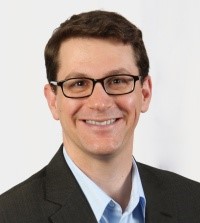
    Dr. Anthony Cate, Psychology Professor at Roanoke College


    The Psychology Department would like to welcome Dr. Anthony Cate to our faculty as our newest professor.  The following is an interview with Dr. Cate where he answers some questions about himself, his interests in psychology, and what he’s looking forward to in terms of teaching at Roanoke College.

    Where are you from?

    I was born in New Jersey, and I moved a lot when I was young.  I have lived in every state between Washington, D.C. and Boston, except for Delaware.  After I got my Ph.D. I also lived in Canada (Ontario) and northern California.

    Where did you receive your undergraduate degree from and what did you study in undergraduate? What was that experience like?

    I got my undergraduate degree from Yale University.  I began as a religious studies major, but I thought that those classes involved too much memorization of names and dates, so I switched to psychology.  Actually, I switched to being a triple major, at least on paper: psychology, linguistics, and East Asian studies.  I shed majors when I figured out that psychology interested me the most.

    I was lucky that I was able to help out in three research labs that had different missions and lab cultures.  I learned that I was bad at doing brain surgery in a rat lab.  I lost some patients.  Everyone there seemed anxious all the time too, which was poignant because anxiety was part of what they studied.  I conducted my first research project in a lab that studied human fear conditioning.  My advisor was a very kind scientist who helped me feel like an important part of the lab, but I disliked having to give participants electric shocks.  I also frequented the lab of my favorite professor, who had taught my perception course.  That lab was very welcoming.  People could just walk in to say hi and check out the experiments, there was a dog, and the students were very productive.  All of those experiences taught me to consider the social environment when I was choosing a graduate program.

    Have you received any other additional degrees? Where did you receive them from?

    I went to Carnegie Mellon University to get my Ph.D. in psychology, which was part of a joint neuroscience program with the University of Pittsburgh.

    Have you taught anywhere else besides Roanoke College?

    I first taught when I was a postdoctoral researcher at Western University in Canada.  My advisor talked me and two other postdocs into teaching one third of a course each, which seemed like a lot at the time.  Later I taught at Virginia Tech, where I worked for nine years before moving here to Roanoke.

    What are you most excited about teaching at Roanoke College?

    I am very excited to teach at Roanoke for many reasons!  It has been hard for me not to talk a mile a minute while teaching during these first few weeks.  It is exciting when students ask me questions, including when I don’t know the answer, because then I get to track the answers down later.  I was very eager to start teaching smaller class sizes.  I think personal interactions form the most effective ways to learn, and instructors get to learn from their students this way, too.  It is also a privilege to join an excellent psychology department where the faculty and staff are so engaged in their mission.

    Dr. Cate in front of MRI machine at Veterans Affairs Northern California Health Care System in Martinez, CA (2007)

    What are your research interests? Why are you interested in this/these field(s)?

    My research investigates how visual perception works, and how it influences other cognitive skills like memory and reasoning about numbers.  I am particularly interested in understanding how different parts of the brain work together.  I have studied techniques for visualizing computer models of brains in order to make maps of which cognitive skills are associated with different brain regions.

    Can you tell us about any research you have already completed in these areas?

    I have published some research about how we perceive the 3D structure of objects, and about how brain damage can alter these perceptions.  I enjoyed learning how to make 3D images using computer graphics, and I especially liked getting to learn what people living with brain damage had to teach me about perception.

    What course or courses are you currently teaching?

    I am teaching Introduction to Psychology and Cognitive Psychology this semester, which is a great combination.  I have been teaching Cognitive Psychology for over nine years, and it is so familiar to me that I get excited when my favorite topics are about to come up in class.  I have never taught Intro Psych before.  It feels like a big responsibility to introduce the entire field.

    Are you interested in taking on students as research assistants?

    Yes!  Students make research better.  I realized a few years ago that when undergraduates helped me with a project, we considered the problems less narrowly.  The projects were much more enjoyable because of all the conversations we got to have.

    What qualities are you looking for in any students who are interested in joining your lab?

    Mainly curiosity, and an appreciation of research for its own sake.  My research questions are usually less about “how can we apply this science?” and more about “how does this work?”  I have had wonderful contributions from students with backgrounds in art and design, but that’s because we had similar interests, and not because students need any particular artistic abilities.  The same has been true for students who are interested in neuroanatomy and computer science.  A passion for those topics makes for a good fit, but students definitely don’t need to have expertise already.

    Welcome to Roanoke College Dr. Cate! Thank you again for taking the time to answer our questions. We are excited to have you here and look forward to learning more about you in the semesters to come!

    .

    .

    .

    Get Connected!

    Bloghttps://psych.pages.roanoke.edu/
    Facebookhttps://www.facebook.com/rcpsychology
    Twitter: @RC_Psychology
    Linked In: https://www.linkedin.com/groups/RC-Psychology-8140491/about
    Website: https://www.roanoke.edu/inside/a-z_index/psychology
    Instagram: rcpsychology


  • HNRS 260 Creates Flyers to Stop the spread of Covid-19

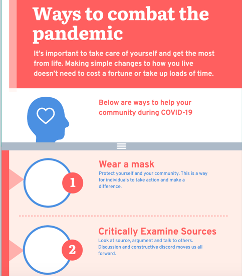
    As a part of Dr. Powell’s HNRS 260 – Psychology in the Media course, students read Van Bavel and colleagues’ (2020) article, Using social and behavioural science to support COVID-19 pandemic response, and created flyers that they thought would grab RC students’ attention to reduce the spread of COVID-19 on campus.

    See what some students came up with below!

    Do the Right Thing

    Graphic designed by Madi Nuckles

    Uncle Sam

    Graphic designed by Hunter Haskins and Snigdha Somani

    Combatting the Pandemic

    Graphic designed by Ben Nelson

    COVID Practices

    Graphic designed by HNRS 260 student

    Great job to all the students who completed this project and created new graphics to share on campus!

    Continue to stay safe, and remember, keep wearing a mask, wash your hands, and social distance to help stop the spread of COVID-19 and keep all of the Roanoke College community safe!

    .

    .

    .

    Get Connected!

    Bloghttps://psych.pages.roanoke.edu/
    Facebookhttps://www.facebook.com/rcpsychology
    Twitter: @RC_Psychology
    Linked In: https://www.linkedin.com/groups/RC-Psychology-8140491/about
    Website: https://www.roanoke.edu/inside/a-z_index/psychology
    Instagram: rcpsychology
  • Undergrad Advice from the Psych Department!

    We are so excited to have so many familiar faces back on campus, and all of the new ones as well! This semester is going to look far different than any before, so some of the professors in the psychology department are here to offer up their best advice from when they were undergraduates!

    Dr. Buchholz

    -Get organized. Build a schedule but leave plenty of extra time because things often take longer than you may expect. 

    -Ask for help, even if it is embarrassing. 

    -Prioritize assignments and other things that you want to accomplish. That way if something comes up and you can’t do it all, you will know what to focus on. Relatedly, pay attention to the syllabus and how much each assignment is worth. If time is short, don’t waste time on things that are not worth that much, focus on doing a good job on the things that count.

    -Have fun. Most of you will look back on this time as one of the best times of your life. Get out there, make friends, take risks (safely). 

    Dr. Allen

    -Talk to your professors, and don’t wait until the situation is desperate.  We are human.  

    -Try to set good habits from the beginning.  It’s a lot easier to form a good habit than to break a bad one, and I say that as someone who is trying to break a couple of them.

     -And something I often find myself telling students who’ve messed up, even in a big way: admit you made a mistake, ask what you have learned from this (I sometimes learn that I need more sleep) and then move forward.  Don’t keep beating yourself up about the mistake other than to remind yourself that you don’t want to make it again. 

    Dr. Hilton

    -Say yes to more things that make you nervous/a little scared. I have learned so much from doing things that initially scared me. Sometimes fear is trying to help us learn things about ourselves and the only way to learn it is to lean into that discomfort (within reason obviously)

    -Invest more in other people. I was very driven (as I know our psych students are as well) and sometimes I chose to pursue academic/career goals over relational goals. I have come to recognize that relationships provide meaning to everything else we do and I sometimes wish I had said yes more often to late nights, last minute trips, coffee meetups, etc., instead of working.

    -Be kind to yourself. Set lofty goals but also be nice to yourself when you fall short. Failing is part of learning and growing…not something to be avoided but a step along the way.

    Dr. Nichols

    -Go to class! Even if you think you can keep up with the readings and learning on your own, it’s helpful to keep yourself on track and keep up to date on any announcements if you go to class every day. Honestly, sometimes I would sit in class and do homework for other classes, balance my checkbook, or write love letters to my girlfriend (it was easier to get away with such things at a large state school), but I felt better prepared for each of my classes when I attended them regularly.

    -Talk to your professors! At first I didn’t speak to my professors, then I pestered them with questions after class that challenged half of the psychology studies presented in the slides, and finally I learned to attend office hours and have a more civil conversation. Your professors are passionate about the topics they teach and would love to help you learn the material better and most likely know some other ways to present the material than what was done in class, so use office hours to chat and/or learn.

    -Talk to students in your class! As a student I was a weird mix of quiet/shy/isolated thinker who tended to sit in the back and not talk to anyone combined with class-clown/passing notes/whispering jokes, depending on the topic and whether I had friends in class. However, I learned to enjoy the friendships that developed by talking to students before or after class that I didn’t know going into the semester. Oftentimes we ended up studying together or inviting each other to parties, but it was nice even to just chit-chat with someone to feel more connected to the class.

    Dr. Carter

    -Seek out professors who do work that’s interesting to you, and find a way to work for/with them. It’s amazing how those experiences help shape and reveal your interests, and how they can translate into opportunities later.

    -Learn how to go to bed at a reasonable hour. It turns out a lot of stuff happens before 10am.

    -Always get apartments on the top floor of the building. That way the neighbors can never stomp on the floor when you make the slightest bit of noise. That’s the worst

    This semester is uncharted, but the advice offered by some of our professors will help us all make it through! Also, remember to have grace for yourself and your professors, because we are all trying to figure this out and no one has all of the right answers. Good luck Maroons!

    . 

    . 

    . 

    Get Connected!

    Bloghttps://psych.pages.roanoke.edu/
    Facebookhttps://www.facebook.com/rcpsychology
    Twitter: @RC_Psychology
    Linked In: https://www.linkedin.com/groups/RC-Psychology-8140491/about
    Website: https://www.roanoke.edu/inside/a-z_index/psychology
    Instagram: rcpsychology
  • RCPA at the Student Activities Fair

    Why not check out RCPA at the student activities fair this Friday, September 11 that will be taking place from 5 pm to 8 pm on the back quad?

    In the past RCPA has hosted exciting events ranging in activities from tie-dying and pieing professors as well as  Toy-like-me modification day and psychology-related talks.

    Live streaming and individual club clips will also be available on Maroon Tube for those who cannot attend in person.

    Extra information about the fair can be found on Roanoke College’s website under events.

    We look forward to seeing you there!

    . 

    . 

    . 

    Get Connected!

    Bloghttps://psych.pages.roanoke.edu/
    Facebookhttps://www.facebook.com/rcpsychology
    Twitter: @RC_Psychology
    Linked In: https://www.linkedin.com/groups/RC-Psychology-8140491/about
    Website: https://www.roanoke.edu/inside/a-z_index/psychology
    Instagram: rcpsychology
  • SPSP Conference 2020!

    On February 27-29, four students and three psychology professors attended the Society for Personality and Social Psychology (SPSP) Conference in New Orleans, Louisiana,  to present research through poster sessions and to attend presentations. The students included Hayley Mulford ’20, Naomi Painter ’22, Kaillee Philleo ’21, and Lauren Powell ’21. These students were joined by Dr. Buchholz, Dr. Carter, and Dr. Osterman.

    Those in attendance have since given some insight onto what it was like presenting at the conference as well as their reactions to the conference and New Orleans, LA: 

    Hayley Mulford

    While I did not present at the conference, It was so cool to see how many different research projects were being done and how enthusiastic people were! Everyone was really professional and genuinely interested in the research. Moreover, people held such intellectual conversations. I got to talk to some people that go to grad school at FSU, which is where I am going, so I was so excited! New Orleans is one of the coolest places I have ever been to. I loved the culture, the people, the food, and the area. I would go back in a heartbeat! 

    Naomi Painter

    Dr. Buchholz and Naomi Painter standing in front of the poster Naomi Presented on – “Assessing the effects of participant inattentiveness on data quality across the semester”
    Presenting at the SPSP 2020 conference was a wonderful experience in communicating our research projects and findings. I had a great time interacting with students and faculty members through discussion of projects and questions. Being able to see the wide variety of ongoing research was quite exciting, as many of the research topics correlated with ongoing issues that one often reads about or experiences each day.
    One of the best parts of the New Orleans SPSP conference was being able to walk around and visit Bourbon Street, Jackson Square, and other popular sites while witnessing firsthand the fascinating and entertaining atmosphere of the great city of New Orleans.


    Kaillee Philleo

    Kaillee Philleo and Dr. Osterman standing in front of the poster Kaillee presented on – “Listener attitudes and social media engagement after offenses by podcast hosts”

    Going into SPSP I was quite nervous, as I have never presented at a conference before. However, after attending a few presentations and talking with other poster presenters, when it came time to present on my own research, it was not nearly as nerve-racking. I loved getting to learn about the variety of research topics in the field of psychology and enjoyed getting to meet other psychologists from across the world and discuss their projects and my own. Beyond the conference, we were able to explore New Orleans and I was able to try gumbo, which has since become my newfound favorite meal. I cannot wait to return to New Orleans in the future and hope to return to SPSP one day as well.

    Lauren Powell

    Lauren Powell and Dr. Buchholz standing in front of the poster Lauren presented on – “Are liberals more empathic than conservatives?”

    This was my second conference but it was the first conference that I have attended that I presented my work independently! It’s not as scary as it seems, and you get to meet a lot of cool people who have the same interests as you – I had a lot of great conversations with people from all over the world!  Moreover, it was fun to see what other people were there to present. It’s always interesting to see that there are so many unexplored topics within the broad category of psychology. Beyond the conference, New Orleans was so much fun and I definitely plan on going back! I am really glad we were all able to experience New Orleans for just long enough to enjoy it but not long enough to be affected by the COVID-19 outbreak that has been happening.  

    Dr. Buchholz

    I always enjoy going to the Society of Personality and Social Psychology annual conference. This year it was in New Orleans, which was a lot of fun. At the conference, we have a chance to interact with some of the leading scientists in the field and to hear about cutting-edge research.  It is also a great opportunity for our students to present research that they have been conducting in our research labs. This year Naomi Painter and Lauren Powell were both able to present as first authors on our research examining empathy. 

    Dr. Carter

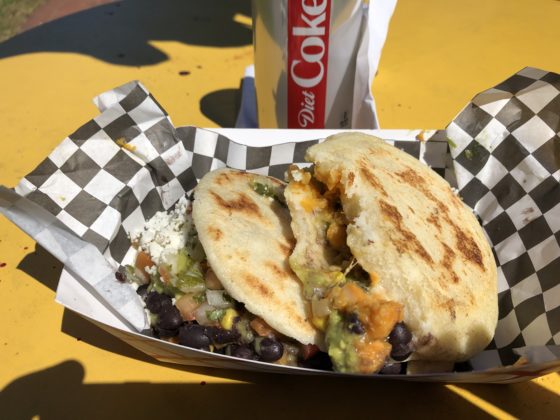
    Dr. Carter’s lunch one day!

    I had a great time at SPSP! I wasn’t able to attend last year due to the birth of my son, so it was great to catch up with colleagues and friends from graduate school that I hadn’t seen in a while, and of course to soak up some culture in New Orleans (and several really good meals). I saw a number of really excellent talks, learned a lot, and took inspiration for a few new research projects. My favorite part, however, was getting to see one of my graduate advisors (Tom Gilovich) win the society’s prestigious Campbell Award. He’s a giant in the field, and he absolutely deserves the recognition.

    Dr. Osterman

    SPSP was a blast as always, and I’m so proud of how well our students did with presenting their research! They represented the college and department well. Kaillee even talked to some people from NPR about her podcasting research!

    Congratulations to all those who attended the conference and for having successful presentations!

    . 

    . 

    . 

    Get Connected!

    Bloghttps://psych.pages.roanoke.edu/
    Facebookhttps://www.facebook.com/rcpsychology
    Twitter: @RC_Psychology
    Linked In: https://www.linkedin.com/groups/RC-Psychology-8140491/about
    Website: https://www.roanoke.edu/inside/a-z_index/psychology
    Instagram: rcpsychology
  • SENIOR HIGHLIGHTS: Ryen Beach, Sophia Bacon, Athey Crump, and Emily Deeds!

    Over the next few days, we will be highlighting the Psychology Department graduating seniors! This post will highlight 4 seniors: Ryen Beach, Sophia Bacon, Athey Crump, and Emily Deeds!

    Ryen Beach

    My plans after graduation are to take a gap semester and then attend nursing. I want to be an emergency department nurse and become a flight nurse.


    Sophia Bacon

    This summer I have been accepted to participate in a clinical internship at Southeast Psych based in Charlotte, NC. In the fall, I plan to both nanny part-time and work at Easterseals UCP where I will be providing ABA therapy to children on the spectrum. I also plan to apply to various graduate school programs in clinical psychology for the 2021 academic year.

    Athey Crump

    My favorite memory is when I was walking down the hall one day and heard each class make a joke and laugh, one after the other. It made me smile and be so happy to be amongst so many good spirited people. 

    After graduation, I plan to spend some time with my family while I’m home. Then I plan to attend graduate school nearby so I can be a little bit closer to home. 

    Emily Deeds

    My favorite memory was passing out in Dr. Powell’s Developmental Psychology class watching the video on fertilization. 

    After graduation, I plan to move down south and pursue a career in Human Resources. 

    Congratulations to you all on the success you have achieved while at Roanoke College and we look forward to seeing all that you do in the future!

    .

    .

    .

    Get Connected!

    Bloghttps://psych.pages.roanoke.edu/
    Facebookhttps://www.facebook.com/rcpsychology
    Twitter: @RC_Psychology
    Linked In: https://www.linkedin.com/groups/RC-Psychology-8140491/about
    Website: https://www.roanoke.edu/inside/a-z_index/psychology
    Instagram: rcpsychology
  • Senior Highlights: Casey Gough, Carter Smith, Emily Townley, and Ji’Asia Anderson!

    Over the next few days, we will be highlighting the Psychology Department graduating seniors! This post will highlight 4 seniors: Casey Gough, Carter Smith, Emily Townley, and Ji’Asia Anderson!

    Casey Gough

    My favorite part of the psychology department is that we are a family. I remember studying with psych students I didn’t even know in the library, studying while goofing off with all my friends, and taking naps on the psych lounge couch together.

    After graduation, I will be attending Appalachian State University in the Fall (2020) for a three-year dual degree MA & EDs school psychology program.

    Carter Smith

    I love the community of the psychology department. Being apart of it was like having our own little family on the fifth floor that would occasionally go to the brewery together, pie each other in the face, and, oh yeah, take classes. 

    After graduation, I will be serving in the Peace Corps as an English teacher and teacher trainer in Indonesia!


    Emily Townley

    Though it was daunting at the time, I greatly enjoyed defending my Honors in the Major/Distinction Project for psychology. It was the culmination of 3 semesters of independent work and I was excited to share my results. 

    After graduation, my plans are to attend a Master’s program for psychology, with a focus on clinical psychology. As of writing this, I have gotten into four so we’ll see where I end up!

    Ji’Asia Anderson

    Carly and I were able to present our poster of the research we were helping Dr. Carter with all semester at the APS Conference in Washington. Sadly, we got a slot on the last day, so we only got to present to Carly’s mother and the group that had a poster next to us. Even though we didn’t have a lot of people to present to, we had a lot of fun seeing the different research that others had been conducting and talked to some really nice people.

    After graduation, I plan to find a job as a counselor or a social worker, so I can use everything that I have learned at Roanoke to help other people. Hopefully, one day in the future, I will be able to work in the prison system as a counselor.

    Congratulations to you all on the success you have achieved while at Roanoke College and we look forward to seeing all that you do in the future!

    .

    .

    .

    Get Connected!

    Bloghttps://psych.pages.roanoke.edu/
    Facebookhttps://www.facebook.com/rcpsychology
    Twitter: @RC_Psychology
    Linked In: https://www.linkedin.com/groups/RC-Psychology-8140491/about
    Website: https://www.roanoke.edu/inside/a-z_index/psychology
    Instagram: rcpsychology