Author: kmphilleo

  • SPSP CONFERENCE Posters 2021

    On February 9-13, eight students attended the Society for Personality and Social Psychology (SPSP) Conference virtually,  to present research through poster sessions and to attend presentations. The students included Sophie Bacon ’20, Carolynn Bructo ’21, Ben Campbell ’22, Sydney Caulder ’21, Kira Hunt ’21, Abbie Joseph ’21, Naomi Painter ’22, and Carly Schepacarter ’21.

    This blog post will highlight the posters that the students presented and a brief summary of their research.

    Sophie Bacon ’20

    Research has shown that social networking platforms (Instagam, Facebook, Snap Chat, ect) afford the opportunity for identity development, specifically through engaging in different types of self-presentation. In this study, we examined the association between social goals (including, authenticity, the need for popularity, and need for belonging) and presentation of the real, ideal, and false self on social media.

    Our main findings were that Authenticity predicted greater real self-presentation on social media, a high need for popularity predicted higher false self-presentation, and a high need for belonging predicted greater ideal self-presentation.

    Carolynn Bructo ’21

    In this study, we examined achievement goal orientations (mastery, performance-approach, and performance-avoidance) in association with intention to remain in STEM majors and differences in these variables and associations by gender and unrepresented minority status in a large sample of undergraduate students. Results suggest achievement goals are meaningfully related to STEM persistence.

    Ben Campbell ’22

    This study aimed to expand on past research on relational aggression in adolescents, but in emerging adults (age 18-25). Relational aggression is an indirect form of aggression used to harm relationships (e.g., silent treatment, excluding others from a peer group, gossiping, verbal threats). We examined associations between relational aggression, resource control strategies (coercive and prosocial), social status (popularity, likeability, and social status insecurity), dominance, and prestige. Results showed that like in adolescents, relational aggression in emerging adults is associated with higher use of dominant behavior, coercive resource control strategies, greater social status insecurity, and greater valuing of popularity. This suggests that people who desire popularity and dominance within a peer group use higher amounts of relational aggression to attain and maintain that status.

    Sydney Caulder ’21

    Research has found that narcissism predicts heightened provoked aggression and hostility. However, less understood is the role of hostile attribution bias (HAB) in these associations. In this study, we examined multiple conceptualizations of narcissism (grandiose and pathological) in relation to HAB and aggressive responses to provocation.

    Kira Hunt ’21

    My poster “Ignoring Red Flags” pertained to online dating and how self-efficacy in romantic relationships impacted how much-emerging adults self-disclosed (i.e. shared information about themselves) to hypothetical online romantic matches. I also wanted to determine if disclosure levels would change if these hypothetical online romantic matches differed in physical attractiveness and were paired with vignettes that varied in honesty. We found that self-efficacy was not associated with disclosure and photo attractiveness did not influence participants’ disclosures but the level of honesty did influence disclosure. Participants were less likely to disclose and continue communicating for deception vignettes.

    Abbie Joseph ’21

    This project explores the use of ghosting as a romantic relationship dissolution strategy and its association with post-dissolutional cyberstalking behaviors. Due to the uncertainty that ghosting involves, it was expected that ghosting would be associated with more severe and more frequent cyberstalking behaviors than relationships ended by other strategies (e.g., an explicit breakup).

    Naomi Painter ’22

    COVID-19 has impacted the food industry’s means of operation and employment. We examined the effect of stigmatization against Asian restaurants on the perception of contamination and willingness to order takeout. We found statistically significant effects as participants with a higher fear of contamination were less likely to order takeout and were also less likely to order Chinese food.

    Carly Schepacarter ’21

    This project’s goal was to determine if people experiencing a negative life event have different tastes in art than others, as well as if interacting with art can help those people have an improved emotional state. In the first study, we were interested in studying if individuals reported a different preference for art after recalling a negative event, and we wanted to know how exposure to art would impact their emotions. Ultimately, participants did not have a specific preference for a subject matter in art, but there was an interaction between Prime and Order which means that the Prime did impact the emotional state of the participants when they did the emotion questionnaire right after the prime, but this effect disappeared when they did the art rating first. The second study tested if this happened because of some impact of the art task, or because of natural decline over time. The results indicated that participants who completed an art task had more positive emotions on a questionnaire than those in a non-art control task. From this, we can say confidently that experiencing art after recalling a negative event increases positive emotions more than the control task. Research from this project was used to create paintings for Hopetree Family Services in Salem, VA.

    . 

    . 

    . 

    Get Connected!

    Bloghttps://psych.pages.roanoke.edu/
    Facebookhttps://www.facebook.com/rcpsychology
    Twitter: @RC_Psychology
    Linked In: https://www.linkedin.com/groups/RC-Psychology-8140491/about
    Website: https://www.roanoke.edu/inside/a-z_index/psychology
    Instagram: rcpsychology
  • Black History Month at Roanoke College

    We dedicate every February to Black History Month. A month that celebrates the incredible achievements of African Americans and highlights and recognizes their central role in U.S. history. Roanoke College is celebrating Black History Month through a series of events, of which more information is provided below.

    Keynote Speaker – “An Evening with Yusef Salaam”

    Date: Tuesday, February 23

    Time: 6:00 – 7:00 p.m.

    Where: Virtual webinar

    Roanoke College Blood Drive

    Date: Thursday, February 25

    Time: 11:00 a.m. – 4:00 p.m.

    Where: Fintel Library – Preregistration required

    Community, Diversity, Equity and Inclusion Symposium 

    Date: Saturday, February 27

    Where: Roanoke College Campus

    Schedule of events:

    9:00 a.m. – 1:00 p.m. 

    • Morehead Hall – Service Learning – Micah’s Backpack Weekend Food Program; Habitat for Humanity “Horses for Habitat”
    • Morehead Hall – Community Art Activity

    9:30 – 10:00 a.m.

    • Morning Reflection with President Michael C. Maxey

    10:00 – 11:00 a.m.

    • Virtual – “Black History and Black Lives Today,” panel discussion moderated by Dr. Shannon Anderson featuring Dr. Jesse Bucher, Jordan Robinson ’22, and Jordan Bell

    11:00 a.m. – 12:00 p.m.

    • Virtual – “King’s Complicated Legacy: Persuasive Non-Violent Action & Resistance,” panel discussion moderated by Courtney Penn and Aaron Rogers ’21 featuring Dr. Paul Hinlicky, the Rev. Dr. David A. Jones and Cathy Bonilla ’14

    1:00 – 2:00 p.m.

    • Virtual – Healing Circle – “Unpacking the Current Climate of America,” moderated by Heather Gunn, LPC

    2:15 p.m.

    • Virtual –  Closing Session – “The Work to be Done”

    More information on each event and registration details can be found here. We hope to see you at these events!

    . 

    . 

    . 

    Get Connected!

    Bloghttps://psych.pages.roanoke.edu/
    Facebookhttps://www.facebook.com/rcpsychology
    Twitter: @RC_Psychology
    Linked In: https://www.linkedin.com/groups/RC-Psychology-8140491/about
    Website: https://www.roanoke.edu/inside/a-z_index/psychology
    Instagram: rcpsychology
  • Congrats Dr. Powell and Alumnae Jensen ’17 and Preston ’17 on Recent Publication!

    Congratulations to Dr. Powell and co-authors Katherine Jensen ’17 and Victoria Preston ’17  on their recent publishing in the Journal of Couple & Relationship Therapy, titled “‘Talking’ as a Romantic Interaction: Is There Consensus?”

    Abstract: “Emerging adults (EAs) use many phrases to refer to their romantic interactions. In two studies (N1  = 110; N2  = 222), EAs’ knowledge and perceptions of “talking” were examined. In Study 1, a majority of college students had heard of “talking,” and perceived “talking” as distinct from “friends with benefits” (FWB) and dating. In Study 2, about half of a broader EA sample had heard of “talking” and perceived “talking” as being significantly less emotionally and physically intimate, and less committed than dating; they did, however, perceived “talking” to be similar in some ways to being FWB. Additionally, EAs varied in their agreement regarding the what, why, and how of “talking.” Incorporating these results into youth relationship education programs may be beneficial to promoting healthy relationship development and reducing relational uncertainty.”

    For more information on the article, follow this link, and once again congratulations to Dr. Powell, Jensen, and Preston for their recent publication!

    . 

    . 

    . 

    Get Connected!

    Bloghttps://psych.pages.roanoke.edu/
    Facebookhttps://www.facebook.com/rcpsychology
    Twitter: @RC_Psychology
    Linked In: https://www.linkedin.com/groups/RC-Psychology-8140491/about
    Website: https://www.roanoke.edu/inside/a-z_index/psychology
    Instagram: rcpsychology
  • Effects of a Relational Maintenance Intervention on Relationship Satisfaction During COVID-19

    Melissa DeShaw, Abbie Joseph, and Grace Page (Advisor: Danielle Findley-Van Nostrand)

    Image found on: https://divine.ca/en/how-to-look-after-your-relationship-during-covid-19/

    Background Information

    In the midst of a pandemic, how have our relationships changed? Due to the COVID-19 pandemic, we suspected that the number of individuals in long-distance relationships may have increased as a result of quarantine and travel restrictions. We also thought this may have disproportionately affected college students who were used to being in geographically-close relationships when they were living on their school’s campus. This shift from being in a geographically-close relationship to being in a long-distance relationship could be a major source of stress that ultimately decreases couples’ satisfaction, and we were interested in considering how this relational dissatisfaction could potentially be reduced in such unprecedented times. After researching relational maintenance behaviors, we decided to examine how the education and implementation of relational maintenance behaviors in college students’ romantic relationships during the COVID-19 pandemic could potentially affect satisfaction in their relationships. Relational maintenance behaviors refer to the several behaviors used to maintain a healthy and successful relationship (Weigel & Ballard-Reisch, 2001). The most common way to measure this is by using the Relational Maintenance Strategy Measure (RMSM) which contains five groups of strategies: positivity, openness, assurances, social networks, and sharing tasks (Stafford & Canary, 1991). These behaviors have been proven to increase satisfaction levels when implemented into a relationship (Weigel & Ballard-Reisch, 2001). Satisfaction was measured using the Relationship Assessment Scale (RAS) which describes several relationship dimensions such as love, problems, and expectations (Hendrick, 1988). Several studies have been conducted on how the use of relational maintenance behaviors correlates with satisfaction, but there are no studies that have used an experiment to test this like ours did. An experiment allows us to determine whether something like relational maintenance behaviors may have a causal impact on satisfaction, and whether they may be able to change through intervention.

    Methods

    The 36 participants were recruited through Roanoke College’s SONA system in the psychology department and received 2 SONA credits for participating in all parts of the study. Participants had to have been in a romantic relationship. Participants signed up for a Zoom session where they were asked to complete a pre-survey in order to measure satisfaction within their current relationships. After the completion of the pre-survey, participants were asked to return to the Zoom session. Those in the experimental group were read a list of examples from the RMSM and encouraged to try some in their current romantic relationships, and those in the control group were asked to watch a 5 minute video about helpful habits for better sleep. The purpose of a control group is to have a base-line to be able to compare the changes in the experimental group to. Within a week, all participants received an email with a link for a post-survey, and their satisfaction in their romantic relationship was once again assessed using the RAS.

    Results and Discussion

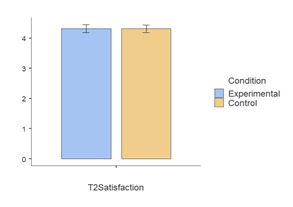
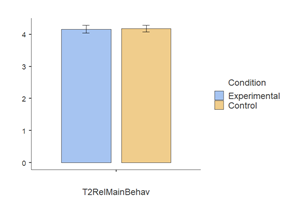
    Contrary to expectations, participants in the experimental group, who received the informational session on relational maintenance behaviors, did not report more satisfaction at the time of the post-survey compared to the time of the  pre-survey. Additionally, participants in the experimental group did not report more satisfaction than participants in the control group at the time of the post-survey. However, we did find that participants in both the control and experimental groups who reported using more relational maintenance behaviors at the post-survey also reported more satisfaction at the post-survey. Participants in both the control and experimental groups who reported more use of relational maintenance behaviors at the time of the pre-survey also reported more use of these maintenance behaviors at the time of the post-survey. Also, participants from both groups who reported high satisfaction at the pre-survey also reported high satisfaction at the post-survey.

    Relational Maintenance Behaviors (Post-Survey) 

    Satisfaction (Post-Survey)

    Due to our very low sample size, the inability to have face-to-face sessions, and the inability for us experimenters to monitor the relational maintenance behaviors of participants, we did not find what we had previously expected. We did, however, find what previous studies have found, as the participants reported more satisfaction when they used more relational maintenance behaviors in their romantic relationships.

    Reflection                                                                                                                                 

    Through this process, we gained some much needed insight on what was beneficial to the success of this study, as well as what kept the study from reaching its full potential. First, we believe this study aimed to measure important variables and believe that a replication or partial replication of this study could result in significant and useful findings. Considering the majority of our findings were insignificant, however, we noted a few different aspects of our study that, if changed, may have led to greater significance. For example, the outcome of our study might have been significantly different if everything did not have to be done through online surveys and Zoom sessions. Additionally, we believe that the pressing SONA credit requirement for Psychology students at Roanoke College may have encouraged students to complete our survey for the sake of completion, rather than to provide quality data. If this study were replicated in the future, it would be important to ensure that the participants take the study seriously.

    Conclusion

    While we found that an information session regarding relational maintenance behaviors given to some participants did not significantly increase satisfaction, we found that all participants seem to already implement these maintenance behaviors in their relationships. The main finding from our study suggests that the use of relational maintenance behaviors in college students’ romantic relationships is associated with their relationship satisfaction, even during a global pandemic.

    References

    Hendrick, S. S. (1988). A generic measure of relationship satisfaction. Journal of Marriage and the Family, 50(1), 93–98.

    Stafford, L., & Canary, D. J. (1991). Maintenance strategies and romantic relationship type, gender and relational characteristics. Journal of Social and Personal Relationships, 8(2), 217–242.

    Weigel, D.J., & Ballard-Reisch, D.S. (2001). The impact of relational maintenance behaviors on marital satisfaction: A longitudinal analysis. Journal of Family Communication, 1(4), 265-279.

  • Coping, Locus of Control, and Intolerance of Uncertainty in Emerging Adulthood

    Ethan Abbott, Sydney Caulder, & Morgan Hamilton (Advisor: Danielle Findley-Van Nostrand)

    Image from thesheaf.com

    Background Info

    Emerging adulthood is a highly exploratory and developmentally rich period of time in an individual’s life. Between the ages of 18 to 29 is a big transitional phase for young adults to develop their own identity and find their niche in society. There are frequent changes experienced through changing vocations, relationships, and living situations attributed to a significantly reduced sense of stability as compared to parts of life prior to and after emerging adulthood (Arnett 2000; Arnett et al., 2014). In order to properly evaluate how young adults are handling the transitional stressors of their lives coupled with the extenuating circumstances brought on by COVID-19 pandemic, we wanted to see if individual’s locus of control helped mitigate stress. Specifically, an internal locus of control refers to how much one believes their actions are the result of their own efforts, relative to the belief that outside events influence their future (external locus of control). If individuals perceive to have some form of control over a situation then they will find the aversive stimulus to be less threatening.

    Another facet of stress management we wanted to measure is an individual’s intolerance of uncertainty. This term refers to the cognitive ability to compartmentalize unknown potentially negative events so that it won’t hinder mental health or physical actions. This anticipation of uncertainty derives from the desire for predictability and an active engagement in seeking certainty and paralysis of cognition and action in the face of uncertainty (Birrell, Meares, Wilkinson, & Freeston, 2011). Emerging adults will also employ various coping strategies for the sake of their physical and psychological well-being. Coping mechanisms are vital towards a young adult maintaining proper mental health because poor maintenance of mental thoughts and adjustment can lead to instability. The four types of core coping mechanisms that young adults utilize are problem-solving, support-seeking, escape, & accommodation (Skinner, Edge, Altman, & Sherwood, 2003). Given the current circumstances of the world at large, we thought it wise to conduct and evaluate a survey administered to the Roanoke College student body to see how these three facets of handling mental stressors are being employed amongst the young adult student population. For the sake of our study we used locus of control and intolerance of uncertainty as predictors of various coping mechanisms.

    Methods

    Participants in this study were recruited from current students at Roanoke College through the Psychology Department’s SONA system. Participants who were enrolled in psychology courses eligible for extra credit upon participation received one half credit. In total, 145 participants completed the study.

    The survey was administered online through Qualtrics where participants were asked demographic information including gender, race, age, year in school, and impact of COVID-19. Previously constructed measurements were used for locus of control, intolerance of uncertainty, and coping. For locus of control, the 24-item Multidimensional Locus of Control Scale was used. Intolerance of uncertainty was measured using the 27-item Intolerance of Uncertainty Scale. Finally, coping was measured using the 60-item COPE inventory.

    Results & Discussion

    We decided to focus on intolerance of uncertainty and locus and control as predictors of coping in a multiple regression model. A multiple regression model demonstrates the strength of two individual predictors controlling for one another while also controlling for shared variance in a single outcome. The COPE inventory included different subscales focusing on specific forms of coping such as focus on venting of emotions or active coping. There were several significant associations found among the different subscales of coping when intolerance of uncertainty and locus of control were used as predictors. And, in each set of tests, there was a large effect size, meaning that these explained a fairly significant amount of the individual type of coping.

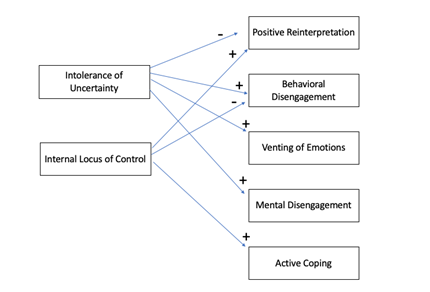
    Having a higher internal locus of control was related to greater use of managing distress emotions rather than dealing with the stressor (positive reinterpretation) and less use of behavioral disengagement when controlling for intolerance of uncertainty which was related to less use of positive reinterpretation and more behavioral disengagement.

    Internal locus of control was unrelated to, and intolerance of uncertainty positively related to both venting of emotions and mental disengagement.

    There was one subscale, active coping, that was positively related to internal locus of control but unrelated to intolerance of uncertainty. See the figure below for an overview of regression results across models; the positive sign indicates as the level of the predictor increases the level of the outcome also increases, and the negative sign indicates that as the level of the predictor increases or decreases the outcome would do the opposite of that increase or decrease).

    We also explored differences of mean scores between males and female participants. There were no significant differences based on gender in internal locus of control and intolerance of uncertainty scores, or coping subscales of use of instrumental social support, positive reinterpretation, active coping or behavioral disengagement. There were significant differences in scores based on gender for the coping subscales of focus on venting of emotions, use of emotional support, and mental disengagement.

    Our data collection and analysis produced logical results that were mostly as expected. Our research can open the door to future research on how different forms of coping may indicate how individuals perceive changes within their life or the amount of control they feel they have over those changes. This research was especially meaningful given the current COVID-19 pandemic and associated mental health difficulties. Intolerance of uncertainty and internal locus of control may be influential in encouraging adaptive forms of coping.

    Figure: Visual Representation of Regression Results: Intolerance of Uncertainty and Internal Locus of Control as Predictors of Forms of Coping.

    Reflection

    Creating a study which was interesting to all of us and able to be done efficiently through remote learning certainly posed a tough challenge to our group. Initially we thought a study more focused on the current challenges for emerging adults amidst the COVID-19 pandemic would be interesting, but we ultimately decided emerging adults face many challenges with uncertainty regardless of if they are enduring a pandemic or not. The beginning stages were relatively easy to manage by dividing up the work and checking in on each other periodically, but as we started using Jamovi our difficulties took a turn. One of the many challenges posed due to remote learning was the opportunity to learn an entirely new data analysis application, Jamovi. Although Jamovi is user friendly when conducting data, we struggled getting it to be compatible with Qualtrics, and those problems were difficult to work through together. Ultimately these issues were ironed out through many meetings with our group and Dr. Findley-Van Nostrand via Zoom trying to figure it out. Although ultimately our outcome of our research was largely unchanged, it was difficult to manage each challenge together while completing our tasks remotely, but I think we all understood the value of good communication and patience through completing this experience remotely.

    References

    Arnett, J.J. (2000). Emerging adulthood: a theory of development from the late teens through the twenties. American Psychologist, 55(5), 469–480.

    Arnett, J.J. (2014). The new life stage of emerging adulthood at ages 18-29 years: implications for mental health. The Lancet Psychiatry, 1(7), 569–576.

    Birrell, J., Meares, K., Wilkinson, A., & Freeston, M. (2011). Toward a definition of intolerance of uncertainty: A review of factor analytical studies of the Intolerance of Uncertainty Scale. Clinical Psychology Review, 31(7), 1198-1208. doi:10.1016/j.cpr.2011.07.009

    Skinner, E.A., Edge, K., Altman, J., & Sherwood, H. (2003). Searching for the structure of coping: a review and critique of category systems for classifying ways of coping.. Psychological Bulletin, 129(2), 216-269.

  • Need for Structure and Academic Motivation as Predictors of Psychological Well-Being during COVID-19

    Caelan DeMuth, Mason Wheeler, Maggie Lewis (Advisor: Dr. Findley Van-Nostrand)

    Image taken fromL Harris, M. (2015). Top Valentine’s places to cry alone on campus. photograph. https://thetab.com/uk/lancaster/2016/02/12/top-valentines-places-cry-alone-campus-4936.

    Background Information

    Many changes brought on by the COVID-19 pandemic have affected well-being of individuals, with college students being uniquely affected given the changes in their academic environment. Specifically, remote learning during the COVID-19 pandemic has changed the way students are expected to learn, potentially driving issues related to focus and to social isolation. Younger students with less experience in university level education may be at higher risk of struggling more than their older peers during the pandemic (Ledman, 2008). In this study, we students’ psychological well-being in relation to their individual need for structure (that is, the extent to which they desire structure and clarity and find ambiguity troubling), academic motivation (the extent to which they are motivated to remain in and do well in school), and academic year. We expected responses that underclassmen or younger students would report higher levels of a need for structure and lower levels of academic motivation, and that both motivation and need for structure would predict well-being. As motivation in academic settings during the ongoing pandemic had yet to be assessed this research may be used to provide insight into how to provide resources to students during upcoming academic terms.

    Methods and Measures

    Participants for this research were individuals currently enrolled at Roanoke College. There were 115 participants, of which 39 were freshmen, 39 were sophomores, 21 were juniors, and 16 were seniors; 30 identified as male, 83 identified as female, and 2 identified as nonbinary.  Participants were recruited via the Roanoke College Psychology Department through SONA and led to an external survey using Qualtrics. Participants answered a combination of questions pertaining to their academic year, gender, and demographics in addition to questions intended to assess individual needs for structure, academic motivation and well-being. Questions pertaining to structure were taken from the Personal Need for Structure scale. Academic motivation was assessed via questions in the Academic Motivation scale. Psychological Well-Being scale was used to gauge the well-being of participants. Ultimately the three scales demonstrated relationships between individualized preferences for structure, mental health and motivation to remain focused and engaged in coursework during COVID-19.

    Results and Discussion

    This study was facilitated successfully, especially given the challenges of a nontraditional semester. Contrary to the initial expectation for this study, participants enrolled in their senior year reported the lowest scores for perceived wellness whereas underclassmen reported the highest scores for this criteria. Although students in lower academic years reported higher values of perceived wellness, responses from first years did have the largest standard deviation, suggesting that there was more variation among participants in lower academic years. However, it was found that there was no statistically significant differences when separating between  the psychological well-being subscales (autonomy, environmental mastery, personal growth, positive relations, purpose in life, self-acceptance) between academic years.

    Personal need for structure was unrelated to academic motivation. Academic motivation was positively related to psychological well-being in the era of COVID-19 learning. Academic motivation is the voluntary engagement with coursework in terms of intrinsic and extrinsic variables (Cerino, 2014), suggesting that those who can maintain high levels of motivation are likely also experiencing higher well-being in other areas. It was found that personal need for structure statistically significantly predicted the psychological well-being subscale of purpose in life, while academic motivation as a whole statistically significantly predicted the psychological well-being subscale of personal growth, and somewhat significantly predicted the psychological well-being subscale of autonomy. Overall, results suggest that need for structure and academic motivation during the pandemic are related to well-being, but this depends on type of well-being.

    Reflection

    This research study challenged each of us extensively throughout the duration of the semester. The first and largest obstacle we as a group encountered was transitioning Research Seminar class typically taught in person to a fully remote and functional formatt. We were given the additional task to complete the workload together across time zones via Zoom rather than have the ease of access to be able to meet whenever necessary in person. Our initial research topic was a much broader version of our final product, with the first intent to be to examine COVID-19 impact on wellness in all of its dimensions and definitions. This was evidently too broad as the eight clinical dimensions of wellness (Stoewen, 2017) would have introduced a myriad of confounds to our research. The goal of our work was to examine if academic motivation and perceived wellness had been impacted during a semester of exclusively remote learning.

    As our study was conducted via online survey, the ease in accessibility for participants was likely beneficial to the recruitment process. The convenience of the survey being administered online allowed for more people to complete it on their own time. An additional positive to the survey being conducted online eliminated the risk of observer bias and made participants more comfortable by removing the risk of potential exposure to COVID-19. Despite the challenges of conducting research in a fully remote manner, our group was able to find significant associations within our data and report conclusive findings.

    Conclusion

    The main findings of this study indicate that college underclassmen are experiencing higher perceived wellness than upperclassmen in the era of COVID-19, and that personal need for structure and academic motivation only significantly correlate with three of the six psychological well-being subscales (purpose in life, autonomy, and personal growth). COVID-19 has caused significant changes to what is defined as a normal academic setting. With this knowledge moving forward, academic institutions may use this information to provide adequate mental health resources for students as well as modify course plans to proceed in more academically efficient means.

    References

    Cerino, Eric. S. (2014). Relationships between academic motivation, self-efficacy, and academic procrastination. Psi Chi Journal of Psychological Research, 19(4).

    Ledman, R. (2008). Comparing student learning in online and classroom formats of the same course. Retrieved September 15, 2020, from https://absel-ojs-ttu.tdl.org/absel/index.php/absel/article/view/424/390.

    Stoewen, D. (2017). Dimensions of wellness: Change your habits, change your life. Retrieved September 15, 2020, from https://www.ncbi.nlm.nih.gov/pmc/articles/PMC5508938/.

  • CONGRATULATIONS TO OUR new PHI BETA KAPPA members!

    Founded in 1776 by students at the College of William and Mary, Phi Beta Kappa is recognized as the oldest, largest, and most prestigious honor society in the nation. PBK’s main objective is to emphasize the importance of liberal arts and sciences while also recognizing those who strive for excellence in academics.

    Membership in Phi Beta Kappa is a distinct honor.  Only 10% of the nation’s colleges and universities have chapters, and Phi Beta Kappa graduates include some of the country’s most distinguished citizens, including 17 U.S. Presidents, 42 Supreme Court Justices, more than 150 Nobel Laureates, and many other notable figures.

    The Psychology Department would like to congratulate Kira Hunt, Abbie Joseph, Grace Page, Kaillee Philleo, Carly Schepacarter, and Lynsey Wyatt on their induction into the Nu Chapter of Phi Beta Kappa. Continue reading to hear from some of the students themselves! 

    Kira Hunt
    I am a senior psychology major with a concentration in neuroscience and a minor in sociology. I was really ecstatic to hear that I was selected because I had been working towards this since hearing about it in my freshman year. While at Roanoke, I’ve been a student assistant in the psychology department as well as an academic coach in the Center for Learning and Teaching. I am also a member of Alpha Lambda Delta and Psi Chi. In addition, I have also participated in research in Dr. Powell’s lab as well as with Dr. Nichols, which is one of the things I am most proud of. I haven’t finished my Honors Distinction Project yet but I’m really proud of the progress I have made on it. After graduation, I plan on being in Teach for America while I prepare to go to graduate school to become a Certified Child Life Specialist.

    Abbie Joseph  
    Image preview

    I am a senior psychology major with a concentration in human development and a minor in Spanish. I was very excited when I found out that I was elected into membership of Phi Beta Kappa, and it felt good knowing that I was being recognized for all my hard work throughout my time here. Here at Roanoke, I am a Subject Tutor in the Center for Learning and Teaching, a member of Stat Crew, and a Spanish cohort/activity leader. I am also a member of Psi Chi, Xi Theta Chi, and Alpha Lambda Delta honor societies. I am involved in research in the psychology department as a research assistant in Dr. Powell’s developmental self-knowledge lab. One of my biggest accomplishments while at Roanoke has been my independent study for my Honors in the Major project titled, “Cyberstalking behaviors after the use of ghosting.” After I graduate, I plan to attend graduate school for my master’s degree in Clinical Mental Health Counseling.

    Kaillee Philleo

    I am a senior psychology and criminal justice double major. I received a voicemail from Dr. Peppers letting me know that I was selected for membership into PBK and I was ecstatic! I have been working towards membership into PBK since freshman year and I was so pleased that my hard work had finally paid off. While at Roanoke I have been involved in many things – from running on the Track and Field team, singing in the Roanotes acapella group, co-hosting a radio show, working as the campus activities director and creating fundraising events for Make-A-Wish in Chi Omega, working as the trip supervisor and guide with Outdoor Adventures, working as a student assistant in the psychology department, conducting research with Dr. Osterman, leading Psi Chi, NSLS, and Alpha Lambda Delta as president, as well as also being a member in Alpha Phi Sigma, Xi Theta Chi, Order of Omega, and Omicron Delta Kappa. It’s safe to say my time at Roanoke College has been far from boring. That all being said, my biggest accomplishments, besides being selected into PBK, are definitely presenting at the SPSP conference in New Orleans last spring, having the opportunity to ask Justice Sotomayor a question during her Zoom visit with Roanoke College, and working towards completing my honor in the major project. Upon graduating from Roanoke, I intend to enter into a Clinical Psychology Ph.D. program and eventually become a forensic psychologist for juveniles.

    Carly Schepacarter

    Image.jpegI am pursuing a Bachelor of Science with a double major in Art and Psychology. When I received the news on Phi Beta Kappa, I was ecstatic. I have worked closely with Dr. Carter on research and a number of other things while on campus, so when he made a point of emailing me personally to let me know that I was selected it really had an additional layer of excitement with it. On-campus, I am a member and past President of the Honors Program, the current President of Alpha Phi Omega, a student assistant at Resource Development, and I do social psychology research with Dr. Carter in the Psychology Department. This semester, I am also an Artist in Residence in Olin Gallery, where I am currently creating and displaying the paintings I am producing for my Honors Distinction Project. One of my proudest accomplishments beyond Phi Beta Kappa was being selected as a Fintel Senior Scholar this summer, as well as being named the Senior Scholar for the Art Department this past year. Beyond awards, I am very proud of the work of the Alpha Phi Omega executive board during quarantine disruptions, where we worked tirelessly to still provide a valuable experience to new and existing brothers while at such an unexpected time. Upon graduation this May, I am looking to enroll in a Clinical Psychology Ph.D. program or an Art Therapy Master’s program, with hopes to work in Family Services.

    Congratulations again to everyone and we look forward to seeing what you accomplish in the future! 

    . 

    . 

    . 

    Get Connected!

    Bloghttps://psych.pages.roanoke.edu/
    Facebookhttps://www.facebook.com/rcpsychology
    Twitter: @RC_Psychology
    Linked In: https://www.linkedin.com/groups/RC-Psychology-8140491/about
    Website: https://www.roanoke.edu/inside/a-z_index/psychology
    Instagram: rcpsychology
  • Paid Internship Opportunitites

    Internships are one of the best ways to gain experience in the field of Psychology and explore future careers that you may end up working in as well as explore future careers that you may end up deciding are not for you.

    Paid internships are hard to come by in the field of psychology, but there are currently three that are approaching application deadline for 2021 admission. Continue reading to learn more about each program.

    Program: Carnegie Mellon University Summer Program for Undergraduate Researchers (SPUR)

    Deadline: December 15, 2020

    Pay: $3,000

    Other Info: According to the programs website, “PIER’s SPUR program allows talented undergraduates to spend 8 weeks during the summer in a research laboratory at Carnegie Mellon University.  Due to the global COVID-19 pandemic, SPUR 2021 may be offered on a remote basis. Each student will receive a fellowship stipend of $3,000 and apartment-style housing will be provided if SPUR 2021 takes place face-to-face. Guidance and supervision of the research project will be provided by a faculty member as well as, in some cases, a postdoctoral fellow and/or advanced graduate student.  Admitted students will also participate in the Go Research! Summer Program at CMU. This program brings undergraduate researchers from across departments together in apartment-style dorms with resident assistants to facilitate community building, manage housing, and provide programming.  A Summer Seminar Series is provided for all students to help prepare for graduate education and research careers.”


    Program: Psychology Research Experience Program (PREP) at University of Wisconsin-Madison Department of Psychology

    Deadline: February 15, 2021

    Pay: $5,000 stipend for the ten-week period housing, a $500 food allowance, health insurance (if needed), and full travel expenses to and from Madison, WI

    Other Info: According to the programs website, “The Psychology Research Experience Program (PREP) provides intensive mentoring and experience in scientific research and professional development to undergraduates from historically underrepresented populations — those from underrepresented racial and ethnic groups, those from low-income backgrounds, those with disabilities, and first-generation college students — who have expressed and demonstrated an interest in a career in scientific psychology.”


    Program: RISE program and Rutgers University – New Brunswick

    Deadline: Applications opened November 1, 2020 and reviews start in late January 2021

    Pay: $4,500 – $5,000 stipend (varies for partner REU programs), free on-campus housing, $500 travel allowance, free GRE prep course

    Other Info: According to the programs website, “RISE at Rutgers is a nationally acclaimed summer research program for outstanding undergraduates from diverse backgrounds. Scholars participate in 10 weeks of cutting-edge research in the biological, physical, and social/ behavioral sciences, math, engineering, and exciting interdisciplinary areas under the guidance of carefully matched faculty mentors. A comprehensive professional development component, including GRE preparation, complements the research.”

    If interested in any of these internships, click the links provided to learn more. Furthermore, Meltem Yucel frequently adds paid internships to their list so be sure to check back for more potential paid internships in the future.

    .

    .

    .

    Get Connected!

    Bloghttps://psych.pages.roanoke.edu/
    Facebookhttps://www.facebook.com/rcpsychology
    Twitter: @RC_Psychology
    Linked In: https://www.linkedin.com/groups/RC-Psychology-8140491/about
    Website: https://www.roanoke.edu/inside/a-z_index/psychology
    Instagram: rcpsychology


  • Graduate Programs and Advice

    Tackling Trauma And Anxiety This Holiday Season | North Jersey Health & Wellness

    With October nearing to an end and November on the horizon, for those graduating in the coming months, it is time to start considering graduate programs. Whether you already know where you are going to be applying to graduate school, or aren’t quite sure if graduate school is for you, follow this blog as a way to learn more about the programs available and for resources on where to find more information.

    Talk with your advisors/professors

    Over the next few weeks, it would be best to reach out to your advisor(s) and professors for advice or guidance, especially if you are still uncertain about what post-graduate option appeals to you the most.

    Look into programs

    There is a multitude of graduate programs available to psychology students. While having a variety is nice, it can also be overwhelming, so you may want to reduce what you are looking at.

    Some options:

    • Degree – Determine what type of degree you are seeking (M.A., Ph.D., Psy.D., etc). and limit your search to just those programs offering those degrees
    • Area/Specialization – Limit by areas/specialization- i.e., Clinical, Counseling, Neuroscience, etc.
    • Search – Google can also be your friend, in which you can search
      “(degree) graduate programs in (area)” and find a variety of programs. Do your research on these programs though as some are not always legitimate.
    • State – if there is a specific state you want to work as a psychologist in/go to school in, you can also limit your search to just those programs
    • Psychology Website – refer to the Roanoke College Psychology page on graduate schools to find more information

    Exploring is key, so whether you are not sure where to begin or know the program, state, and area you want to go to graduate school in, explore your options and come up with a list of 10-20 programs that interest you.

    Moreover, while you look at programs you should also make note of professors that align with your interests and that are accepting students for the coming academic year. Especially if you choose to go into a Ph.D. program, you will likely need to declare which professor you wish to research alongside, so making this list early is helpful.

    Start Planning

    Once you have determined that graduate school is for you, start planning when and how you will get everything done. Here are some common items to complete before application deadlines:

    • CV/Personal Statement – make sure your CV is up to date and create a general personal statement that can be revised/edited to fit a specific program later
    • Transcript – Request and send your official transcript to the programs you are applying to
    • Letters of Recommendation  – reach out to the professors that you want to write your letters of recommendations and be sure to follow up with them during the month prior to the application deadline
    • GRE – If your program requires the GRE, GRE subject test, or other standardized tests, take it a few months before the application deadline. Moreover, if you have already taken the GRE/other tests, be sure to send your scores to any schools that require it.
      • *Note – In response to the COVID-19 pandemic, many schools have made the GRE optional/waived so be sure to check each program for their requirements.
    • The Programs Application – Each school requires different items to be included in their application. Therefore, check early to ensure you have enough time to send everything to the schools and to fill out the application/provide any supplemental writing/other items.

    Finalize Your List

    By the time it comes to applying to programs, you should limit yourself to applying to between 10-15 programs. While it will not hurt you to apply to more, the cost of graduate school applications vary and can add up quickly. Therefore, having a few reach programs, a few middle of the road programs and a few safety programs tend to be best practice.

    Seek Advice

    Seek advice from your professors and advisor(s) throughout the application process. Moreover, seek the advice of other graduate students. Don’t be afraid to continue to ask questions, the process can be daunting, but relying on the help of others can make it doable.

    For more information, check out some of our other blog posts highlighting graduate programs and providing more graduate advice here.

    Applying to graduate programs can be stressful, but by reaching out to your professors/advisors and starting to do some research on different programs, you will soon find yourself generating a list of potential programs and beginning the application process.

    Best You Can Do It GIFs | Gfycat

    .

    .

    .

    Get Connected!

    Bloghttps://psych.pages.roanoke.edu/
    Facebookhttps://www.facebook.com/rcpsychology
    Twitter: @RC_Psychology
    Linked In: https://www.linkedin.com/groups/RC-Psychology-8140491/about
    Website: https://www.roanoke.edu/inside/a-z_index/psychology
    Instagram: rcpsychology
  • Course Highlight: PSYC 110 Pursuing your Purpose

    PSYC 110 – Pursuing your Purpose is a 1/2 credit course that assists students in considering career paths and informs them of the opportunities available to them within the Psychology Department and across the College. The course is particularly well-suited for sophomores or others who have recently declared the major, but all are certainly welcome and have benefited from the course. The course will meet virtually one time a week on Tuesday evenings with part of the class being synchronous and the rest of the work being asynchronous.

    Three students that recently took this course, Kristianna Jenner, Emily Gabrielian, and Kristi Rolf took some time to answer questions regarding this course:

    Why did you decide to take PSYC 110?

    Kristianna Jenner: I decided to take PSYC-110 because I needed a little more direction and guidance. Psychology is just so broad and I felt like I needed a different perspective on the field as well as to gain more practical information for my future.

    Emily Gabrielian: After the fall semester of my sophomore year, I decided to switch my major from biochemistry to psychology. I really enjoyed the psychology courses that I had taken before, but I had no idea what I wanted to do with a psychology major. Right after I declared my major in psychology, Dr. Allen recommended this class to me. Dr. Allen emphasized that this class would help me find my path in psychology and would allow me to learn more about the amazing opportunities that Roanoke College and the psychology department has to offer. I decided to take PSYC 110 because I really wanted some guidance on what I wanted to do with my psychology major.

    Kristi Rolf: I decided to take PSYC 110 on a friend’s recommendation because I had just declared it as my major and was totally in love with psychology, but had no idea what discipline or career path I wanted to pursue.

    What did you and other students do in the class?

    Kristianna Jenner: So in the class, we get to learn more about the practicality of the science of psychology. We do our own research to find out what things we are interested in and to find the degree requirements, location of the prevalence of jobs, and also the salaries. All of these are super important for making decisions on where you want to go to school, where you may end up living, and what things you’re genuinely interested in. There is also a community-Based learning aspect of the course, where we go out into the real world here in Salem and the surrounding towns to shadow people who are working in the fields (or are adjacent) you are interested in.

    Emily Gabrielian: One of the reasons why I loved this class so much was because of the other students in the class. During this class, the students really get to know one another and become more comfortable with sharing their goals and dreams. Everyone in the class was motivated to learn more about the opportunities that Roanoke has to offer. Also, everyone in the class wanted to discover the potential paths they could go after graduating from Roanoke. It was clear that everyone in the class wanted to grow and develop. I am thankful for this class because it gave me the opportunity to connect with my peers and create new friendships.

    Kristi RolfEach week Dr. Powell assigned readings and/or activities on a certain topic that we discussed in class that ranged from potential career choices to resources at Roanoke College. Everything we discussed was backed up by empirical articles and Dr. Powell brought guest speakers in for many classes which really enriched our learning. In the second half of the semester, Dr. Powell and Jesse Griffin from the office of civic engagement helped match each of us to a location for job shadowing where we would complete 20 hours before the end of the semester (sadly last semester we had to cut the job shadowing short due to COVID-19).

    How has PSYC 110 helped you and what did you get out of it?

    Kristianna Jenner: I learned about aerospace psychology, which might just be the coolest thing ever. I never would have found this entire subfield had I not been in this class. Aerospace psychologists work with airline personnel, airplane manufacturers, engineers, and airlines themselves. They work to help make the skies safer for everyone and the interfaces easier for those working in the airline industry. I found this to feel like it was something I could see myself doing with my life and I found the guidance I wanted out of the class.

    Emily GabrielianAlthough our time was cut short due to the Coronavirus, I still got so much out of this class. This class helped me figure out that after Roanoke, I want to go to graduate school in order to further my learning and work towards becoming a counselor. After every class, I was so giddy about all of the opportunities that Roanoke has to offer. I was so excited about the opportunity to study abroad, complete an internship, and conduct research. Also, from my volunteer experience at the West End Center, I realized that in the future I want to work with children. Overall, I got so much more out of this class than what I was expecting. This class truly made me more motivated with my studies and more excited about what the future holds.

    Kristi RolfPSYC 110 helped me the most by providing clarity on my degree path at Roanoke and all the resources that are available for me in the department and throughout the College.

    Why would you recommend PSYC 110?

    Kristianna Jenner: I definitely think that if you’re struggling while considering the future or even if you’re like me, where all you want is just a little more guidance on life, this is the class to take. Overall, I think that this class will only help, never hurt.

    Emily Gabrielian: I would recommend PSYC 110 because this class gives you the opportunity to learn more about yourself, but also learn more about what Roanoke has to offer. When I would talk with my friends about this class, they all emphasized how they wished their majors offered a class like this. Even if you know what you are going to do after Roanoke, I still encourage you to take this class because you may discover that there is another path that is more interesting. Also, this class gives you the opportunity to give back to the community and meet new people. I fully recommend taking this class because it will be so beneficial for you and your future.

    Kristi RolfI would recommend PSYC 110 because it is a fantastic tool for getting more involved in the department and absorbing lots of wisdom from Dr. Powell which has been invaluable for me!

    If you are interested in taking this course or would like to know some more information, please reach out to Dr. Darcey Powell at dpowell@roanoke.edu.

    .

    .

    .

    Get Connected!

    Bloghttps://psych.pages.roanoke.edu/
    Facebookhttps://www.facebook.com/rcpsychology
    Twitter: @RC_Psychology
    Linked In: https://www.linkedin.com/groups/RC-Psychology-8140491/about
    Website: https://www.roanoke.edu/inside/a-z_index/psychology
    Instagram: rcpsychology