Are you looking for a summer job? How about an internship experience? Well, look no further, because Camp Easterseals is hiring summer staff!
.
.
.
Are you looking for a summer job? How about an internship experience? Well, look no further, because Camp Easterseals is hiring summer staff!
.
.
.

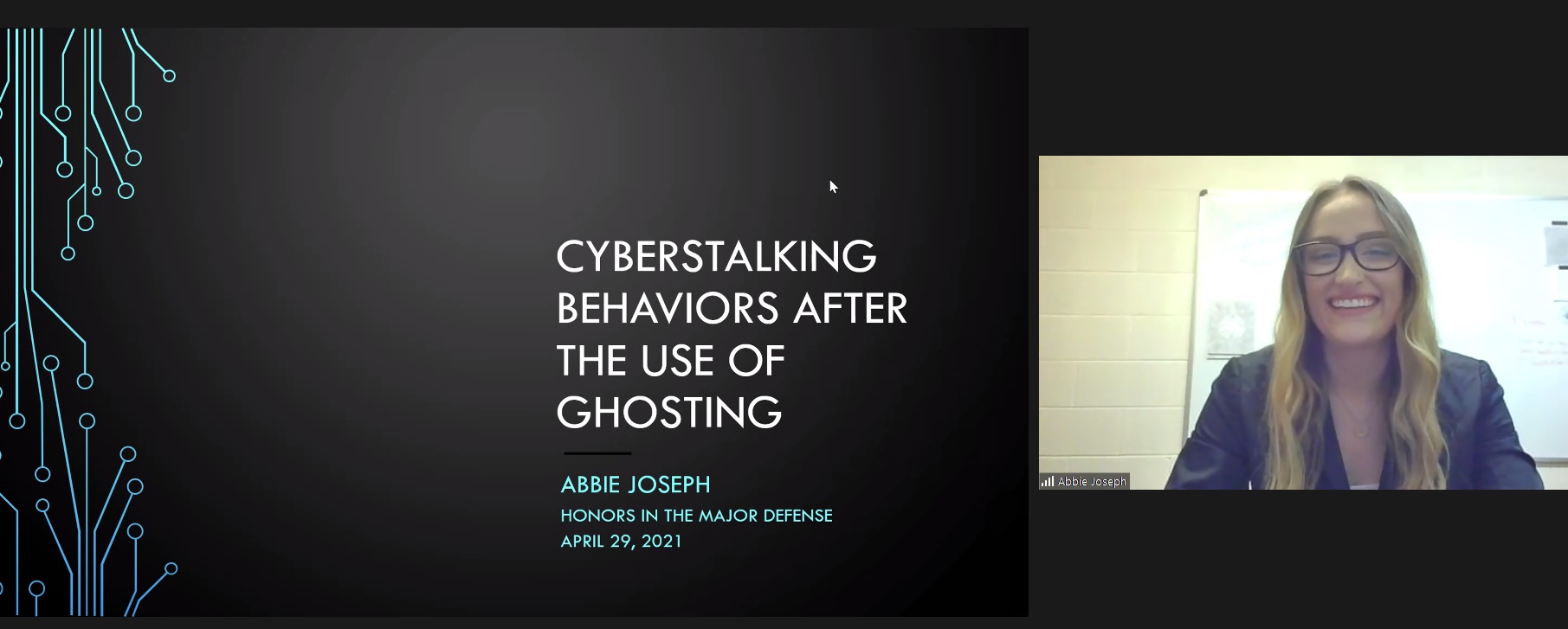
Congratulations to Abbie Joseph ’21 for the successful defense of her Honors in the Major Project! Her project was titled “Cyberstalking Behaviors After the Use of Ghosting”. Her supervisor, Dr. Darcey N. Powell was joined by committee members, Dr. Osterman and Dr. Berntson, to oversee her defense.

Project Abstract:
The purpose of the current study was to examine the differences in cyberstalking behaviors after the dissolution of a romantic interaction based on the dissolution strategy used (i.e., ghosting or explicit reasoning). Participants included emerging adults between the ages of 18 and 29 (N = 240) who had a romantic interaction end. A survey was used to collect information regarding participants’ most recent relationship dissolution, their experiences with ghosting and cyberstalking, their engagement in cyberstalking behaviors towards an ex-partner and the ex-partner’s new partner, their social media app usage, and their relationships with their ex-partner. Analyses revealed that participants whose most recent romantic interaction ended via ghosting did not engage in significantly more cyberstalking behaviors than participants whose most recent romantic interaction ended via explicit reasoning. There were no significant differences in the length of engagement in cyberstalking behaviors after the breakup between participants whose relationship ended through ghosting and participants whose relationship ended explicitly. There were no significant differences in engagement of cyberstalking behaviors between participants who initiated the ghosting and participants who were ghosted. Participants who were ghosted engaged in cyberstalking behaviors to seek out information about their ex-partner and the ex-partner’s new partner. The findings of the current study provide information on how the dissolution strategy is associated with post-dissolutional cyberstalking behaviors.
Congratulations again to Abbie Joseph on a successful defense and we look forward to seeing all you accomplish in the future!
.
.
.

Congratulations to Naomi Painter and Ben Campbell for being selected as Summer Scholars!
Roanoke College’s Summer Scholar Program is designed for serious students who want to use their summers wisely and work one-on-one with faculty. Every year, students compete for selection to receive one of the summer scholarships. Faculty from across the college review student research proposals and decide these prestigious awards.
Naomi will be working with Buchholz on her project in light of the occurrence of the COVID-19 pandemic and issues involving prejudice and discrimination where she intends to examine the effects of disgust on the presence of prejudicial responses and the individual differences that contribute to said relationship.
Ben will be working with Dr. Findley-Van Nostrand on his project, inspired by his interest in traditional or toxic masculinity, where he intends to research the effects of jealousy on threatened masculinity and relational aggression (i.e., aggression used to harm peer relationships) use.
.
.
.

Miami University is now accepting applications for their third annual Diversifying Psychology Weekend being held virtually, May 1st, 2021. This weekend is designed to help students from underrepresented and diverse backgrounds learn more about research and graduate school in psychology, prepare to apply for a doctorate in psychology, network with graduate students and faculty, and learn more about what their department has to offer. The event is supported by Miami University’s Psychology Department, College of Arts and Sciences, and Graduate School, and Center for Student Diversity & Inclusion. Students who are early in their college careers and/or who are less familiar with doctoral degrees in psychology are encouraged to apply.
To receive full consideration, successful applicants should:
To apply, follow this link. Applications are due April 7th, 2021.
More information about their psychology department can be found here.
.
.
.
Congratulations to Alumnae Alex DiFelice ’17 and Dr. Powell on their recent publishing in the Journal of Sport Behavior, titled “Self-Efficacy of Female Youth Athletes in An Intensive Training Camp”. This paper is based on DiFelices’ Honor in the Major Project and specifically, examined how sport-specific self-efficacy, as well as sources of sport-specific self-efficacy, changes post attending an intensive training camp. They found that intensive training camps are in fact effective for increasing both sport-specific self-efficacy, as well as sources of self-efficacy. For more information refer to the graphic below, and once again congratulations to DeFelice ’17 and to Dr. Powell for their recent publication!

.
.
.
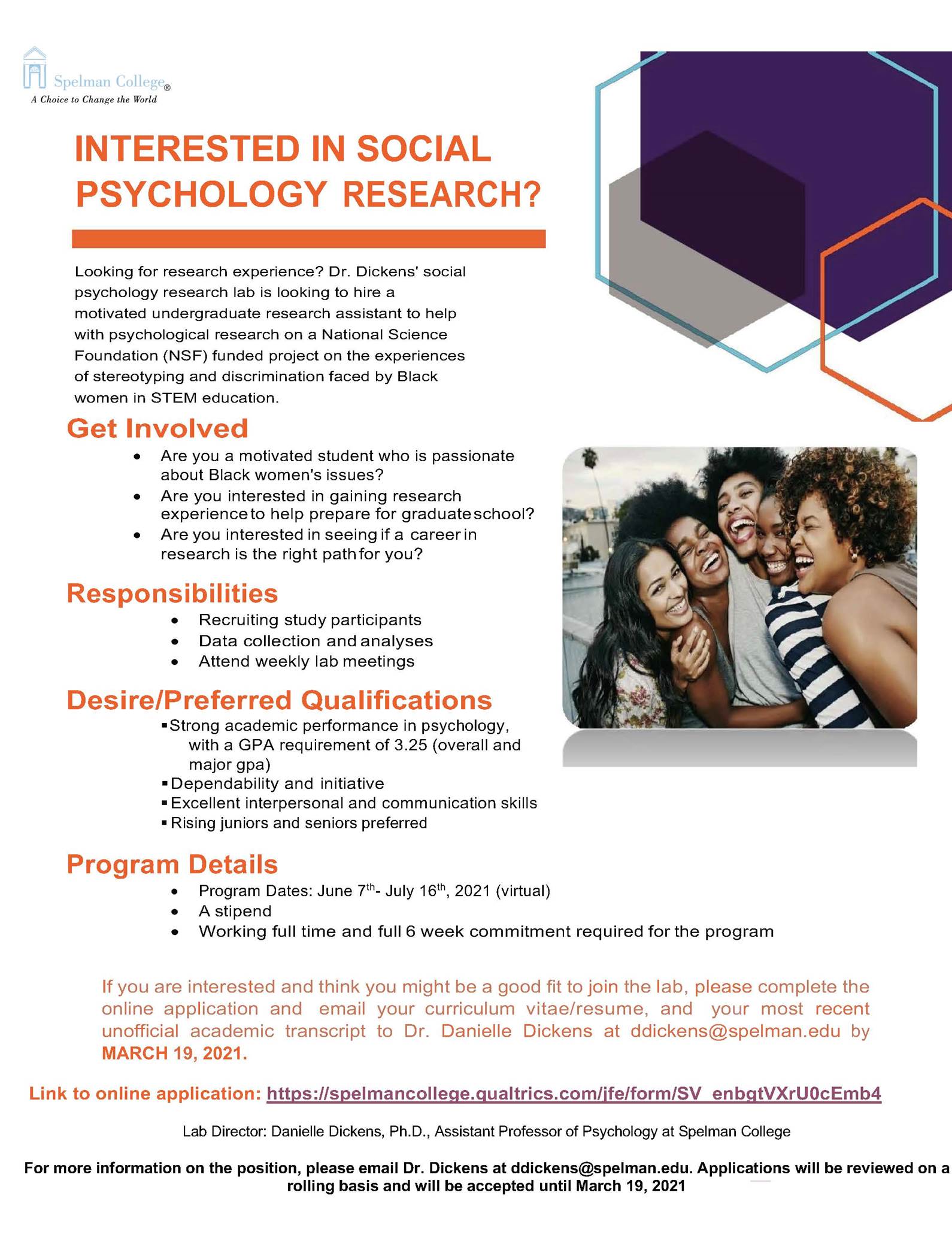
Dr. Dickens’ social psychology research lab at Spelman College is looking to hire an undergraduate research assistant to help with research focused on the experiences of Black women in STEM education.
During a 6-week summer program (June 7th – July 16th, 2021), students will have the opportunity for one-on-one mentorship and research experience with a faculty member. This opportunity will be virtual but working full time for the full 6-week commitment is required for the program. A stipend will be provided.
Responsibilities of the research assistant include:
It is preferred that interested students have the following qualifications:
Selection into the program is rolling and will last until March 19th, 2021.
If you are interested in applying, please complete the online application using this link and email your curriculum vitae/resume, and your most recent unofficial academic transcript to the lab director Dr. Danielle Dickens, at ddickens@spelman.edu.

.
.
.

Are you still debating what to do over the summer but are interested in research? Roanoke College offers several opportunities to get involved with research this upcoming summer.
Roanoke College Summer Scholars
As the March 15th deadline quickly approaches, we will highlight Roanoke College’s Summer Scholars program. Summer scholars work one-on-one with faculty on a project that will be presented during Family Weekend (late September/early October). On-campus housing is provided and summer scholars will be paid $3000 and earn a summer course credit.
To apply students must have a 3.0 or higher GPA, have completed 8 units by the start of the grant period, and plan to return the following fall. The application consists of a cover sheet, a student application for summer scholars, and a faculty nomination to mentor a summer scholar. These forms and more information about the process can be found on the summer scholars page, here.
Below are some past psychology majors and their summer scholars projects:
2018
Aislinn Foutz. Parental and Peer Factors in Children’s Theory of Mind Development. Major: Psychology. (Faculty Mentor: Danielle Findley-Van Nostrand, Psychology)
Yipeng Wang. Gender Difference of Domestic Abuse and How Honor Culture Would Affect those Differences. Major: Psychology. (Faculty Mentor: Lindsey L. Osterman, Psychology)
2017
Sabrina McAllister. Time Perspective as a State-Based Measure. Major: Psychology. (Faculty mentor: David Nichols, Psychology)
Megan Miller. Self-driving cars as a test of the potentially harmful effects of empathy on moral decision making. Major: Psychology. (Faculty mentor: Chris Buchholz, Psychology).
Summer Research Incentive Program
As part of the Summer Experience Incentive Program, students are provided reduced summer tuition for one unit of internship, research, or independent study credit. To qualify for reduced summer tuition, approval for their project must be received no later than May 15th.
Students have the responsibility of finding a faculty member who is willing to supervise the project. It is recommended that students start working on proposals by Spring Break to give faculty members time to review the plan and give the students time to make revisions and acquire needed signatures.
Projects, required reflections, final paper, and final reflection (3-page minimum) must all be completed and submitted to their faculty supervisor by September 30th. Students in the program are also required to participate in a showcasing event.
A more in-depth description of the program, as well as the applications for the program, can be found on the Summer Research Incentive Program page, here.
Salem VA Medical Center and Roanoke College Undergraduate Research Experience
Please note that the program is currently on hold during the COVID-19 pandemic but those interested should email the director of undergrad research at research@roanoke.edu to get on the mailing list for when applications become open.
This collaboration with the Salem VA Medical center allows Roanoke College undergraduates to work in research with a Principal Investigator (PI) on current medical research and present it. Research has included topics such as “Predictors of Treatment Response Among Veterans with PTSD”, “Mental Health in Rural Veterans with and without Traumatic Brain Injury”, and “Effect of Exercise Training on Inflammation and Function in HIV Infected Veterans”.
It is recommended interested students meet with the Director of Undergraduate in the fall semester or early in the spring semester to discuss the program. To apply, students must submit a cover letter (with research interests), a curriculum vitae, an unofficial transcript, and two letters of recommendation to the Director of Undergraduate Research by the deadline.
More information about expectations and other important information can be found here.
.
.
.

On February 9-13, eight students attended the Society for Personality and Social Psychology (SPSP) Conference virtually, to present research through poster sessions and to attend presentations. The students included Sophie Bacon ’20, Carolynn Bructo ’21, Ben Campbell ’22, Sydney Caulder ’21, Kira Hunt ’21, Abbie Joseph ’21, Naomi Painter ’22, and Carly Schepacarter ’21.
This blog post will highlight the posters that the students presented and a brief summary of their research.
Sophie Bacon ’20
Research has shown that social networking platforms (Instagam, Facebook, Snap Chat, ect) afford the opportunity for identity development, specifically through engaging in different types of self-presentation. In this study, we examined the association between social goals (including, authenticity, the need for popularity, and need for belonging) and presentation of the real, ideal, and false self on social media.
Our main findings were that Authenticity predicted greater real self-presentation on social media, a high need for popularity predicted higher false self-presentation, and a high need for belonging predicted greater ideal self-presentation.
Carolynn Bructo ’21
In this study, we examined achievement goal orientations (mastery, performance-approach, and performance-avoidance) in association with intention to remain in STEM majors and differences in these variables and associations by gender and unrepresented minority status in a large sample of undergraduate students. Results suggest achievement goals are meaningfully related to STEM persistence.
Ben Campbell ’22

This study aimed to expand on past research on relational aggression in adolescents, but in emerging adults (age 18-25). Relational aggression is an indirect form of aggression used to harm relationships (e.g., silent treatment, excluding others from a peer group, gossiping, verbal threats). We examined associations between relational aggression, resource control strategies (coercive and prosocial), social status (popularity, likeability, and social status insecurity), dominance, and prestige. Results showed that like in adolescents, relational aggression in emerging adults is associated with higher use of dominant behavior, coercive resource control strategies, greater social status insecurity, and greater valuing of popularity. This suggests that people who desire popularity and dominance within a peer group use higher amounts of relational aggression to attain and maintain that status.
Sydney Caulder ’21
Research has found that narcissism predicts heightened provoked aggression and hostility. However, less understood is the role of hostile attribution bias (HAB) in these associations. In this study, we examined multiple conceptualizations of narcissism (grandiose and pathological) in relation to HAB and aggressive responses to provocation.
Kira Hunt ’21

My poster “Ignoring Red Flags” pertained to online dating and how self-efficacy in romantic relationships impacted how much-emerging adults self-disclosed (i.e. shared information about themselves) to hypothetical online romantic matches. I also wanted to determine if disclosure levels would change if these hypothetical online romantic matches differed in physical attractiveness and were paired with vignettes that varied in honesty. We found that self-efficacy was not associated with disclosure and photo attractiveness did not influence participants’ disclosures but the level of honesty did influence disclosure. Participants were less likely to disclose and continue communicating for deception vignettes.
Abbie Joseph ’21

This project explores the use of ghosting as a romantic relationship dissolution strategy and its association with post-dissolutional cyberstalking behaviors. Due to the uncertainty that ghosting involves, it was expected that ghosting would be associated with more severe and more frequent cyberstalking behaviors than relationships ended by other strategies (e.g., an explicit breakup).
Naomi Painter ’22

COVID-19 has impacted the food industry’s means of operation and employment. We examined the effect of stigmatization against Asian restaurants on the perception of contamination and willingness to order takeout. We found statistically significant effects as participants with a higher fear of contamination were less likely to order takeout and were also less likely to order Chinese food.
Carly Schepacarter ’21

This project’s goal was to determine if people experiencing a negative life event have different tastes in art than others, as well as if interacting with art can help those people have an improved emotional state. In the first study, we were interested in studying if individuals reported a different preference for art after recalling a negative event, and we wanted to know how exposure to art would impact their emotions. Ultimately, participants did not have a specific preference for a subject matter in art, but there was an interaction between Prime and Order which means that the Prime did impact the emotional state of the participants when they did the emotion questionnaire right after the prime, but this effect disappeared when they did the art rating first. The second study tested if this happened because of some impact of the art task, or because of natural decline over time. The results indicated that participants who completed an art task had more positive emotions on a questionnaire than those in a non-art control task. From this, we can say confidently that experiencing art after recalling a negative event increases positive emotions more than the control task. Research from this project was used to create paintings for Hopetree Family Services in Salem, VA.

.
.
.

For those students still looking for graduate programs, Shippensburg University, located in south-central Pennsylvania, is providing a complete asynchronous (online) program that can be completed in one year as a full-time student or two years as a part-time student. To earn the degree, a total of ten courses (thirty credits) of graduate work is required.
The program according to Shippensburg University “emphasizes the application of psychological principles and methodologies to real-world problems.” Many of their graduates assume research-related roles (e.g., program evaluation, survey research, data analyst, etc.) across various areas in business/industry, government, and non-profit settings.
Students in the program are able to pursue one of two specialties. Those interested in quality control careers can pursue a Six Sigma greenbelt certification. Those who are interested in working with individuals with learning or social impairments such as those with autism can earn a Behavior Specialist Certificate which provides advanced coursework in applied behavioral analysis.
Remote assistantships are available on a competitive basis but are subject to change based on university funding.
Shippensburg University has rolling admissions which allow students to begin and complete the program in any term.
More information on the program can be found on their official webpage found here. For answers to any other questions or more information about the program, feel free to contact the graduate program coordinator, Dr. Thomas Hatvany at Tchatvany@ship.edu.
.
.
.

If you are anything like the majority of psychology students across the country, you are probably trying to find a meaningful experience to fill your time over the 2021 summer. For some, this could mean going home and spending time with family, while others may have a job lined up and waiting for them. Whether you have an idea of what to do or not, we encourage everyone to take a look at summer internship and research opportunities for psychology!
Internships offer real-world learning experiences that allow students to apply what they are learning in the classroom in a professional setting and broaden their education from abstract to applied contexts. Internships also give you valuable information to add to your resume, allow you to develop a professional network, and there are opportunities for you to earn academic credit or pay for the work you are performing.
Research in psychology is a broad field that has endless topics to conduct research on. Psychology research occurs every day and providing support to research does not require extensive degrees, or prior experience. Research experience is a very valuable component to any graduate school or job application. Just like with internships, research experience provides a wealth of knowledge about the research process that your classes may not even begin to cover. It also opens a window of academic networking opportunities, is an outstanding experience to list on your resume, and often earns you course credit.

All Roanoke College students should remember that internship credits can be earned for research-based internships, and/or paid opportunities as well! This year specifically, credit can be earned locally, through a virtual opportunity, or wherever home is.
Not sure where to start looking for an internship? Check out this list of paid internship positions in developmental and general psychology. OR take a look at this site, which offers both psychology job listings and opportunities for internships for undergraduate students.
Additional information about internships and research can be found here, as well as contact information for Dr. Danielle Findley-Van Nostrand, the Internship Director for Psychology.
.
.
.